

Quick answer: Set a real estate marketing budget from available cash, not hoped-for closings. DispoKey Growth Lab readers should protect operating obligations first, list recurring and one-time commitments, then cap acquisition, infrastructure, follow-up and testing. Forecast payment dates weekly, preserve contingency and review results without assuming any channel guarantees leads, contracts or investment returns.
- Gather the records before committing money or dates.
- Separate verified facts from planning assumptions.
- Write down the next action, its owner and the review date.
Start with a cash-first checklist
Identify unrestricted cash, protected obligations, recurring commitments, payment dates, spending owners and review triggers. A monthly allocation can look affordable while creating a cash shortage if software renews before an expected closing. Answer both how much can be spent and when the money leaves.
A budget is easier to control when someone can explain a charge before it appears rather than reconstructing its purpose afterward. Give each line an owner and approval limit. Keep planned receipts separate from cleared receipts and show what happens if an expected transaction is delayed or fails to settle.
Set the ceiling before selecting channels
Start with business cash and remove amounts reserved for taxes, operations, property commitments and other protected needs. Decide how much of the remainder you can risk during a defined period. The available remainder is not automatically a marketing allowance, and a projected fee is not cash available for today’s payments.
The SBA says there is no hard-and-fast answer for a marketing budget’s size. Its historical examples are not current investor benchmarks. Use revenue as context, not proof of next week’s affordability. The SBA marketing-budget guidance supports setting goals and tracking the allocation without establishing a universal investor percentage.
Allocate by job, not by software brand
Separate attracting inquiries, maintaining infrastructure, handling follow-up and bounded testing. Paid distribution is only one part of marketing cost. Tracking tools, production, staff time and management can continue even when ads stop. List them explicitly instead of hiding them outside the campaign report.
Hold contingency outside committed buckets. It is flexibility for an approved unexpected need, not money that must be spent by month-end. Use the channel economics guide for acquisition-cost comparison and SEO versus PPC for timing and control. This article owns cash allocation and payment runway, not another channel-price catalogue.
Worked example: a three-month envelope
Illustrative amounts, not a recommended minimum: a business has $36,000 cash and protects $21,000 for other obligations and reserves. The maximum example marketing envelope is $15,000 over three months. Planned monthly spending is $2,200 distribution, $1,500 management, $200 tracking and software, $300 follow-up labor and $300 creative testing.
These lines total $4,500 monthly and $13,500 over three months. Keep $1,500 uncommitted as contingency: $13,500 plus $1,500 equals the $15,000 envelope. Without protecting contingency, dividing $15,000 by $4,500 gives 3.33 months of marketing-only runway; with contingency preserved, exactly three planned months are funded.
| Step | Decision |
|---|---|
| Available envelope | $36,000 cash − $21,000 protected = $15,000 |
| Planned spending | $4,500 × 3 months = $13,500 |
| Contingency | $15,000 − $13,500 = $1,500 |
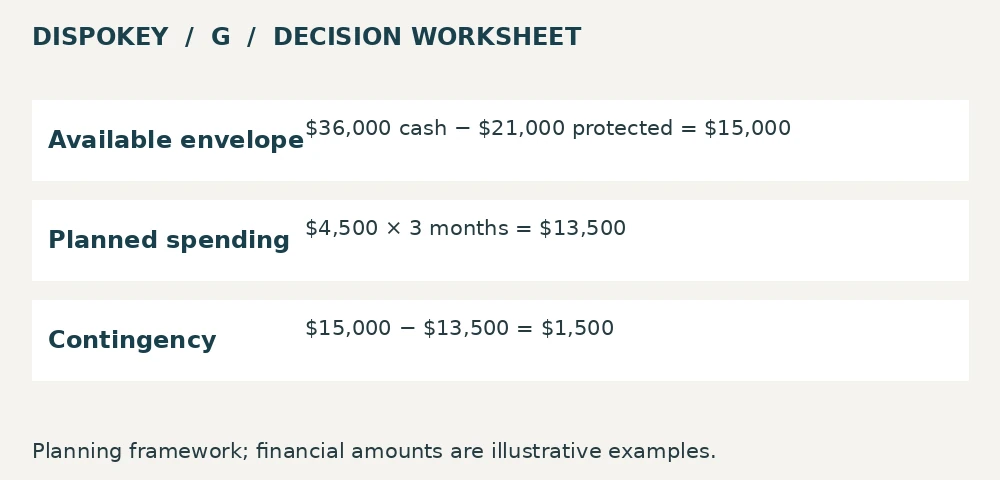
This is not total-business runway because other obligations are protected separately rather than modeled as every business outflow. If no closing receipts arrive, the example still fits its funded envelope. If an unexpected $900 setup charge appears, use contingency only with approval or reduce another line; do not quietly raise the ceiling.
Translate monthly budgets into payment weeks
Create a rolling thirteen-week schedule with opening cash, expected receipts, committed payments, discretionary payments and closing cash. Thirteen weeks is an editorial planning choice, not an SBA mandate. Record annual renewals in their actual payment week instead of spreading them evenly across a cash schedule.
The SBA’s business-management guidance includes managing finances, capital and cash flow. Apply the principle by updating the schedule when invoice dates, commitments or expected receipts change. The official SBA management resource is general business guidance, not a promise that a particular cash plan will succeed.
Separate cancellable tests from contracts that continue billing after campaigns pause. Record notice periods and payment obligations from actual agreements. A pause in ad delivery does not necessarily pause management, software or production costs. Keep the remaining committed amount visible before deciding whether a quiet week leaves room for another channel.
Understand advertising pacing before forecasting charges
Google Ads says that for most campaigns the daily spending limit is twice the average daily budget and the monthly spending limit is 30.4 times that budget. Daily spending can therefore vary. Google’s average-daily-budget guidance contains the campaign qualifications; do not turn the example into a universal account-wide cap.
For an unchanged $50 average daily budget in an applicable campaign, the illustrative limits are $100 on a day and $1,520 for a month. Budget changes and campaign types need their own review. Use the provider’s actual billed amounts and payment schedule in the cash forecast, not a flat daily assumption that ignores how charges occur.
Set reallocation rules before moving money
Review cash weekly and allocation monthly. The weekly question is affordability; the monthly question is whether each bucket serves its intended job. A promising campaign can still exceed available cash, while an affordable campaign can be ineffective. Those are different reasons for a change.
Record the reason, amount, owner and next review date. Useful pause triggers include crossing the protected floor, broken tracking, lost follow-up coverage or reaching a test cap. These are governance decisions, not claims about the time every campaign needs to perform. Do not move money because one quiet afternoon feels alarming.
If subscribers or inquiries engage but nobody handles them, move effort to response coverage before increasing distribution. If reporting is unreliable, repair measurement before treating a headline result as evidence for more spend. Keep changes bounded so the next review can distinguish one decision’s effect from several simultaneous interventions.
Keep outcome reporting and cash control separate
A cost-per-contract report evaluates acquisition economics; a cash schedule evaluates whether payments can be made. Both matter, but neither replaces the other. Preserve actual receipts, unpaid invoices and expected transactions distinctly. An unsigned opportunity should not offset a bill due next week.
If a delayed closing pushes the base case below its protected floor, reduce discretionary commitments before relying on uncertain proceeds. Revisit the envelope only after a deliberate funding decision. The honest result may be a smaller test or a postponed launch. More channels do not automatically create faster or more reliable receipts.
When DispoKey may not be your best option
If you cannot support several months of promotion and follow-up without uncertain receipts, a managed acquisition commitment may not fit yet. Narrow the plan or delay it rather than expecting future leads to repair a cash gap. A working response process is part of the budget, not an optional afterthought.
DispoKey Growth Lab costs $1,500 per month; ad spend is separate. Clients own all leads and contracts, and DispoKey dispo is optional. Lead counts and ROI are not guaranteed. The example management line does not imply that other illustrated costs are included. Confirm the actual scope and payment commitments before choosing the allocation.
Key takeaways
- Make the decision from documented inputs, not a headline promise.
- Keep costs, timing and responsibilities visible.
- Recalculate when material facts change.
Frequently asked questions
What percentage of revenue should fund marketing?
There is no universal investor percentage. Test the proposed amount against cash, protected obligations, payment timing and your chosen risk limit.
Should contingency be spent every month?
No. Keep it uncommitted unless an approved need arises; automatic spending removes the flexibility it was meant to provide.
What if a closing payment is delayed?
Update the cash forecast and reduce discretionary commitments before crossing protected reserves. Do not assume receipts arrive before the next bill.