


Quick answer: Real estate investor postcards work when a clear message reaches the right list repeatedly. Put one plain offer, a real name, a phone or web address and a reason to call now on the card, mail to targeted lists like absentee or inherited owners, and track every card with a unique number or URL. USPS Every Door Direct Mail suits saturation routes. Growth Lab runs this for $1,500/mo.
- Mail targeted lists more than once.
- One message, one call to action per card.
- Track each campaign with its own number or URL.
Why postcards still work
Postcards are cheaper than letters and get seen without being opened. For motivated sellers who do not search online, a card on the counter can be the reminder that prompts a call when the timing is right.
They work best as part of a sequence with letters and digital follow-up. Our direct mail guide covers the channel strategy, and yellow letters cover handwritten-style mail.
What to put on an investor postcard
- A plain headline: what you do, such as buying houses as-is in a named city.
- Two or three reasons: no repairs, choose your date, no showings.
- A real person: name and photo build trust.
- One call to action: a tracked phone number or short URL.
- Your business name and address so recipients know who you are.
Avoid fake checks, urgent stamps or anything that looks like a government or legal notice.
Which lists to mail
List quality matters more than design. Common targeted lists include absentee owners, inherited or probate properties, tax delinquent owners and long-time owners with high equity. Our guides to absentee owner lists and tax delinquent properties explain each.
USPS mailing options
USPS offers Every Door Direct Mail, which lets you mail every address on chosen carrier routes without a list, useful for saturating a neighborhood. Targeted list mail usually goes as Marketing Mail through a printer or mail house; USPS PostalPro explains mailing standards and preparation.
Ask your printer about address cleaning against change-of-address data to cut waste.
How often should you mail?
Response often builds with repetition. Many investors mail the same targeted list every few weeks for several months, changing the design while keeping the message consistent. Record each drop so follow-up calls reference the right card.
How to test and track postcards
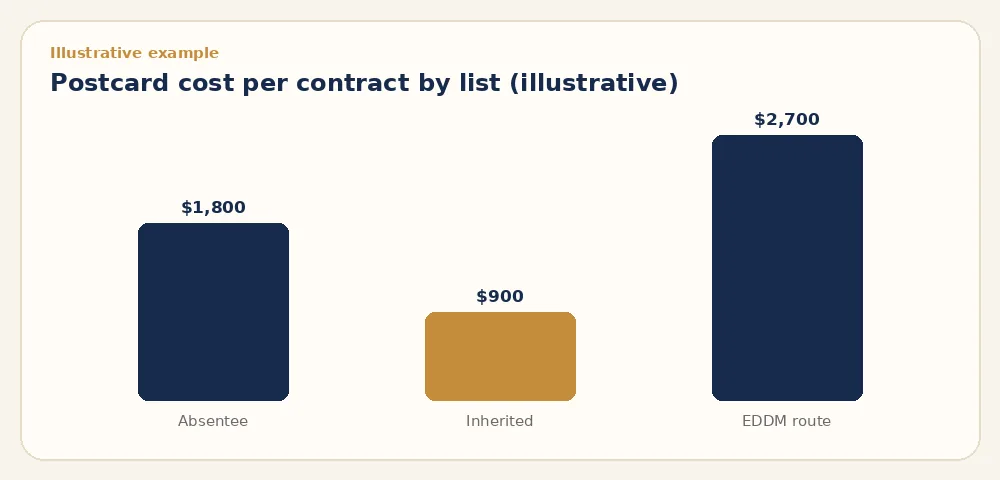
Change one thing at a time: headline, photo, size or list. Give each version its own tracking number or URL. The illustrative example in this guide compares two lists by cost per contract, which is the number that matters.
| List (illustrative 3-month test) | Cards mailed | Mail cost | Contracts | Cost per contract |
|---|---|---|---|---|
| Absentee owners | 6,000 | $3,600 | 2 | $1,800 |
| Inherited / probate | 1,500 | $900 | 1 | $900 |
| EDDM saturation route | 9,000 | $2,700 | 1 | $2,700 |
Fair housing and honest claims
Fair housing rules apply to mail. Describe your service, not the kind of person you want to hear from, and avoid claims you cannot support, such as guaranteed prices or closing dates before you see the home.
Design tips that improve response
- Use a large, readable headline and high-contrast colors.
- Choose a real photo of a local home or your team, not generic stock.
- Leave white space; crowded cards get ignored.
- Put the phone number or URL in large type on both sides.
- Use a size that stands out, such as 6 by 9 or larger, if your budget allows.
Print a test card and read it from arm's length. If the offer is not clear in three seconds, simplify it.
Follow up every response
Answer calls live or return them within the hour, and log each caller's card version and list. People who call but are not ready yet should go into a nurture sequence of mail, email or calls with consent. Many contracts come months after the first response.
Remove people who ask to stop, and keep your suppression list current across every campaign.
How to budget a postcard campaign
Start with how many contracts you want and work backward. If a list historically produces one contract per 3,000 cards and each card costs about 60 cents to print and mail, one contract costs about $1,800 in mail. Mailing that list four times over a few months might mean 12,000 cards and about $7,200. Use your own printer quotes and results; these numbers are an example only.
Hold back a small share of the budget for tests of new lists or designs so you keep learning while the core campaign runs.
Keep your mail honest and compliant
Postcards are advertising, so claims must be truthful and supportable. Do not imply you are a lender, a government office or the owner's current mortgage company. Avoid language that suggests a deadline the owner does not face. Include your real business name and a working way to opt out, and honor requests to stop. Clear, honest mail protects your reputation in the neighborhoods you work. If you mail the same street often, neighbors talk; a card that sounds respectful and specific earns calls over time, while a pushy or misleading one gets thrown away and remembered.
Postcards with Growth Lab
Growth Lab coordinates mail with search, social and follow-up for $1,500/mo, plus your mail costs. You own every lead and contract, and DispoKey disposition is optional. We do not guarantee lead counts or ROI. See Growth Lab.
When Growth Lab may not be your best option
If you only want to mail one list yourself, a printer and a simple tracking number may be enough. Growth Lab fits investors who want multiple channels run together.
Key takeaways
- List quality matters more than design.
- Use one message and one tracked call to action.
- Mail targeted lists repeatedly.
- Judge postcards by cost per signed contract.
Frequently asked questions
Do postcards work for real estate investors?
They can, when targeted lists are mailed repeatedly with a clear message and tracked results.
What should a we-buy-houses postcard say?
What you do, where, two or three plain benefits, a real name and one tracked way to respond.
What is Every Door Direct Mail?
A USPS service that delivers to every address on chosen carrier routes without a mailing list.
Does Growth Lab guarantee postcard results?
No. Growth Lab costs $1,500/mo, you own every lead, and results depend on your market.