

Quick answer: Direct mail for real estate investors works when you mail a targeted list every few weeks, answer calls fast and judge results by cost per contract. A labeled example: 5,000 pieces, a 1% response and a 4% close rate give two contracts. DispoKey's Growth Lab runs seller campaigns for $1,500/mo, and you own every lead.
- Start with one list type in one county.
- Plan at least four touches per owner.
- Use a tracked phone number for each campaign.
- Measure cost per contract, not response rate.
Direct mail reaches owners who never search "sell my house." An inherited house in another state, a tired landlord, a homeowner who keeps ignoring the tax bill: those owners open mail. The question is not whether mail works but whether your campaign is measured well enough to know. This guide covers lists, formats, cadence, tracking and a labeled cost-per-contract example. For how mail compares with search ads, see our direct mail vs PPC comparison.
Step 1: Choose the right list
The list decides most of your result. Pick owners with a reason to sell.
Absentee owners, tax delinquent properties, probate filings and code violations are common starting points; county assessor sites such as the Cook County Assessor show owner mailing addresses. [4] Owners who appear on two or more lists usually respond better; our wholesaler guide on finding motivated sellers explains list stacking.
Every Door Direct Mail or a targeted list?
Every Door Direct Mail sends to every address on a carrier route; a targeted list sends only to owners you selected. Targeted lists usually cost more per piece but waste fewer pieces.
USPS describes EDDM as a way to reach every address on chosen routes without a mailing list. [1] That suits neighborhood awareness more than finding specific distressed owners.
Step 2: Pick formats and a message
Postcards are cheaper and read at a glance; letters feel personal. Test both on the same list.
Open the mail-piece checklist
- Name the property address, not just the owner.
- State the offer simply: as-is, no repairs, a closing date they pick.
- One phone number and one web address, both tracked.
- A real return address and company name.
- No fake checks, fake urgency or official-looking government styling.
Avoid pieces designed to look like government notices or checks. They erode trust with exactly the owners you want to reach.
Step 3: Mail on a schedule
One mailing rarely finds a seller at the right moment. Plan four to six touches every three to four weeks.
| Week | Touch | Format |
|---|---|---|
| 0 | 1 | Postcard |
| 3 | 2 | Letter |
| 6 | 3 | Postcard |
| 9 | 4 | Letter with a different angle |
| 12 | Review | Cost per lead and contract by touch |
Remove owners who ask to stop, who sold or who already signed with you before each drop. Change the angle between touches rather than resending the same card: one piece about repairs, one about timing, one about inherited property. Sellers who ignored the first message often respond to the one that names their actual problem. Keep the phone number and company name the same on every piece so the owner recognizes you when they are finally ready.
Step 4: Track every call
Give each campaign its own phone number and web address. Without that, you cannot tell which list made money.
Our call tracking guide shows how to set it up, and speed to lead covers why answering in minutes matters. If you follow up by phone, check do-not-call rules first; the FTC's Telemarketing Sales Rule guidance explains them. [3]
Step 5: Measure cost per contract
Cost per contract is total campaign spend divided by signed contracts. It is the only number that tells you whether to scale.
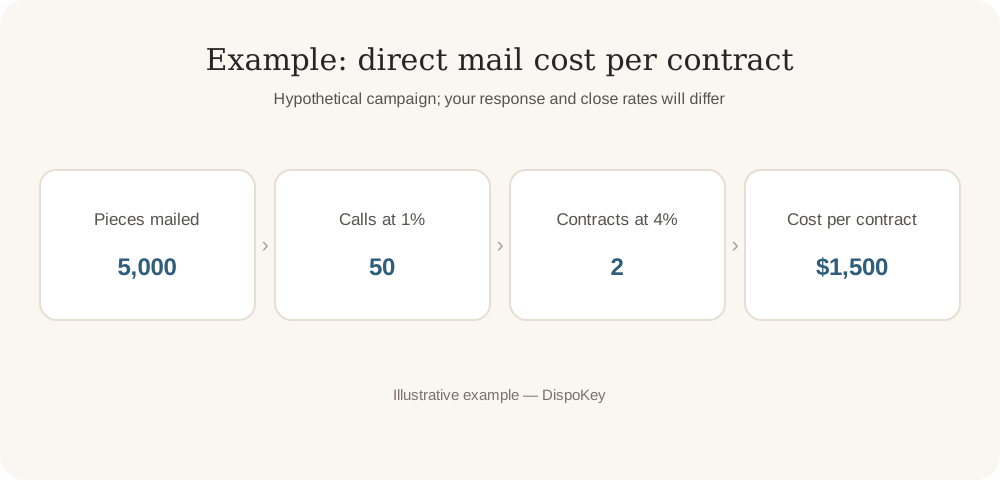
- Example pieces mailed: 5,000
- Example all-in cost per piece (print, postage, data): $0.60, so $3,000
- Calls at an example 1% response: 50
- Contracts at an example 4% close rate: 2
- Cost per contract: $1,500
Check current postage on the USPS business prices page; it changes. [2] Compare the result with other channels in our cost per contract guide.
Run it yourself or hire an agency?
In-house mail costs less per month but takes your time for lists, design, drops and tracking. An agency trades a fee for that time.
The old way was to buy a list, mail once and guess. Whoever runs it, insist on campaign-level tracking and a monthly cost-per-contract report. Ask who owns the list, the phone numbers and the call recordings if you part ways; you should keep all of them. Ask how quickly calls are answered, and whether the same team follows up on owners who said "not yet," since many contracts come from the third or fourth conversation rather than the first.
When DispoKey may not be your best option
If you cannot fund at least three months of marketing beyond the agency fee, wait. Mail and ads need time to produce contracts, and a campaign cut after one drop proves nothing. Growth Lab does not guarantee lead counts or returns.
How Growth Lab runs seller campaigns
Growth Lab builds and manages seller-lead campaigns for $1,500/mo, with tracking on every channel. You own every lead and contract. Selling contracts through DispoKey is an optional safety net, never required. Book a Growth Lab call.
Key takeaways
- The list matters more than the design.
- Plan four to six touches, three to four weeks apart.
- Track each campaign with its own number.
- Scale on cost per contract, not response rate.
Frequently asked questions
Does direct mail still work for real estate investors?
It can, especially for owners who are not searching online. Results depend on the list, how often you mail and how fast you answer calls.
How many times should I mail the same list?
Many investors mail the same owners every few weeks for several months, because a seller's timing changes. Track results by touch to see where yours flatten.
What is the best direct mail piece for motivated sellers?
Test postcards against letters on the same list. Formats matter less than a clear message, a working phone number and fast follow-up.
How much does direct mail cost?
Postage, printing and data all count. USPS publishes its current prices, and Every Door Direct Mail is priced per piece for carrier routes.