


Quick answer: A real estate investor website needs six core pages: home with the offer and a form, how it works, situation pages, about, contact and privacy. Keep the form to 3 to 5 fields, track every call and form, and write for local sellers. DispoKey's Growth Lab builds and runs these for $1,500/mo, and you own every lead.
- One clear offer above the fold.
- A short form: address, name, phone, email, timeline.
- Tracked phone numbers and form events.
- Real people, a real address and honest claims.
Most investor websites look alike: a stock photo of a house, a "we buy houses" headline and a five-step form. Sellers notice. The sites that produce leads explain the offer plainly, answer the questions a stressed owner has, and make contact easy. This guide covers the page structure, the form, tracking, search basics, accessibility and consent. A single campaign page is covered in our investor landing page guide; this one covers the whole site.
What pages does a real estate investor website need?
Six pages cover most sellers' questions. Add more only when you have real, local content for them.
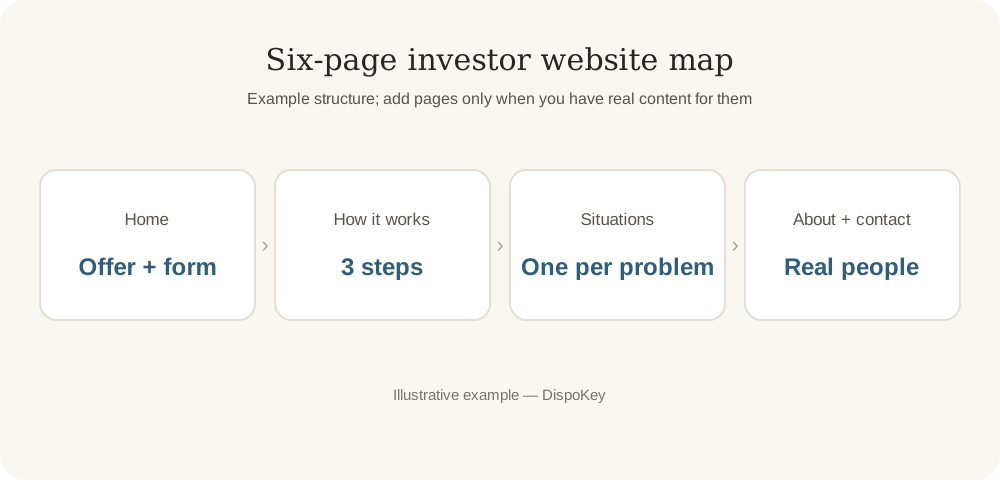
| Page | Job | Must include |
|---|---|---|
| Home | State the offer and capture the lead | Headline, short form, how it works in 3 steps |
| How it works | Remove fear of the process | Steps, timeline, what the seller pays |
| Situation pages | Match the seller's problem | One page per real situation you handle |
| About | Prove you are real | Names, photos, market, company details |
| Contact | Make reaching you easy | Phone, form, hours, service area |
| Privacy | Explain data use | What you collect and how you contact people |
Why build situation pages?
Sellers search their problem, not your company. Pages for inherited houses, tenant problems or code violations match those searches.
Write each from experience in your market. A thin page copied across ten cities helps nobody, and Google's guidance favors content written for people. [1]
How to build a lead form that converts
Ask only what you need to call back and start a valuation. Three to five fields is a good starting point.
Open the form checklist
- Property address first, with autocomplete if possible.
- Name, phone and email.
- Optional: timeline and property condition.
- A clear consent statement if you will call or text.
- A thank-you page that says when you will call.
If you plan automated calls or texts, the FCC explains when prior express consent is required. [3] Put the consent language next to the submit button, not in a hidden link.
Track every lead to its source
Each channel needs its own phone number and form tag. Otherwise you cannot tell which spend produced contracts.
Set up conversion tracking for form submits and calls, and record the source on every lead in your CRM. Our call tracking guide and lead qualification guide cover the setup.
Search basics for an investor site
Write descriptive titles, one main heading per page and helpful answers. Speed and mobile layout matter because most sellers browse on phones.
Google's SEO starter guide recommends unique, descriptive titles, clear site structure and content that is useful and reliable. [1] Compare paid and organic channels in our SEO vs PPC guide.
Make the site accessible
Accessible sites work for more sellers, including older owners who often have the houses investors want.
The Justice Department's web accessibility guidance explains how the ADA applies to websites of businesses open to the public and lists common barriers, such as poor color contrast, missing image text and forms that cannot be used with a keyboard. [2]
Trust signals that matter
Real names, real photos and a real address build more trust than badges. Never invent reviews, statistics or results. Show who answers the phone, the counties you actually buy in and how long you have operated there. Sellers dealing with a foreclosure notice or an estate are wary of strangers, and a page with a face and a local office address answers that worry better than any headline.
The FTC has adopted a rule addressing fake consumer reviews and testimonials. [4] If you show reviews, show real ones.
What does a site cost to run? A labeled example
The build is a one-time cost; traffic is the ongoing cost. Plan for both.
- Example build: core pages and form
- Example monthly: hosting, call tracking and CRM
- Example traffic: paid search or mail driving visits
- Measure: cost per contract across the whole funnel
A site with no traffic produces no leads. Budget for ads or content to bring sellers to it. Organic search takes months to build, so most new investor sites pair the launch with paid search or mail that points to the site. Review the numbers monthly: visits, form starts, completed forms, calls, appointments and contracts. A big drop between form starts and completed forms usually means the form is too long or breaks on phones; fix that before spending more on traffic.
When DispoKey may not be your best option
If you do not have budget for at least three months of traffic after the site launches, wait. A site alone rarely produces leads in the first weeks. Growth Lab does not guarantee lead counts or returns.
How Growth Lab builds investor websites
Growth Lab builds the site, runs the traffic and tracks every lead for $1,500/mo. You own the leads, contracts and site content. Selling contracts through DispoKey is an optional safety net, never required. Book a Growth Lab call.
Key takeaways
- Six core pages cover most sellers' questions.
- Keep forms short and consent clear.
- Track every call and form to its source.
- Real people and honest claims beat badges.
Frequently asked questions
What should a real estate investor website include?
A clear offer, a short lead form, a how-it-works page, pages for common seller situations, a real about page and contact details, plus tracking on every form and call.
How do I build a real estate investor website?
Start with six core pages, write them for sellers in your market, connect a short form and tracked number, then add local situation pages as you learn what sellers ask.
Do real estate investor websites need SEO?
Yes, if you want organic leads. Google's SEO starter guide recommends descriptive titles, helpful content and clear site structure.
Does my website need to be accessible?
The Justice Department has published guidance explaining how the ADA applies to the websites of businesses open to the public. Follow its accessibility basics.