
Quick answer: Real estate lead qualification means sorting motivated-seller leads by motivation, timeline, condition and price expectation before you spend call time. DispoKey's Growth Lab scores each factor from 0 to 3, so a lead scoring 9 to 12 gets a same-day callback, 5 to 8 goes on a follow-up cadence and 0 to 4 goes to long-term nurture.
- Score four factors from what the seller actually said.
- Call the hottest leads first, the same day.
- Follow the calling and texting rules for every lead.
Most seller leads are not ready to sell this week. Some are curious about value, some are months away and a few need to move now. Treating them all the same wastes your best hours on the wrong conversations and leaves urgent sellers waiting. Qualification is the habit of sorting first and calling second. This guide gives a simple scoring model, a follow-up cadence and the compliance basics that apply when you call or text leads you paid to generate.
What is lead qualification in real estate investing?
It is the process of deciding which leads are worth an offer conversation now, which need follow-up and which are not a fit. You base it on evidence from the form, the first call and public records, not on gut feel.
A motivated seller has a reason to sell that matters more than squeezing out the top price: an inherited house, a job move, repairs they cannot fund, a tired landlord situation. Your job is to find out how strong that reason is, how soon it bites, what the property needs and whether the seller's price expectation can meet a cash offer. Write down what they said in their words. That record makes handoffs between team members much cleaner.
How do you score a motivated seller lead?
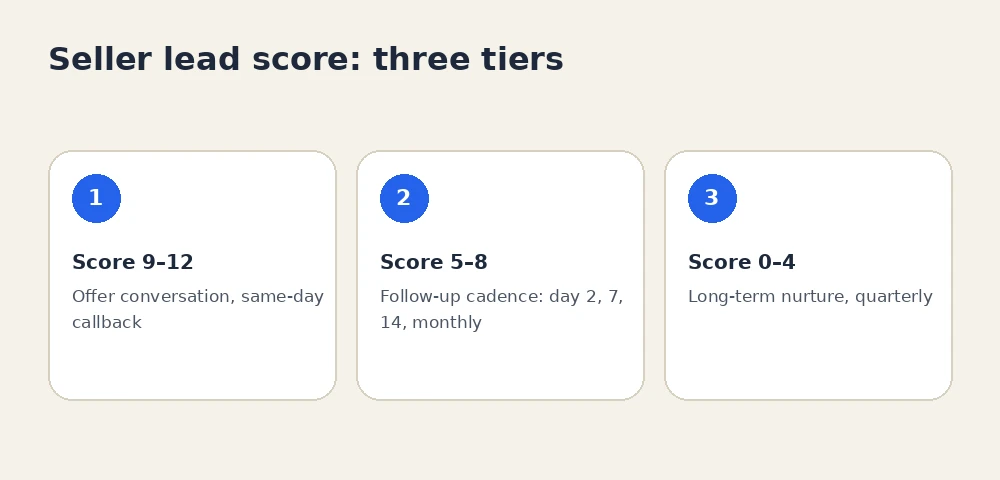
Score motivation, timeline, condition and price expectation from 0 to 3 each, then add them. The total decides the next step, and a missing answer scores 0 until you learn it.
Open the four-factor scoring sheet
- Motivation: 0 just curious · 1 thinking about it · 2 clear reason · 3 urgent reason with a deadline
- Timeline: 0 over a year · 1 6–12 months · 2 1–6 months · 3 under 30 days
- Condition: 0 fully updated · 1 light cosmetic · 2 dated or repairs needed · 3 major repairs or vacant
- Price expectation: 0 above retail · 1 near retail · 2 open to a discount · 3 asks what you can offer
| Total score | Next step | Example timing |
|---|---|---|
| 9–12 | Offer conversation | Same-day callback |
| 5–8 | Follow-up cadence | Day 2, 7, 14, then monthly |
| 0–4 | Long-term nurture | Quarterly check-in |
What does a scored lead look like?
The leads below are invented examples for illustration. Lead A inherited a house, wants it sold before the estate's tax bill is due next month, says the kitchen and roof need work and asks what you can pay: 3 + 3 + 3 + 3 = 12, so call today.
Lead B is relocating in about five months, the house is dated and they hope for a price near a recent neighbor's sale: 2 + 2 + 2 + 1 = 7, so start the follow-up cadence and send the comparison they asked for. Lead C wants a value estimate for refinancing and has no plan to sell: 0 + 0 + 1 + 0 = 1, so add them to quarterly nurture only if they agreed to hear from you.
How fast should you follow up with seller leads?
Call high-scoring leads the same day, ideally within minutes of the inquiry. Speed matters most when the seller is comparing options, which is exactly when the score is highest.
Our guide to speed to lead shows how response time changes the conversation. For mid-score leads, a written cadence beats memory: a call on day two, a useful message on day seven, another call on day fourteen, then monthly. Stop when the seller asks you to. Track cost per lead alongside how many leads reach each tier; our breakdown of cost per contract shows why the tier mix matters more than raw lead volume.
What rules apply when you call or text seller leads?
Telemarketing rules can apply to calls, texts and automated messages. Check Do Not Call status, get the right consent before automated calls or texts and honor every opt-out promptly.
The Telemarketing Sales Rule at 16 CFR 310.4 lets a seller rely on its Do Not Call compliance process only if it uses a version of the national registry obtained no more than 31 days before the call and keeps records of that process. [1] The same section limits outbound telemarketing calls to a residence to between 8:00 a.m. and 9:00 p.m. local time at the called person's location. [1] Under 16 CFR 310.2, an inquiry about your service creates an established business relationship for 90 days after that inquiry, but a person's request not to be called by your company still has to be honored. [2]
Under the FCC rule at 47 CFR 64.1200, autodialed or prerecorded calls to cell phones generally need the called party's prior express consent, and telemarketing calls of that kind need prior express written consent. [3] For email follow-up, the CAN-SPAM Act at 15 U.S.C. 7704 makes it unlawful to keep sending commercial email more than 10 business days after an opt-out request. [4] State rules can be stricter. Our post on marketing permissions covers consent records in more detail.
When DispoKey may not be your best option
If you cannot fund at least three months of ads, or nobody on your team can answer and qualify calls the same day, paid lead generation will likely disappoint. Build the qualification process first.
If you have the budget and the call coverage, book a Growth Lab call. Growth Lab runs seller campaigns for $1,500 per month; you own every lead and contract, and DispoKey disposition is an optional safety net, not a requirement. We do not guarantee lead counts or returns; results depend on your market, budget and follow-up.
Key takeaways
Score motivation, timeline, condition and price from the seller's own words, call the top tier the same day and run a written cadence for the rest. Follow Do Not Call, consent and opt-out rules on every channel. This is educational information, not legal advice.