

Quick answer: Real estate negative keywords exclude unwanted searches, but a copied blocklist can also remove legitimate homeowner intent. Review actual queries, select broad, phrase or exact negative matching deliberately, and record why each exclusion belongs. DispoKey Growth Lab costs $1,500/mo; clients own leads and contracts, with optional disposition support and no performance guarantee.
- Classify queries before excluding them.
- Test the match behavior against relevant seller searches.
- Keep a dated change log and a rollback owner.
This is an exclusion-governance workflow for motivated-seller search campaigns, not another general PPC introduction. The old way is to paste a long negative list and assume every excluded word is waste. The better comparison is whether a specific exclusion blocks the wrong service without cutting off a homeowner you can genuinely help.
Start with actual search terms, not a generic list
The Search terms report shows queries that triggered ads, subject to Google's reporting limitations. It is evidence of observed traffic, not a complete inventory of every search.
Google notes that terms without sufficient activity can be omitted for privacy. [1] Use the report alongside campaign settings, landing-page intent and lead outcomes. Do not infer that an unreported query never happened. Record the review date and campaign so a colleague can reproduce the context.
Distinguish a search term from the keyword that matched it. Awkward wording may still express genuine seller intent.
Use four query buckets before changing exclusions
Sort each term into relevant, irrelevant, ambiguous or insufficient evidence. Only the second bucket is an immediate exclusion candidate.
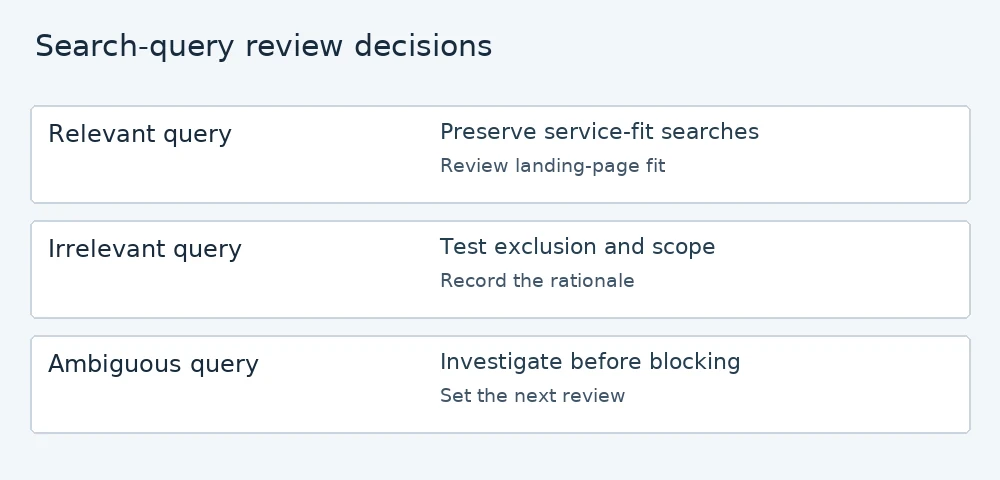
Relevant queries match your service and market. Irrelevant queries clearly seek something else, such as an employment vacancy when you only buy houses. Ambiguous queries need context: “sell rental house” can be a motivated homeowner, while “house for rent” may seek a tenancy. Insufficient evidence means you cannot yet make a sound judgment. These are illustrative classifications, not observed queries from DispoKey campaigns.
Understand negative broad, phrase and exact matching
Negative match types have different blocking behavior. Google says negatives do not expand to close variants in the same way as positive keywords. [2]
For negative broad match, an ad generally will not show when the search contains all negative-keyword terms, even in a different order. Negative phrase requires the terms in that order, with additional words allowed. Negative exact blocks that specific term sequence without extra words. Use Google's examples to check the effect before applying a multiword exclusion.
A singular, plural or other variation may need separate consideration. Do not assume a negative automatically blocks every related concept, synonym or close variant. Equally, do not add every variation without verifying that it is genuinely irrelevant.
Test each proposed exclusion before release
Check both a query you want blocked and a query you want preserved. A useful exclusion should pass both tests.
Open the negative-keyword release checklist
- Observed query and campaign recorded.
- Wrong-service rationale written.
- Relevant seller counterexample tested.
- Negative match type and scope chosen deliberately.
- Existing list conflicts checked.
- Reviewer, date and rollback owner named.
| Query decision | Next action | Evidence to retain |
|---|---|---|
| Clearly relevant | Preserve and review landing-page fit | Intended service and market |
| Clearly irrelevant | Propose a tested exclusion | Query, rationale, match and scope |
| Ambiguous or too little evidence | Investigate, do not auto-block | Missing context and next review date |
Why can broad negatives such as rent or realtor cause trouble?
Those words can appear in genuine seller searches. They are not universal negatives for every real estate campaign.
For example, a landlord searching “sell my rental house” may fit an as-is purchase service. A homeowner comparing an agent with a cash sale may mention a realtor. A campaign that does not provide leasing should address clearly tenant-seeking queries, but an unrestricted “rent” exclusion can be a blunt tool. Evaluate whole phrases and campaign intent rather than treating a word as proof that a lead is worthless.
Choose the narrowest appropriate exclusion scope
Apply an exclusion only where the rationale holds. Shared lists can spread a mistaken decision across campaigns with different purposes.
Check account, campaign and ad-group settings as applicable to the campaign type. A query that is wrong for one offer may belong in another. Before adding to a shared list, identify every campaign using it and test each relevant service. Document whether the exclusion is temporary, campaign-specific or suitable for a broader list.
Google's negative-keyword ideas workflow explains how to add terms from the Search terms report; terms added there default to negative exact match. [3] Review the selected match type rather than assuming the interface has made your strategic decision.
A worked review example without promised savings
Use examples to reason about matching, not to predict lower costs or more contracts. The following queries and decisions are invented training cases.
Suppose a house-buying campaign receives “real estate marketing jobs” and “sell my rental house with repairs.” The first seeks employment, so a tested employment-related exclusion may be appropriate. The second expresses a homeowner sale problem; blocking it because it contains “rental” would ignore the service fit.
Write one row for each: observed wording, service intent, proposed negative, match type, scope and relevant counterexample. Another reviewer should be able to explain why the first is excluded and the second preserved. Do not call this exercise evidence of actual campaign savings. Measure the real effect after an authorized change.
Separate conversion actions from signed contracts
A recorded form or call is not automatically a qualified lead or contract. Check what the conversion action actually measures before judging query quality.
Google describes conversion measurement as tracking selected valuable actions. [4] Verify that test submissions, duplicates and incomplete actions are understood in reporting. Reconcile qualified-lead and contract outcomes through your own process rather than labelling every conversion a deal.
Our cost-per-contract guide covers the business scoreboard; the PPC overview covers broader campaign planning. This article owns the exclusion decision, not the whole measurement stack. Use the PPC glossary for definitions and preserve separate conversion diagnostics.
Review after changes and keep a rollback path
After an exclusion goes live, compare relevant query coverage and lead quality over a meaningful period. Do not declare success from a single quiet afternoon.
Keep the date, reviewer and before-change context. Note other campaign changes, budget limits and tracking problems that could explain results. If relevant traffic appears to disappear, investigate the negative alongside other settings. The rollback owner should be able to remove an exclusion and document why, not reconstruct the entire list from memory.
A practical review cadence depends on spend and query volume. Schedule a repeatable review, but avoid universal thresholds that imply every campaign produces enough evidence in seven days. Unknown remains unknown when reporting is limited.
When DispoKey may not be your best option
If you do not have budget for at least three months of advertising or someone to handle seller conversations, solve those constraints before hiring an agency.
A small well-managed campaign may be suitable in-house. DispoKey Growth Lab is $1,500/mo; confirm advertising spend and campaign scope during the call. You own all leads and contracts, and DispoKey disposition is optional. There is no guarantee of lead counts or ROI. Use the resources hub for existing tools, not a promised exclusion tool that has not been built.
Key takeaways
Classify real queries, understand negative matching and preserve legitimate seller intent. Test scope, log changes and reconcile conversions with actual outcomes. A smaller justified list can be more useful than a longer list nobody can explain.