

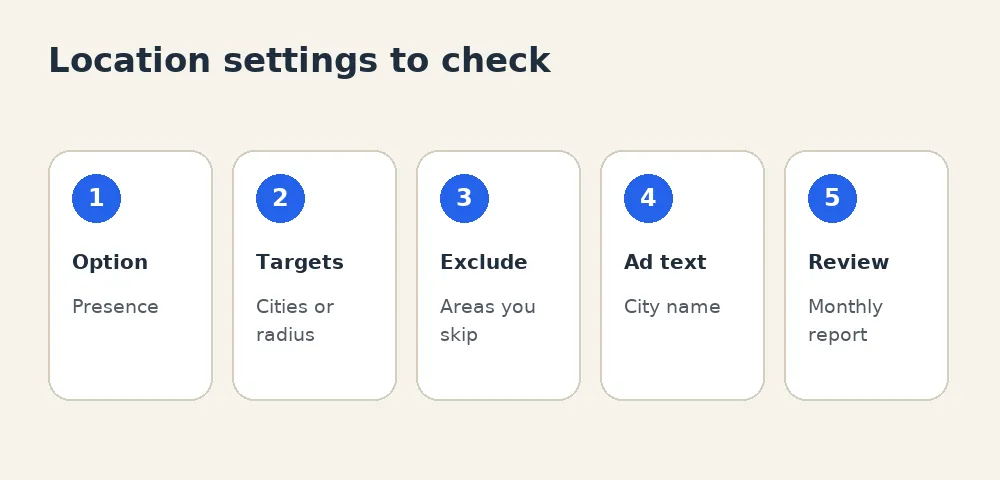
Quick answer: Google Ads location targeting for real estate investors should match the area you can actually buy in. DispoKey recommends Presence instead of the default Presence or interest, city or radius targets instead of ZIP codes, exclusions for areas you do not serve and a monthly check of where clicks came from.
- Switch location options to Presence.
- Use cities or a radius; plan without ZIP codes.
- Review the locations report every month.
Most motivated-seller campaigns waste money in one place before any keyword is wrong: the map. A campaign set to the default can show ads to people outside your buying area who merely searched for it. This guide covers the geography layer of a seller campaign. For keyword exclusions, read our negative keywords review; for the broader channel, see PPC for real estate investors.
Should investors use Presence or Presence or interest?
Most local investors should use Presence: people in or regularly in your targeted locations. The default also reaches people who have shown interest in those places from elsewhere.
Google describes the default as including both physical locations and locations of interest, with Presence as the narrower option. [2] Interest can be legitimate: an heir living in another state may search for help selling a parent's house in your city. If that seller matters to your business, test Presence or interest in a separate campaign and judge it on qualified conversations, not clicks.
Open the location settings checklist
- Location option set to Presence
- Targets match the buying area on your map
- Excluded areas you will not buy in
- City names used in ad text where relevant
- Locations report reviewed monthly
- Same settings confirmed in every campaign
Can real estate investors target ZIP codes in Google Ads?
Plan as if you cannot. In the United States and Canada, Google restricts ZIP code targeting for housing ads, and real estate services are among its examples.
Google's housing policy allows radius, city and country targeting, requires radius targets of at least 1 kilometer and does not allow targeting by ZIP code, gender, age, parental status or marital status in those countries. [3] Whether a particular "we buy houses" campaign is classified under that policy is decided in the account, so check its policy status rather than assuming. Building around cities and radius targets from the start avoids rebuilding later.
Is a radius or a city list better for a buying area?
A city list follows boundaries people recognize; a radius follows driving distance from a point. Use whichever more closely matches where you will actually make offers.
Google notes that location targeting relies on signals that are not 100% accurate and that it does not determine geographic borders. [1] Expect some spill at the edges and use exclusions for areas you never buy in.
| Setting | Recommended starting point | Why |
|---|---|---|
| Location option | Presence | Limits interest-only reach |
| Target type | Cities or radius | ZIP codes restricted for housing ads |
| Exclusions | Areas you will not buy | Stops edge spend |
| Ad text | City name | Filters people elsewhere |
| Review | Monthly locations report | Catches drift |
A worked example of location spend leakage
Measure leakage from your own locations report. The numbers below are illustrative, not typical results or a promise of savings.
Suppose a campaign spends $3,000 in a month on the default setting and the locations report shows $540 of clicks from people outside the buying area, 18% of spend. If none of those clicks became a qualified seller conversation, switching to Presence and adding exclusions could redirect that $540 toward the area you serve. If two of those out-of-area clicks were heirs with houses inside your area, the answer changes: keep a small, separate interest campaign and measure it on cost per lead and lead-to-contract rate instead.
How do you read the Google Ads locations report?
Compare where you targeted with where clicks and conversions actually came from. The gap between the two shows how much spend reaches people outside your buying area.
Look at two views. The targeted locations view shows performance for the cities or radius you chose. The matched or user locations view shows the areas people were actually in, which can include places just over a border or across a state line. Sort by cost, then mark each row as inside the buying area, near the edge or outside it. Rows outside the area with spend and no qualified conversations are candidates for exclusion. Rows near the edge with good conversations may justify widening the target. Check the report monthly, and again after any change to location options, so you can see whether the change worked rather than assuming it did. Keep notes of each change and date in the same spreadsheet you use for lead quality.
How do ad text and landing pages support location targeting?
Naming the city in the ad and on the page filters out people elsewhere before they click. It also tells sellers you actually buy in their area.
Google suggests including targeted location names in ad text to reduce clicks from outside the area. [4] Keep the conversion page consistent with the ad: the same city, the same offer and a form that asks for the property address first. Avoid demographic language in ads and targeting; the Fair Housing Act entry explains why.
When DispoKey may not be your best option
If you do not have budget to run ads for at least three months, paid search may not have time to produce reliable data. Organic and referral work may fit better first.
If you want a team to run seller campaigns for you, book a Growth Lab call. Growth Lab is $1,500 per month, you own every lead and contract, and using DispoKey for disposition is optional. We do not guarantee lead counts or returns. Related reading: Local Services Ads and offline conversion imports.
Key takeaways
Use Presence, target cities or a radius, plan without ZIP codes, exclude areas you never buy in, name the city in ads and review the locations report monthly. This is educational information; check Google's current policies in your own account before changing campaigns.