

Quick answer: Motivated seller keywords are searches from owners who want a fast or as-is sale, like "sell my house fast" plus a city, or situations such as inherited homes or foreclosure. Group them by intent, choose match types, add negative keywords and follow Google's housing ad rules. Judge them by cost per signed contract. Growth Lab builds this for $1,500/mo, and you own every lead.
- Start with high-intent phrases plus your city.
- Add situation keywords sellers actually search.
- Exclude job seekers, renters and DIY searches.
What are motivated seller keywords?
They are the words owners type when they want to sell quickly, as-is or because of a life event. Intent matters more than volume: a small number of searches for "sell inherited house fast" can be worth more than thousands of general real estate searches.
Use them in Google Ads campaigns and on landing pages and articles so the page matches the search. Our guide on PPC for real estate investors covers the campaign build.
Motivated seller keyword groups
Organize keywords by the seller's situation so each group gets its own ad and page.
- Speed: sell my house fast, sell house quickly, cash for houses.
- Condition: sell house as-is, sell house that needs repairs.
- Inheritance: sell inherited house, sell house in probate.
- Financial pressure: sell house before foreclosure, behind on mortgage.
- Landlord: sell rental with tenants, tired of being a landlord.
- Life events: sell house during divorce, relocating.
Add city and county names where you buy.
Which match types should you use?
Google Ads offers broad, phrase and exact match. Exact match shows ads for searches with the same meaning as your keyword; phrase match includes searches that contain its meaning; broad match reaches related searches and relies on Google's signals.
Many investor campaigns start with exact and phrase match on high-intent terms, review the search terms report weekly, and expand only when data supports it.
Negative keywords that protect your budget
Negative keywords stop ads from showing for searches you do not want. Common exclusions for seller campaigns include jobs, rent, apartments, how-to-become-an-agent searches, and buyer phrases like homes for sale. Our negative keyword review shows how to build the list from real search terms.
Housing ad rules to follow
Google's personalized advertising policies restrict how housing ads can be targeted, and in the US housing ads cannot target or exclude audiences by protected characteristics, with limits on targeting such as age, gender, parental status and ZIP code. Fair housing law applies to your ad wording too. Keep targeting to geography and search intent, and write plain, honest ads.
How to research and prioritize keywords
Use Google's Keyword Planner and your search terms report to see what people actually type. Score each keyword by intent, estimated cost and how well your landing page answers it. Search Console shows which organic queries already bring impressions, which can guide new articles; our investor SEO guide explains how.
Match each keyword group to a page
An inherited-house search should land on a page about inherited homes, not your homepage. Matching the page to the search improves relevance and usually lifts conversion. Give each major group its own landing page with the same words in the headline, a short form and a clear next step. Our landing page guide shows the layout.
Using the same keywords for SEO
The same groups guide articles and service pages. Write one page per main keyword so your own pages do not compete, and link related pages to each other.
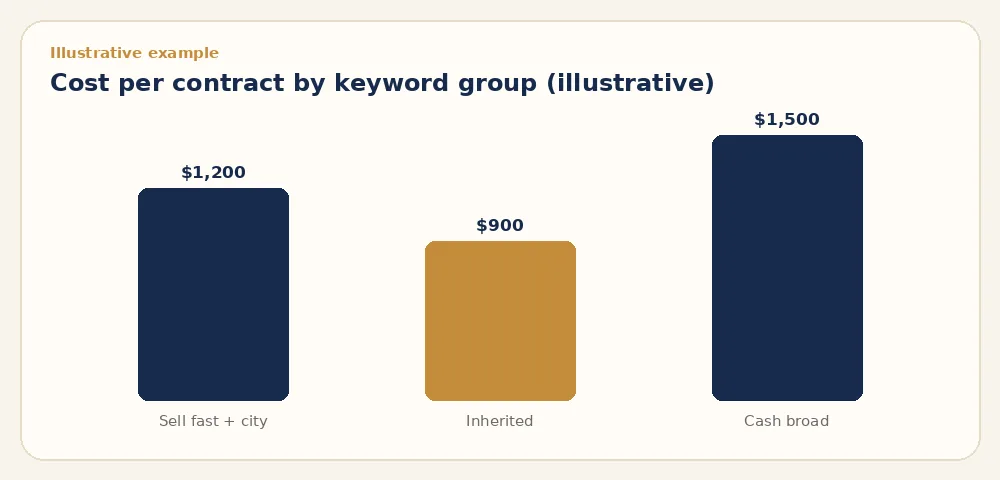
| Keyword group (illustrative month) | Spend | Leads | Contracts | Cost per contract |
|---|---|---|---|---|
| Sell house fast + city | $2,400 | 30 | 2 | $1,200 |
| Inherited / probate | $900 | 9 | 1 | $900 |
| Cash for houses (broad) | $1,500 | 38 | 1 | $1,500 |
Judge keywords by cost per contract
Clicks and leads matter less than signed contracts. Track each keyword group to the contract stage in your CRM and compare cost per contract. The illustrative example in this guide shows a cheaper group that costs more per contract.
Seasonal and local patterns
Search demand shifts with the calendar and local news. Probate and inherited-home searches follow life events year round, while weather disasters can spike damage-related searches in specific areas. Review search terms and Keyword Planner trends monthly, and shift budget toward groups that are rising in your markets. Keep a short list of local place names, such as counties and suburbs, that sellers actually use when they search.
A weekly keyword routine
Spend 30 minutes each week in the search terms report: add new negatives, move strong searches into their own exact-match keywords and pause groups with high cost and no contracts after enough data. Log each change with the date so you can see what helped.
How to split budget across groups
Give each keyword group a small, fixed test budget for the first month, then move money toward groups with the lowest cost per contract. Keep a modest share for testing new groups so you keep learning as search behavior shifts.
Keyword strategy with Growth Lab
Growth Lab builds keyword groups, ads, landing pages and follow-up for $1,500/mo. You own every lead and contract, and DispoKey disposition is optional. We do not guarantee lead counts or ROI. See Growth Lab.
When Growth Lab may not be your best option
If your ad budget cannot support at least three months of testing, start with SEO and direct mail first. Growth Lab fits investors ready to run campaigns consistently.
Key takeaways
- Group keywords by the seller's situation.
- Start with exact and phrase match on high-intent terms.
- Use negative keywords from real search term reports.
- Judge keywords by cost per signed contract.
Frequently asked questions
What are the best motivated seller keywords?
High-intent phrases like sell my house fast plus a city, and situation terms such as inherited house or foreclosure.
Which match type should real estate investors use?
Many start with exact and phrase match on high-intent keywords and expand only when data supports it.
Are there special rules for housing ads?
Yes. Google restricts targeting for housing ads in the US, and fair housing law applies to ad wording.
Does Growth Lab guarantee leads from keywords?
No. Growth Lab costs $1,500/mo, you own every lead, and results depend on your market.