
Quick answer: Wholesale real estate marketing should start with a release gate: confirm contract rights and applicable state requirements, approve photos and public claims, then control buyer access. DispoKey's off-market process offers a 72-hour buyer-match guarantee, a 60/40 split favoring the wholesaler and $0 upfront; none of these replaces the seller's written permission.
- Document who can approve marketing and changes.
- Separate public material from restricted deal documents.
- Never treat a signed purchase agreement as automatic permission for every advertising channel.
This is a pre-marketing workflow for an off-market contract, not a nationwide explanation of wholesaling legality. The operational problem is simple: one partner uploads photos, another circulates a packet, and nobody can identify which version or access instructions were approved. Fix that before distribution begins.
Verify rights before releasing wholesale marketing
Review the purchase agreement and local requirements before a partner advertises anything. Your partner's enthusiasm does not expand the rights you hold.
Ask counsel to clarify what interest may be marketed, whether the agreement permits the intended transfer and what seller authorization is required for advertising or access. Confirm signatures, amendments and the correct property identity. Do not claim ownership of a property you do not own or assume marketing your contract means advertising the property is unrestricted.
Keep state-specific questions with the local real-estate regulator and attorney. Oregon's official wholesaling FAQ illustrates that registration, exemptions and advertising disclosures can matter. [1] It is an example of a jurisdiction to check, not guidance that automatically applies elsewhere.
Is marketing authorization the same as a JV agreement?
No. A partner agreement can allocate work and compensation while leaving unresolved what may actually be published.
Use the JV agreement guide for partner responsibilities, then add a release record for the approved material. Name the contract holder, marketing partner, permitted channels, approved facts and the person who can withdraw or revise the packet. Have counsel determine the appropriate documentation. This checklist is not a ready-to-sign agreement and does not create rights missing from the purchase contract.
Split the packet into three release tiers
Share only what each recipient needs. A public summary, a reviewed-buyer packet and closing documents should not be identical downloads.
Open the pre-release approval checklist
- Contract and state-law questions reviewed.
- Photo-use permission and privacy review complete.
- Known facts separated from estimates.
- Buyer access instructions approved.
- Release version and withdrawal owner recorded.
- Restricted documents excluded from public links.
| Release tier | Typical content | Keep out |
|---|---|---|
| Approved public summary | Authorized photos and clearly qualified facts | Personal documents and entry codes |
| Reviewed buyer packet | Approved diligence material and scheduled access | Unneeded seller identifiers |
| Title or counsel channel | Documents needed for the transaction | Unrestricted public sharing links |
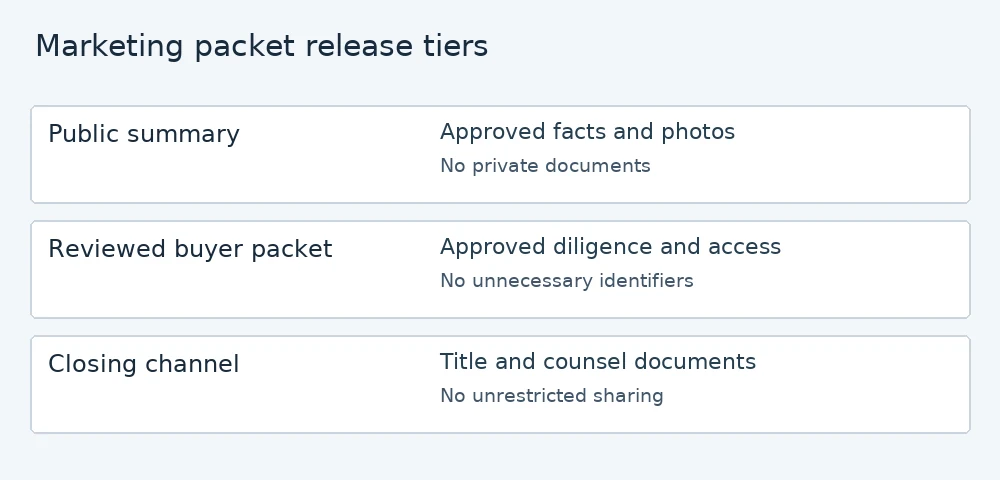
This framework is an operational example, not a statement that every item may be shared. Apply the governing agreement, privacy obligations and local rules first. NIST's voluntary Privacy Framework helps organizations identify and manage privacy risk. [2] Use that risk-management lens to avoid sharing unnecessary personal data; a buyer does not need a seller's bank details to assess a property's fit.
Approve photo rights and remove private information
Confirm permission to use each photograph; possessing a file is not the same as holding publication rights. Review what is visible before uploading.
The Copyright Office explains that permission from a copyright owner may be needed to use another person's work. [3] Do not copy listing photos merely because they are online. Ask who took the photographs and what use was authorized. Record that answer alongside the approved files and any limitations on distribution.
Inspect mirrors, desks, refrigerators and open cabinets for private paperwork or identifying information. Remove or blur sensitive details in a clearly documented copy, preserving the original securely where needed. Never edit damage out of a marketing image or crop away a known defect to make condition look better.
What belongs in a photo-redaction review?
Look for material unrelated to evaluating the property that exposes occupants or confidential information. Use a checklist rather than assuming a wide-angle photograph is harmless.
Examples include account statements, prescriptions, identity documents, visible access codes and family schedules. Ask whether people should appear at all and obtain appropriate permission. Photographs containing occupants require a more careful review than an empty room. If a defect needs explanation, keep it visible and attach factual context; privacy cleanup must not become deceptive property presentation.
Separate verified facts from estimates in the summary
Label price assumptions, rehab budgets and valuation ranges as estimates. State the source and date for facts you can support.
A projected after-repair value is not an appraisal, and a rehab allowance is not a contractor's binding quote. Link comparable-sale analysis to the comping guide instead of adding an unsupported “guaranteed profit” banner. Confirm square footage, occupancy and condition descriptions against available records; note discrepancies rather than selecting whichever number sells better.
Do not state that title is clear just because nobody has reported a problem. The title or escrow company has a separate role. Avoid promises about buyer inspection rights or cancellation windows that the executed documents do not support.
Control buyer access without distributing entry codes
Use approved appointments and one access coordinator. A marketing release should not create open-ended permission to enter an occupied or vacant house.
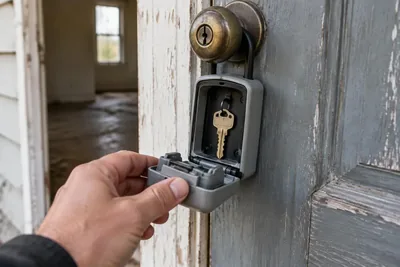
Confirm who authorizes each visit, how occupants receive notice and whether anyone must accompany visitors. Keep codes and keys in a restricted channel, not the public packet. Record date, attendee and access confirmation. Do not give a buyer more access than the agreement and local rules permit. For timing issues, consult the contract inspection-period guide; this workflow does not change contractual deadlines.
If an occupant objects or conditions are unsafe, stop and clarify. A buyer-match deadline is never a reason to bypass permission, safety or privacy.
Keep a version record and a withdrawal owner
Every released packet should have an owner and date. When a fact changes, that person should know where the outdated material went.
An example log has six fields: packet version, approved photos, authorized channels, release date, access coordinator and withdrawal contact. Add the recipient group rather than unnecessary personal details. If the contract is amended, terminated or no longer available, pause circulation and update the approved channels. Ask recipients not to keep forwarding an outdated offer.
A named person can reconcile the packet with the current contract, rather than an untraceable message chain.
How this fits the DispoKey handoff
Prepare the release information before requesting disposition support. DispoKey accepts off-market contracts only; on-market deals are not accepted.
Use the deal-submission flow and the wholesaler hub to start the review. The offer is a 72-hour buyer-match guarantee, 60/40 fee split favoring the wholesaler and $0 upfront. Buyer matching is not a guarantee of closing or a substitute for a valid contract. Run your assumptions through the MAO and JV calculators without treating calculator output as legal clearance.
When DispoKey may not be your best option
If you already have a strong buyer and a sound process, you may not need a disposition partner. If rights or authorization remain unclear, resolve them before distribution.
The wholesaling-license glossary is a starting point for terminology, not state-specific approval.
Key takeaways
Check rights, approve honest photos, separate release tiers and control access. Keep a dated packet and withdrawal owner. Faster distribution only helps when the information and authority behind it are sound.