

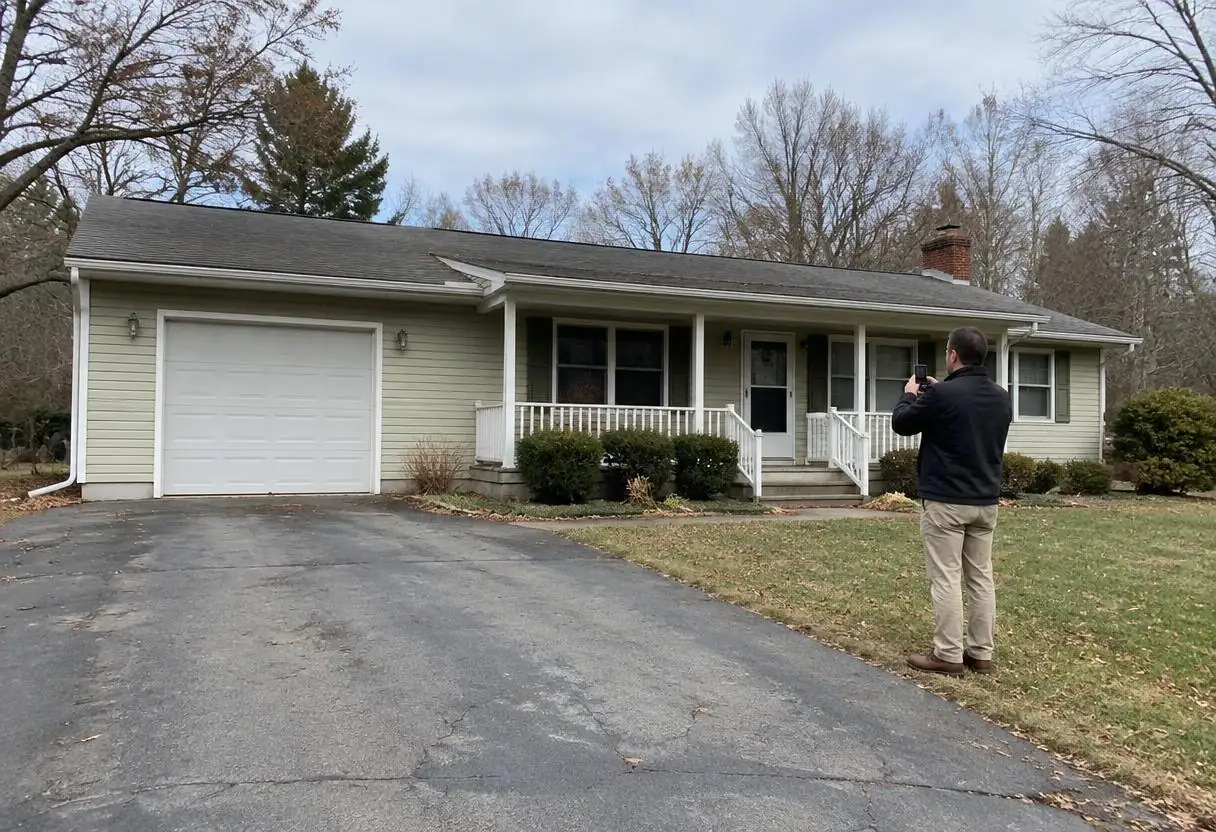
Quick answer: Market an approved wholesale deal through a staged campaign: relevant buyers first, selected channels next, then evidence-led review. DispoKey coordinators should record questions, objections and executable offers rather than confusing clicks with demand. Keep one current packet and consistent terms, and revise the campaign only when the response identifies a specific bottleneck.
- Gather the records before committing money or dates.
- Separate verified facts from planning assumptions.
- Write down the next action, its owner and the review date.
Confirm readiness before the first message
Complete the separate marketing-permissions review, establish one current packet and asking position, select relevant buyers and assign a response owner. Set a spending cap and reassessment time tied to actual contract obligations. This guide begins after approval; it does not create rights to advertise, enter the property or distribute private documents.
Use the permissions checklist for rights and release controls, and the deal-sheet guide for packet construction. The problem here is sequencing: who hears about the opportunity, what their response means and which next action follows. Do not rebuild the buyer-list or general dispo guide.
Choose one objective and one coordinator
The objective is enough informed engagement to evaluate whether a workable offer exists within the actual timeline. Impressions, clicks and reactions are supporting observations, not proof of executable demand. Give one person responsibility for the response log and the version buyers receive.
When several partners answer without a shared record, different price numbers or access instructions can spread. Log the question, verified answer, next action and owner. Set review times from capacity and deadlines rather than an invented universal countdown. A sample three-day sequence is an operating framework, not a promise to sell every deal in three days.
Keep official rules attached to the campaign
Oregon’s Real Estate Agency says residential wholesalers must be registered or hold an eligible license, and describes disclosures in transaction communications and advertising. Its guidance is specific to Oregon. A packet ready for distribution does not substitute for an applicable credential or disclosure requirement. The official agency guidance defines the state example.
For commercial email, the FTC requires accurate headers and subjects, advertising identification as applicable, a valid postal address and an opt-out mechanism. It says opt-outs must be honored within 10 business days and that business-to-business commercial email is covered. The FTC guide supports those requirements; it does not authorize texting or automated calling.
Before launch, identify which requirements apply to the chosen jurisdiction and channel. Do not generalize Oregon’s rules nationally or assume that a paid tool handles every obligation. Keep the record of release approval separate from the recipient’s communication preferences. If a channel is not authorized or suitable, leave it out of the sequence.
First wave: relevant buyers before wider exposure
Start with existing relationships whose geography, property type and strategy fit. A Buy & Hold landlord and a heavy-renovation Fix & Flip buyer may interpret the same house differently. A shorter, relevant list can produce more useful questions than a large unrelated audience. This is audience selection, not a promise of a response rate.
Use a factual message naming the opportunity, current asking position, available analysis and requested next step. Explain which figures are estimates. Do not invent bidding activity, guaranteed returns, an allocation or an inspection period. If the buyer needs a missing fact, resolve it or state the uncertainty before expanding distribution.
A repeated question often exposes a packet gap. If several buyers ask about the same repair, add verified information rather than writing a stronger promotional subject line. Keep your original assumptions and the new evidence so the change remains explainable. The campaign should make evaluation easier, not create pressure to overlook uncertainty.
Second wave: expand selectively and consistently
After reviewing initial questions, use selected channels where appropriate buyers participate. Follow the group’s rules and the applicable communication requirements. Label each source in the response log so you can distinguish substantive conversations from attention that never becomes a next step.
| Step | Decision |
|---|---|
| Launch | Relevant buyers receive the approved packet |
| Learn | Questions and objections get recorded |
| Handoff | Workable written offers and conditions go to closing |
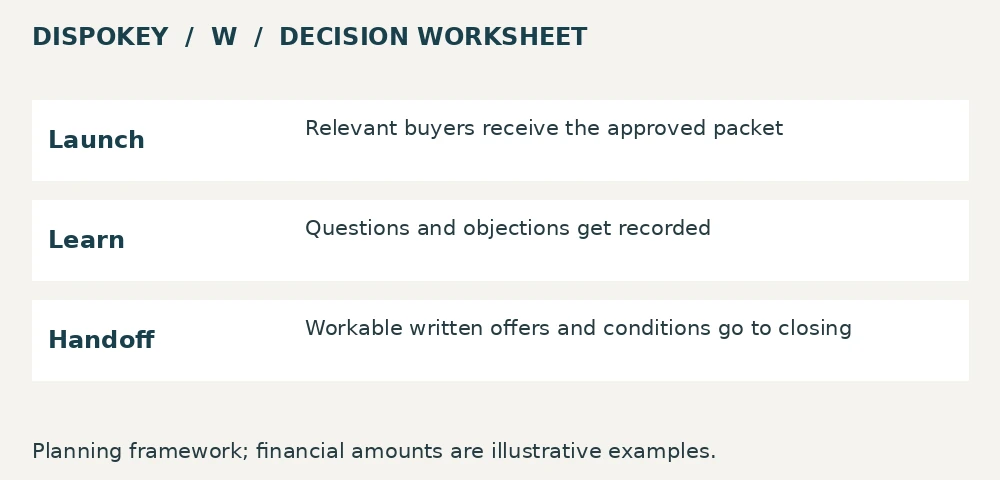
Keep one current offer across channels. Several contradictory versions make response interpretation difficult and can confuse buyers. When terms change, distribute the supported current position consistently. Expansion should improve qualified reach, not multiply unsupported claims or different asking numbers.
Follow up around the unresolved question
A useful follow-up answers the issue preventing evaluation. If the buyer asked about foundation condition, provide available verified information or identify what remains unknown. For a recipient who has not answered, a concise preference-respecting message can ask whether the obstacle is fit, numbers, timing or missing evidence.
Respect a decline. Repeated messages do not make a property more suitable. Route access requests through the established scheduling process rather than creating new permissions through a marketing conversation. Record when a buyer needs more information and who will obtain it; do not count that request as an offer.
Diagnose before reducing the price
Group feedback into audience mismatch, missing evidence, timing constraints and economic mismatch. More distribution cannot repair an unsupported rehab allowance. Silence alone does not identify the correct asking price. If relevant buyers repeatedly point to the same economic problem, revisit supported assumptions with the pricing guide.
Distinguish a requested discount from evidence that total project costs no longer work. Buyers who cannot meet the timeline present a different issue from buyers who cannot underwrite the property. Sometimes the honest conclusion is that the opportunity is not currently marketable on the proposed terms; buying more exposure can increase cost without resolving that.
Worked example: campaign cost and fee share
Illustrative allowances only: a $300 campaign cap includes $120 for photography and travel, $60 allocated to email and tools and $120 for showing coordination. Suppose the hypothetical result is six relevant conversations, two completed visits and one offer. Those counts are not benchmarks, success claims or forecasts.
If an assignment closes with a $10,000 fee under DispoKey’s 60/40 split favoring the wholesaler, the shares are $6,000 and $4,000. If the wholesaler bears $300 of campaign cost, $5,700 remains before acquisition spending, taxes and other costs. With no closing, assignment revenue is $0 and campaign spending remains incurred. Test scenarios without treating possible revenue as cleared cash.
When DispoKey may not be your best option
If you already have a capable buyer and reliable coordination, a disposition partner may be unnecessary. DispoKey accepts off-market contracts only, not on-market deals. It offers a 72-hour buyer-match guarantee, a 60/40 split favoring the wholesaler and $0 upfront; buyer matching is not guaranteed closing, income or acceptance of every asking price.
Review the wholesaler hub or submit an eligible contract. Before handoff, identify unresolved conditions, responsible parties and the next documented action. Interest is not a completed assignment. Keep that distinction visible until the transaction actually closes.
Key takeaways
- Make the decision from documented inputs, not a headline promise.
- Keep costs, timing and responsibilities visible.
- Recalculate when material facts change.
Frequently asked questions
Should I post a deal everywhere immediately?
Begin with relevant buyers, learn from their questions and expand selectively. Broad exposure cannot repair missing evidence or weak economics.
When should I lower the asking position?
Review audience fit, missing information, timing and buyer economics first. Silence alone does not establish a supported new price.
What is the best campaign metric?
Track qualified stage progression and executable offers alongside costs. No universal response-rate benchmark guarantees a closing.