
Quick answer: A wholesale real estate business plan should define one off-market niche, a capped budget, accountable stages and weekly reviews. DispoKey operators can use a 90-day test to evaluate execution, not promise income. Track cash spent, verified opportunities, contract deadlines and actual receipts, then choose whether to continue, narrow the scope or pause.
- Gather the records before committing money or dates.
- Separate verified facts from planning assumptions.
- Write down the next action, its owner and the review date.
Start with a one-page operating checklist
Choose one geography, property type and buyer strategy. Set a spending ceiling, protect a separate reserve and record applicable operating requirements. Give every opportunity and deadline an owner. Define the evidence needed before an offer, contract or disposition handoff. Put the weekly review and day-90 decision on the calendar before buying more tools.
A plan should tell you what to do next Monday and which unanswered question stops a transaction. It is not a forecast dressed as certainty. Keep definitions in the real estate glossary and detailed transaction instructions in their existing guides. Use this document for scope, cash exposure and accountable decisions.
Define a narrow model before purchasing tools
Write a scope such as “off-market single-family opportunities in one county for Fix & Flip buyers.” Record price range, condition limits and available working hours as planning choices, not proof of inventory or demand. A niche makes repeated evaluation possible; it does not guarantee sellers or buyers will transact.
Choose problems you can assess. Without reliable repair input, complicated structural projects may exceed your capability. Limited daytime availability needs a realistic plan for visits, seller communication and closing coordination. If every opportunity involves a new market and unfamiliar property type, the first quarter becomes difficult to learn from.
Attach official compliance evidence
Do not write “no license needed” across a national plan. Oregon’s Real Estate Agency states that residential property wholesalers must be registered or hold an eligible real estate license. Its official guidance also describes written disclosures for transaction participants and advertising. This is an Oregon example, not a nationwide rule. Read the agency’s wholesaling guidance for the actual scope.
Oregon’s registration page lists a $300 registration fee and applicant-paid fingerprinting. Include applicable setup costs in your real budget rather than assuming the example below covers them. Commercial email needs its own checklist: the FTC says CAN-SPAM covers business-to-business email and requires accurate sender information, non-deceptive subjects, a postal address and opt-out handling. The official FTC guide explains the requirements.
Keep each requirement linked to its official source and identify when it was checked. A software subscription, business entity or partner agreement does not establish permission for every activity. Do not generalize one state’s registration or advertising guidance to another. Use the existing contract and state-rule guide for complementary context.
Days 1–30: make the workflow repeatable
Create an opportunity record with source, property identity, seller objective, evidence needed, next action and due date. Separate unverified leads from properties you can actually evaluate. Identify who handles valuation, repair input, contract administration and closing coordination. One person may cover several jobs, but each job needs an owner.
Month-one exit criteria are practical: you can explain the niche, locate current documents, identify every live deadline and show spending to date. If those basics are missing, adding lead volume increases confusion. End each review with one corrective action and a due date instead of a wish list of software features.
Days 31–60: test one acquisition workflow
Choose one approach that fits available resources and verified requirements. Track its costs separately rather than launching several unrelated channels and attributing results to whichever conversation you remember. Record the property evidence, seller objective and constraint that prevents a responsible offer. The pricing guide owns detailed buyer-backward math.
Set activity targets from capacity, not borrowed success stories. A target is intended work; a scenario is an uncertain outcome. Neither should become a promise of contracts, fees or income. At day 60, identify whether source quality, response ownership, underwriting or available time is the main constraint. Fix that constraint before purchasing another tool.
Days 61–90: audit and choose the next quarter
Review live opportunities and losses separately. Unsuitable property, incomplete analysis, missed follow-up and unsupported pricing need different corrections. If a contract reaches disposition, use the buyer packet guide rather than duplicating all its fields in the business plan.
| Step | Decision |
|---|---|
| Days 1–30 | Scope, evidence and accountable ownership |
| Days 31–60 | One workflow with a spending ceiling |
| Day 90 | Continue, narrow or pause from evidence |
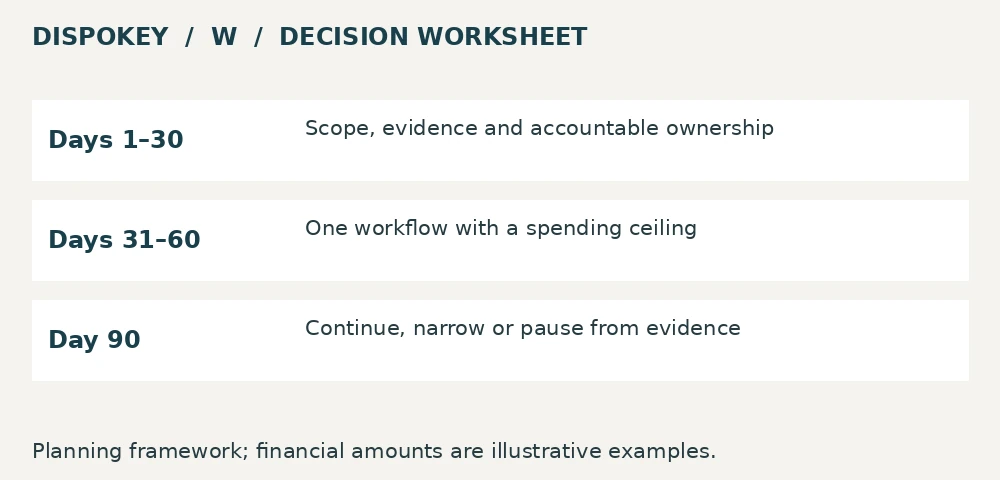
Continue when execution is controlled and another test is affordable. Narrow when a segment produces more supportable opportunities. Pause when spending exceeds the limit or basic execution remains unreliable. A disciplined pause is a valid business decision, not a failure to meet an invented deadline for income.
Worked example: budget and fee-share arithmetic
Illustrative allowances, not market prices: a 90-day operating cap of $3,000 includes $600 for tools and administration, $900 for research, $900 for outreach and $600 for travel and analysis. Hold a separate $1,500 reserve outside that cap. Earnest money, state-specific setup costs, taxes and transaction charges need separate treatment.
If a completed assignment produces a $12,000 fee under DispoKey’s 60/40 split favoring the wholesaler, the wholesaler share is $7,200 and DispoKey share $4,800. Subtracting $3,000 operating spending leaves $4,200 before taxes and other costs. With no closing, revenue is $0 and the spending remains incurred. These figures are scenarios, not expected results.
Under these simplified assumptions, $3,000 divided by 60% equals $5,000 of gross fee revenue to cover operating spending alone. It excludes other costs and does not predict a closing. Check alternative inputs with the calculators, keeping timing and any deposits visible rather than treating a possible fee as cleared cash.
Use a weekly scoreboard that changes decisions
Review spending, remaining allowance, verified opportunities, supported offers, live obligations and actual receipts. Keep unsigned interest separate from completed assignments. A large pipeline is not available cash. Write down what would cause a pause, who may authorize extra spending and how an extension or changed deadline reaches the responsible person.
If spending is affordable but the same missing facts recur, improve evidence collection. If responses arrive but nobody handles them, fix ownership. If no qualified opportunities emerge, reconsider scope or source quality rather than calling it a disposition problem. The next action should address a demonstrated bottleneck, not merely increase activity.
When DispoKey may not be your best option
A strong existing buyer and reliable closing process may make retaining the full fee more appropriate. DispoKey accepts off-market contracts only; on-market deals are not accepted. The offer is a 72-hour buyer-match guarantee, a 60/40 split favoring the wholesaler and $0 upfront. Matching is not a guarantee of closing or income.
Review the wholesaler hub or submit an eligible deal. Do not confuse a $0 upfront disposition service with a business that has no operating costs. Preserve your cash ceiling and verified requirements even when using a partner.
Key takeaways
- Make the decision from documented inputs, not a headline promise.
- Keep costs, timing and responsibilities visible.
- Recalculate when material facts change.
Frequently asked questions
How long should a business plan be?
Start with one operating page, a budget and a pipeline record. Add detail when it changes a decision or responsibility.
Should I include an income target?
You can include a clearly labeled scenario, but keep personal living expenses separate from uncertain assignment proceeds.
What if no deal closes in 90 days?
Review spending, evidence and execution. Continue only if the next test is affordable and addresses a specific unresolved question.