Quick answer: To price a wholesale deal, start from the end buyer's maximum offer — ARV × 0.70 minus rehab — and work backward. Your assignment fee is the gap between that buyer price and your contract price, typically leaving the buyer at least 10–15% margin. DispoKey matches priced contracts with buyers within 72 hours and splits fees 60/40 in your favor.
- Price from the buyer's math, not from what you hope to earn.
- Verify ARV and rehab with evidence buyers can check.
- Leave real margin; overpriced deals sit and die.
- Set an asking price and a walk-away floor before marketing.
Most wholesale deals that fail do not fail because of the house — they fail because of the price. A contract priced for the wholesaler's fee instead of the buyer's numbers sits on the list until the inspection period runs out. This guide shows how to price backward from the buyer, with a fully labeled example. It pairs with how to comp a wholesale deal and the assignment fee definition.
Why should you price from the buyer's side?
Because the buyer decides whether the deal closes. Cash buyers run their own maximum allowable offer; if your price sits above it, no fee you write on the deal sheet will ever be paid.
What is the buyer's maximum allowable offer?
The MAO is the most a buyer can pay and still hit their margin. Fix-and-flip buyers often use ARV × 0.70 minus rehab; Buy & Hold buyers check rent support and debt coverage instead. Learn the flip version in how to calculate ARV.
How does your contract price fit in?
Your contract price with the seller is your cost. The spread between that price and the buyer's MAO is the most room you have. Your fee should take part of that room, not all of it.
The wholesale pricing formula, step by step
Work from ARV down to the buyer price, then subtract your contract price. Every input should have evidence you can attach to the deal sheet.
| Step | Action | Example (labeled) |
|---|---|---|
| 1 | Verify ARV from 3–5 renovated comps | $240,000 |
| 2 | Apply the buyer's factor (70%) | $168,000 |
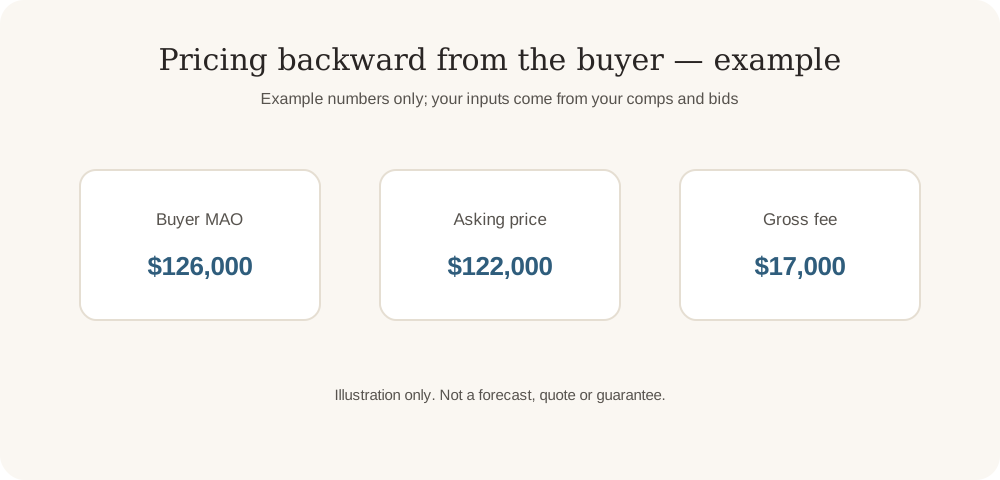
| 3 | Subtract a documented rehab budget | −$42,000 → $126,000 buyer MAO |
| 4 | Set asking price a little under MAO | $122,000 |
| 5 | Subtract your contract price | −$105,000 |
| 6 | Gross assignment fee | $17,000 |
Why ask a little under the buyer's MAO?
A price slightly under MAO gives buyers a reason to move fast and absorbs small disagreements on rehab. In the example, the $4,000 cushion between $126,000 and $122,000 is what makes a buyer say yes on the first walkthrough instead of renegotiating.
How do you check ARV and rehab before pricing?
Buyers rebuild your numbers from scratch, so your inputs must survive that test. Weak ARV support is the most common reason a priced deal stalls.
What ARV evidence do buyers expect?
Renovated sold comps from the last 90–120 days, same neighborhood, similar size. If you must use older sales, age them with the FHFA House Price Index for the state or metro. [1] Never use active listings as sold comps.
How detailed should the rehab budget be?
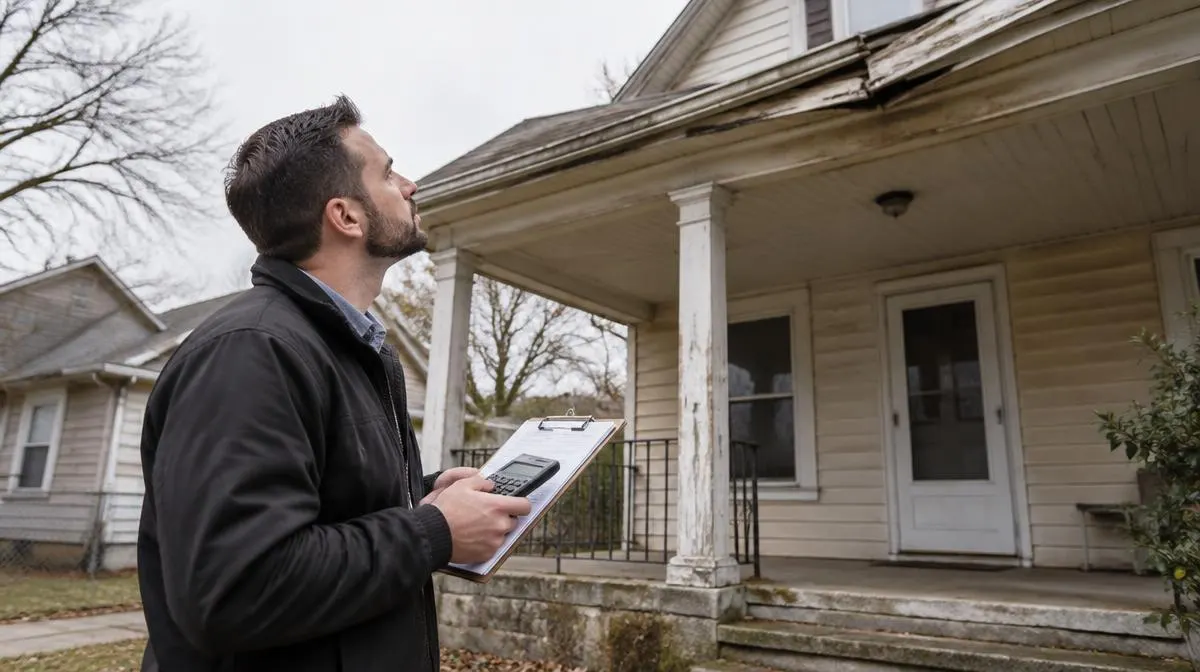
Line-item it by system: roof, HVAC, electrical, plumbing, kitchen, baths, flooring, paint. Add a 10% contingency. Photos of every major item let buyers check your scope without a second visit. See how to estimate rehab costs.
How do you sanity-check the market?
Compare your ARV with local median values from the Census American Community Survey, and read HUD's regional housing market analysis where one exists for the metro. [2] [3] An ARV far above the area's typical values needs extra-strong comps.
How much should your assignment fee be?
There is no fixed percentage. The right fee is whatever fits inside the spread while leaving the buyer enough margin to act quickly. The table below shows how the same house prices at different contract prices, using labeled example numbers.
| Contract → asking (example) | Gross fee | Buyer cushion under $126,000 MAO |
|---|---|---|
| $100,000 → $120,000 | $20,000 | $6,000 — moves fast |
| $105,000 → $122,000 | $17,000 | $4,000 — moves |
| $112,000 → $128,000 | $16,000 | Over MAO by $2,000 — sits |
The lesson: your negotiation with the seller sets your fee. Once the contract is signed, the buyer's MAO caps it.
How does pricing work when you JV with DispoKey?
You submit the contract with your ARV, rehab and photos; our disposition team checks the numbers against buyer demand and helps set an asking price buyers in that market will act on. We match a buyer within 72 hours, and the fee splits 60/40 in your favor with $0 upfront. In the example, a $17,000 fee pays you $10,200. Off-market contracts only.
Submit a deal, run numbers in the wholesaler calculators, or text (802) 618-0015 with your DK ID once you have one. Start with how the JV works.
What pricing mistakes kill wholesale deals?
Overpricing is the big one, but it usually starts with one of a few habits. Catch them before the deal goes out and you save days of dead marketing.
- Comping against the best house on the street. One record sale is not the ARV; use the middle of a tight comp set.
- Rounding rehab down. Buyers bid contractors; if your number is light, they will find out on the first walkthrough.
- Ignoring buyer holding and closing costs. The 70% factor exists to cover them; shaving it to 75% in a slow market leaves no room.
- Pricing to the inspection deadline. Price the deal correctly on day one so you are not forced into a fire-sale cut on the last day of your contract window.
- Hiding the fee math. Clear numbers build trust; buyers who feel misled stop opening your deal sheets.
A simple habit fixes most of these: have someone who did not find the deal rebuild your numbers before you send it. If they land more than about 5% below your ARV, rework the comps before any buyer sees the price.
When DispoKey may not be your best option
If you already have a strong buyer lined up at your asking price, sell to that buyer and keep the full fee. If the property is listed on the MLS, we cannot take it — we accept off-market contracts only.
Key takeaways
- Price backward from the buyer's MAO, never forward from your desired fee.
- Back every input with evidence buyers can verify.
- Ask slightly under MAO so buyers move on the first walkthrough.
- Your fee is set when you sign with the seller.
- A deal that sits loses more than a smaller fee would have.
Frequently asked questions
How do you price a wholesale deal?
Verify ARV, apply the buyer's factor, subtract the rehab budget to find the buyer's MAO, set your asking price slightly under it, then subtract your contract price to see your fee.
What is a good assignment fee?
A good fee is one the deal can carry while leaving the buyer real margin. Size it from the spread between your contract price and the buyer's MAO, not from a fixed number.
Why is my wholesale deal not selling?
The most common cause is price above the buyer's MAO, usually from optimistic ARV or a thin rehab budget. Rework the numbers with renovated sold comps and line-item repairs.
Can I lower my price after marketing a deal?
You can lower your asking price, which reduces your fee. Your contract price with the seller stays the same unless the seller agrees to a written change.