
Quick answer: A wholesale real estate contract is a purchase agreement in which you agree to buy a seller's property and keep the right to assign it or close and resell. It needs the parties, price, earnest money, closing date, an assignment clause and disclosed terms. DispoKey matches off-market contracts with vetted buyers within 72 hours, with $0 upfront and a 60/40 split favoring you.
- Use a state-appropriate purchase agreement, not a generic template.
- Disclose your intent to assign or resell where the law requires it.
- Match the closing date to a realistic buyer timeline.
What a wholesale contract does
The contract gives you an equitable interest in the property: the right to buy it at an agreed price by an agreed date. In wholesaling, you either assign that right to an end buyer for a fee or close and resell in a double close.
The document itself is usually a standard purchase agreement with clauses that permit assignment and give you time to find a buyer. The assignment of contract is a separate, shorter document you sign later with the end buyer. Our guide to JV-ing a wholesale deal explains how a joint venture differs from a straight assignment.
Essential clauses to include
Every contract needs the basics: names, legal description or parcel number, price, earnest money, closing date and signatures. A wholesale contract adds clauses that protect your ability to assign and close.
Assignment clause
State that the buyer may assign the contract, often written as the buyer's name followed by "and/or assigns." Without it, some contracts bar assignment by default.
Earnest money terms
Name the amount, who holds it and when it becomes non-refundable. See earnest money in wholesale deals.
Inspection and access
An inspection or due diligence period and an access clause let you and your buyers walk the property. Read the inspection period guide for how sellers view it.
Closing and title
Name the title company or closing attorney, set a closing date and require marketable title.
State rules and disclosure duties
Several states now regulate wholesaling directly, with license, registration or written disclosure requirements. Check your state's real estate commission before you sign a seller.
Oregon's Real Estate Agency explains its residential property wholesaler rules, including licensing. Ohio's law on wholesale purchase agreements, effective in 2026, requires written disclosures to the record owner; the text is on the Ohio Revised Code site. Connecticut adopted a wholesaler registration framework published in its General Statutes supplement. Our wholesaling legality guide summarizes more states. Treat any template as a starting point and confirm it matches current law where the property sits.
Worked example: price, fee and split
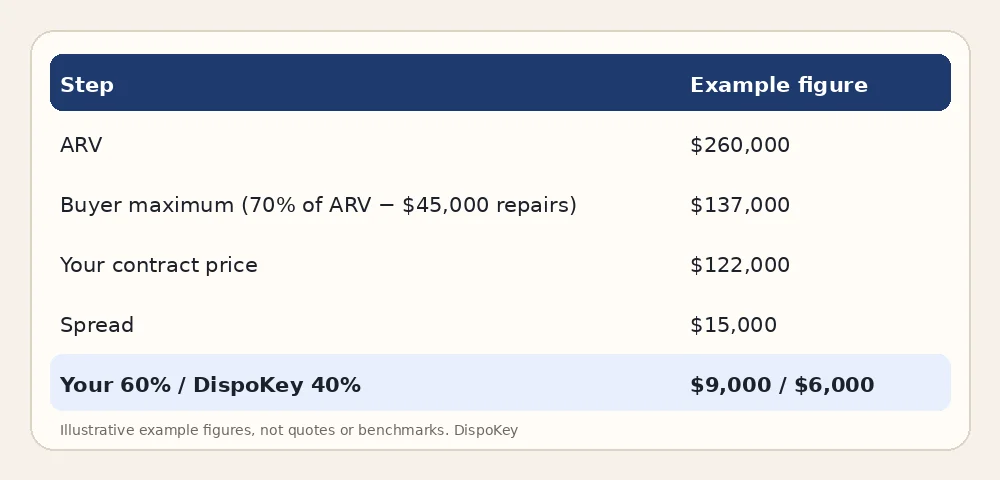
The contract price sets your margin, so work the numbers before you sign. Here is an example using the maximum allowable offer approach.
Illustrative only: after-repair value is $260,000 and estimated repairs are $45,000. A buyer using 70% of ARV minus repairs would pay up to $137,000. You contract the property at $122,000, leaving a $15,000 spread. Through DispoKey's JV, the 60/40 split favoring the wholesaler gives you $9,000 and DispoKey $6,000, with $0 upfront. See how to price a wholesale deal and the assignment fee entry.
| Step | Example figure |
|---|---|
| ARV | $260,000 |
| Buyer maximum (70% of ARV − $45,000 repairs) | $137,000 |
| Your contract price | $122,000 |
| Spread | $15,000 |
| Your 60% / DispoKey 40% | $9,000 / $6,000 |
Set a closing date your buyers can meet
A tight closing date protects the seller but can squeeze you if buyers need time to walk the house and arrange funds. A long date can lose a motivated seller.
Many wholesalers set 21 to 30 days and add an extension option with written consent. DispoKey's 72-hour buyer-match guarantee means a matched buyer is identified quickly, which leaves the rest of the window for title and funding. Only off-market contracts are accepted; on-market listings are declined.
Red flags in free templates
Free online contracts often miss state-required disclosures, use the wrong closing language or omit an assignment clause. Others include one-sided terms that a seller's attorney will reject.
Watch for missing legal descriptions, earnest money with no named holder, vague contingencies such as "subject to partner approval" with no deadline, and no clause covering who pays closing costs. A clean, specific contract also makes buyers more confident when they review the deal sheet. Telling the seller to have their own attorney review the agreement is good practice.
Submit the contract for a buyer match
Once the contract is signed, submit the deal with the address, contract price, closing date and photos. DispoKey reviews it and, if it fits, matches it with vetted cash buyers within 72 hours.
Use the deal submission form or read how the JV works on the wholesaler page. You can text (802) 618-0015 with your DK ID for status updates.
A pre-signing checklist
Before the seller signs, read the draft aloud with them and confirm each blank is filled. Check the legal description against the deed, the price in words and figures, the earnest money amount and holder, the closing date and any extension language. Confirm who pays which closing costs and whether personal property stays. Send the signed copy to the title company the same day so the title search starts while you market the deal.
When DispoKey may not be your best option
If you already have a strong buyer lined up at your price, assigning directly keeps the full fee. A JV makes most sense when you need buyer reach, speed or help with disposition before your closing date.
Key takeaways
- Start from a state-appropriate purchase agreement.
- Include assignment, earnest money, access and closing clauses.
- Check your state's wholesaler disclosure and license rules.
Frequently asked questions
Is a wholesale contract legally binding?
Yes. A signed purchase agreement binds both parties to its terms, including price, closing date and any contingencies.
Do I need a special contract to wholesale a house?
Usually a standard purchase agreement with an assignment clause works, but some states require added disclosures.
What does "and/or assigns" mean on a contract?
It signals that the named buyer may transfer the contract rights to another buyer before closing.
How long should a wholesale contract closing period be?
Long enough for buyers to inspect and fund, often 21 to 30 days, with any extension agreed in writing.
Official references
- Oregon Real Estate Agency: Residential property wholesaling
- Ohio Revised Code: wholesale purchase agreement disclosures
- Connecticut General Statutes: Chapter 392a
- CFPB: What is owner's title insurance?