

Quick answer: Whether a wholesale real estate transaction is legitimate depends on applicable state rules, your role, required disclosures and the actual contracts. DispoKey recommends verifying those conditions before marketing an off-market deal. Its 72-hour buyer-match guarantee is not legal clearance; one state's requirements cannot establish legality in another state.
- Check licensing or registration before contracting.
- Document disclosures and marketing permissions.
- Confirm the closer accepts the reviewed structure.
The useful question is not whether the label sounds respectable. It is whether the specific conduct is permitted, accurately described, and documented. A polished website, large buyer list, or impressive projected fee cannot answer that question. This guide provides three current 2026 state examples and a practical file-review process, not a national legality opinion.
What should you check before marketing a deal?
Verify your legal capacity, contractual rights, required disclosures, and permission to advertise before sending the property to buyers. Stop when any essential document is missing rather than trying to repair the file after an interested buyer appears.
Early compliance and deal details checklist
- Property state, unit count, title holder, and proposed transaction structure.
- Your license, broker representation, or registration where required.
- Executed purchase agreement and all amendments.
- Assignment restrictions, deadlines, deposit requirements, and cancellation terms.
- Required seller and buyer disclosures with delivery evidence.
- Written access, photography, and marketing permissions.
- Closing professional's acceptance of the structure and funding plan.
- Verification of the applicable official rules, actual parties, forms, and proposed advertisements.
A contract granting purchase rights is not the same as owning the property. Describe the interest you hold accurately. Likewise, a clause allowing assignment does not by itself settle licensing, advertising, disclosure, or consumer-protection questions.
What does Iowa require in 2026?
Iowa requires broker licensure or representation by a licensed real estate broker for wholesaling within the statute's scope. Iowa Code §543B.6A covers residential property with one to four dwelling units and defines the relevant equitable-interest transaction. [1]
The section requires written disclosure to all parties before executing a purchase contract or a contract conveying an equitable interest. Required information includes the parties' legal identities and an explanation that the wholesaler holds an equitable interest and may not be able to convey title. It also requires a copy of an executed agency agreement to all parties before the relevant contract is executed. [1]
Failure to meet the specified disclosure requirement gives the seller or buyer a pre-closing cancellation right without penalty and permits retention of earnest money paid by the wholesaler. The statute also provides a civil penalty up to the greater of $10,000 or ten percent of the property's sale price for a violation. A broker introduction alone does not supply the disclosures and executed agency agreement required by this section. [1]
What changed under Ohio's 2026 rule?
Ohio Revised Code §5301.95, effective March 2, 2026, establishes specific disclosures for covered residential wholesalers, including role-dependent statements before binding contracts. Its definition addresses assignments or novations involving one-to-four-unit residential property and includes stated exceptions. [2]
For a wholesaler acting as grantee, the required disclosure to the record owner must be separate from the purchase agreement, conspicuous, in boldface, and at least twelve-point type. The statute supplies substantially required language. Its definition also includes a wholesaler acting as grantor, but the disclosure duty in subsection (B) is imposed on a wholesaler acting as grantee and requires delivery to the record owner. Do not substitute a casual email saying that you are an investor. [2]
Use the current official text to determine the appropriate statement, signatures, and consequences of failure. Ohio's disclosure statute is not evidence that licensing or other rules elsewhere are satisfied. A generic national contract package cannot resolve those differences.
What does Connecticut Chapter 392a require?
Connecticut's Chapter 392a establishes a wholesaler registration and disclosure framework effective July 1, 2026. The chapter addresses definitions, registration, contract terms, seller duties, disclosure reports, prohibited recording, remedies, regulations, and unfair or deceptive practices. [3]
Connecticut General Statutes Chapter 392a, from §20-329aaa through Section 20-329hhh, must be read as a connected framework. Section 20-329bbb addresses registration, while Section 20-329eee addresses the written wholesale disclosure report. On and after October 1, 2026, the wholesaler must provide the prospective seller with the commissioner's written wholesale disclosure report before executing a real estate wholesale contract; electronic delivery is permitted. [3]
Connecticut defines a real estate wholesaler by the covered activity, not by the absence of a broker or salesperson license. A person may simultaneously hold a broker or salesperson license and a wholesaler registration. Read the current supplement alongside the underlying statutes, and do not assume a broker license replaces the registration requirement. [3]
| State example | First compliance gate | File evidence to request |
|---|---|---|
| Iowa | Broker license or broker representation | Agency agreement and required disclosures |
| Ohio | Correct role-specific pre-contract disclosure | Separate compliant statement and execution evidence |
| Connecticut | Applicable registration and chapter requirements | Credential verification and wholesale disclosure report |
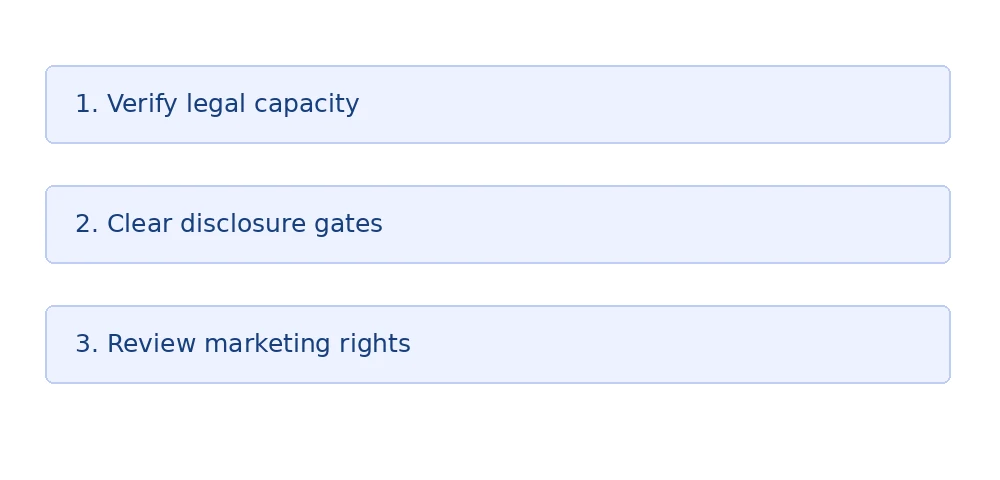
Information gain: what decision tree prevents wasted marketing?
Clear legal and contractual gates before spending time on buyer outreach. This decision tree separates a compliance problem from a pricing problem, because stronger demand cannot cure missing authority.
Labeled decision tree: First, identify the property state and covered transaction. If official rules and credential records do not establish the required credential or representation, stop. If the credential gate clears but mandatory pre-contract disclosures were missed, stop and verify the consequences and remedies in the applicable official rules; do not backdate documents. If disclosures clear but marketing or access authority is uncertain, obtain a reviewed written agreement before outreach. Only then evaluate buyer demand, pricing, and closing feasibility.
Finally, ask the closer to confirm the accepted structure and settlement treatment in writing. A title company's willingness to process a file is useful operational evidence, but it is not a substitute for your own legal obligations.
How should you evaluate a disposition split?
Calculate your retained fee after the partner share and agreed expenses, then compare it with the realistic alternative of finding a buyer yourself. A larger theoretical fee is not collected income.
Illustrative math: A $15,000 assignment fee split 60/40 leaves $9,000 to the sourcing wholesaler and $6,000 to DispoKey before any separately agreed costs or taxes. These are invented numbers, not expected results. Record who pays each expense and whether it reduces the split base before authorizing outreach.
When DispoKey may not be your best option
Skip a partner when you already have a qualified buyer and a workable closing process, or when your rights and disclosures are unresolved. A disposition service cannot convert an unauthorized transaction into a compliant one.
DispoKey's off-market service offers a 72-hour buyer-match guarantee, $0 upfront, and a 60/40 split in your favor. The match window is not a guaranteed funded closing or a substitute for legal clearance. On-market listings are not accepted for this service. Review the written agreement, exclusivity window, and release terms before submitting.
Use the wholesaler hub, then submit a reviewed off-market deal if you need buyer support. Read marketing permissions and choosing an investor-friendly title company. The assignment glossary explains the contract concept.
These examples describe the cited statutes, not nationwide legality. Verify the applicable state rules, covered activity and actual documents.
Key takeaways
Verify credentials, disclosures and contract rights before marketing. A buyer-match service does not replace compliance with applicable official rules.