
Quick answer: An investor-friendly title company is one that has closed assignments of contract and double closings before, will insure the title for your end buyer and puts your fee on the settlement statement. DispoKey recommends interviewing two or three companies with the same five questions before you sign a contract, then verifying their license and wiring process yourself.
- Ask whether they close assignments and double closings.
- Confirm how your fee appears on the settlement statement.
- Verify wire instructions by phone, every time.
A good contract and a good buyer still fall apart if the closer refuses the file. Title companies are not required to close every structure, and some decline assignments or back-to-back closings as a matter of policy. Finding the right one before you put a property under contract saves you from scrambling during the inspection period. This guide covers what title companies actually do, the questions to ask, and how to protect your fee and your buyer's money.
What does a title company do in a wholesale deal?
It searches the property's ownership history, issues title insurance, holds earnest money, prepares the settlement statement and disburses funds, including your fee. In most areas the title company also acts as the closing agent.
The Consumer Financial Protection Bureau describes title services as including title insurance, a title search and related services, and notes that in most parts of the country they also include the closing agent's fee. [1] Before closing, the company issues a title commitment listing the property interest, the parties' claims, the issues to resolve before closing and the policy terms. [2] Owner's title insurance protects the buyer against covered title problems that existed before the purchase, while a lender's policy protects only the lender's loan. [3] Read the title company glossary entry for the basics.
What should you ask a title company before using it?
Ask five things: whether they close assignments, whether they close double closings, how your fee is shown, how they handle earnest money from an end buyer and how they verify wire instructions. Get the answers in writing.
Open the title company interview checklist
- Do you close assignments of contract? Any limits on fee size?
- Do you close a double close on the same day, and do you require separate funding for the first leg?
- How does the assignment fee appear on the settlement statement?
- Who holds the end buyer's earnest money, and when is it deposited?
- What is your wire verification process, and which phone number should we call?
- Typical time to clear title, and who works liens and payoffs?
Do title companies treat assignments and double closings differently?
Yes. An assignment is one closing between the seller and the end buyer, with your fee shown on the statement. A double close is two closings, so the title company must handle funding for your purchase leg as well as the resale.
Some companies will not use the end buyer's funds to close the first leg, which means you may need transactional funding. Ask before you choose the structure. Our guide on double closing versus assignment walks through when each makes sense.
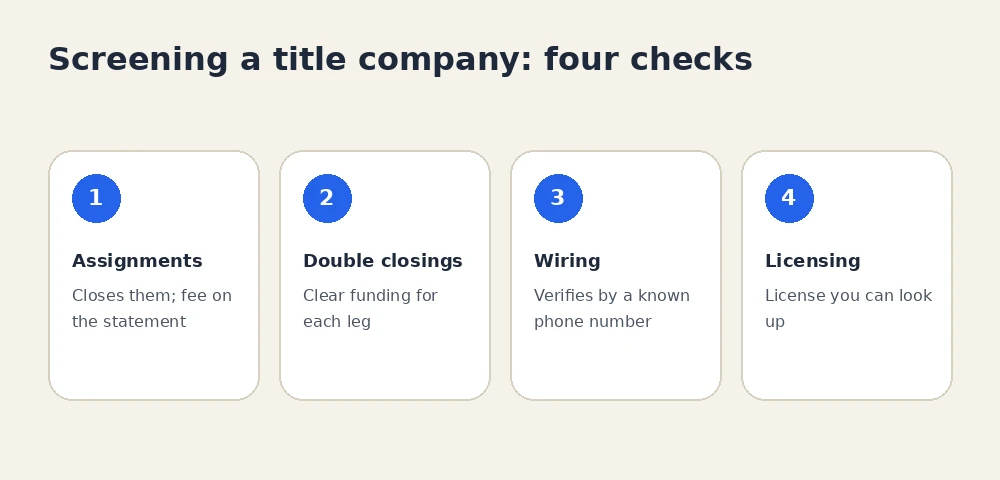
| Check | Good sign | Warning sign |
|---|---|---|
| Assignments | Closes them routinely, fee on statement | Will not close, or wants fee paid outside |
| Double closings | Explains funding for each leg | Unclear who funds the first leg |
| Wiring | Calls you back on a known number | Changes instructions by email |
| Licensing | Agent license you can look up | No license number provided |
How should your assignment fee appear at closing?
On the settlement statement, paid by the title company from the closing funds. A fee paid in cash or outside closing is harder to prove, harder to collect and can create problems for everyone at the table.
The figures below are invented examples for illustration, not a typical fee. Suppose your contract price with the seller is $140,000 and your end buyer agrees to pay $155,000. The settlement statement should show the seller receiving $140,000 less the seller's costs, and a $15,000 line to you for the assignment of contract. If your earnest money was $1,000 and the contract credits it back to you, that line appears too. If the title company cannot show the fee this way, find out why before closing day, not at the table.
How do you verify a title company's license?
Title insurance is regulated by state insurance departments, so start with your state's agent or company license lookup. Ask for the agent's license number and which underwriter issues their policies.
The National Association of Insurance Commissioners publishes a consumer guide to title insurance that covers how policies work, shopping and closing, and fraud prevention. [4] Use your state insurance department's lookup to confirm the agent and agency are active. Be cautious about referral arrangements: RESPA's Regulation X at 12 CFR 1024.14 prohibits fees or kickbacks for referring settlement services on federally related mortgage loans, and bars splitting a settlement charge except for services actually performed. [5] Whether a particular deal falls under that law is a question for a real estate attorney.
How do you protect closing funds from wire fraud?
Treat any change in wiring instructions as suspicious until verified. Call the title company at a phone number you already know, not one in the email, before anyone sends money.
The FBI's Internet Crime Complaint Center warns that criminals compromise legitimate email accounts to send fake payment instructions, and recommends verifying any change by calling a known, verified number. [6] Share the same rule with your end buyer. Our checklist on changed assignment-fee wire instructions covers what to do if a request arrives mid-deal, and earnest money in wholesale deals covers deposits.
When DispoKey may not be your best option
If you already have a strong buyer and a title company that closes your structure, you may not need a disposition partner on this deal. Keep 100% and close it yourself.
If you need a buyer fast, submit the off-market contract. DispoKey works with the title company on the file, carries a 72-hour buyer-match guarantee, takes $0 upfront and splits the fee 60/40 in your favor. On-market listings are not accepted.
Key takeaways
Interview title companies before you contract, confirm they close your structure, see your fee on the settlement statement and verify every wire by phone. Licensing, referral arrangements and assignment rules vary by state; check your state real estate commission's published rules for your market.