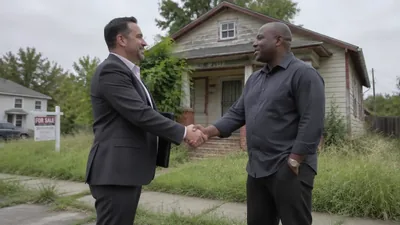


Quick answer: To JV a wholesale deal, sign a short written agreement with a partner who brings what you lack, usually buyers, that names the property, each side's role, the fee split and what happens if it doesn't close. Peer splits are often 50/50; DispoKey uses a fixed 60/40 split in your favor with a 72-hour buyer-match guarantee.
Every wholesaler eventually holds a contract they can't move: wrong market, thin buyer list, or the clock is down to ten days. A joint venture turns that problem into a smaller check instead of a cancelled contract and an angry seller. Done well, JVs are how many wholesalers expand into new markets without building a buyer list from scratch. Done badly, they cause most of the disputes you read about in wholesaler groups.
What a wholesale JV is (and isn't)
A wholesale JV is a one-deal partnership. One party controls the contract with the seller; the other brings something the deal needs, most often a buyer, sometimes transactional funding or local knowledge. They agree in writing how the assignment fee or double-close spread will be split. It is not a general business partnership, and neither party becomes an owner of the other's company.
The two common JV models:
- Contract holder + dispo partner: you hold the contract; the partner markets it to their buyers.
- Acquisitions partner + bird dog: someone brings a lead; you negotiate and contract it.
How JV fee splits are calculated
The split applies to the net spread: assignment fee (or double-close margin) minus agreed deal costs such as transactional funding fees. Agree in writing whether costs come off the top before the split.
| Example deal (labeled) | 50/50 peer JV | DispoKey 60/40 |
|---|---|---|
| Contract price to seller | $140,000 | $140,000 |
| Buyer price | $162,000 | $162,000 |
| Gross spread | $22,000 | $22,000 |
| Agreed costs off the top | $1,000 | $0 upfront |
| Net to split | $21,000 | $22,000 |
| Your share | $10,500 | $13,200 |
| Partner share | $10,500 | $8,800 |
Numbers are illustrative. The point: the split percentage matters less than whether the deal closes. 60% of a closed deal beats 100% of a cancelled one.
Steps to JV a wholesale deal
- Confirm the deal is off-market and assignable. Read your purchase agreement for an assignment clause or "and/or assigns" language. If assignment is restricted, plan a double close.
- Check your state's rules. Several states regulate marketing an equitable interest in a contract. Illinois's Real Estate License Act, for example, addresses repeat wholesaling activity. Confirm before advertising.
- Vet the partner. Ask for recent closed deals with title-company confirmation, not screenshots.
- Sign the JV agreement before sharing the address. Include a non-circumvention clause.
- Hand over a complete deal packet: photos, comps, rehab estimate, access instructions, contract dates.
- Agree on who talks to the seller. Usually only the contract holder.
- Close through a title company that disburses both parties' shares on the settlement statement.
What to include in a JV agreement
- Property address and contract date.
- Each party's responsibilities and who controls marketing.
- Split percentage and what costs come off the top.
- Earnest money: who posted it, and who bears the risk if it is lost.
- Non-circumvention and confidentiality.
- Term: when the JV ends if no buyer is found.
- Disbursement instructions to title.
Write the template once, check it against your state real estate commission's rules, then reuse it.
The risks, and how to manage them
- Circumvention: a partner goes around you to the seller or buyer. Mitigate with a signed agreement first and a title company that knows both parties.
- Over-marketing: the deal gets blasted to every list and looks shopped. Agree who markets and where.
- Bad numbers: inflated ARV or underestimated repairs destroy buyer trust. Send honest comps.
- Compliance: calls and texts to buyers fall under federal telemarketing rules (FTC Telemarketing Sales Rule) and the TCPA. Use consent-based lists.
- Taxes: JV income is generally self-employment income; keep records for each deal.
How a DispoKey JV works
DispoKey is built for one job: the back half of your deal. You submit an off-market contract; our dispo team markets it to vetted cash buyers. If we don't match a buyer within 72 hours, you walk with no obligation. When it closes, you keep 60% of the fee, with $0 upfront. Wholesalers can text their DK ID to (802) 618-0015 for status updates.
Assignment or double close inside a JV?
Most JVs close by assignment: the end buyer steps into your contract and the title company pays both JV partners from the assignment fee on the settlement statement. When the seller's contract restricts assignment, or the spread is large enough that you'd rather not show it, a double close is used instead: you buy with transactional funding and resell the same day. Transactional lenders typically charge a percentage of the purchase price or a flat fee, so agree in the JV agreement whether that cost comes off the top. Either way, disclose your role honestly and follow your state's rules on marketing an equitable interest.
When a JV may not be your best option
If you already have a strong buyer for this exact property, a JV just gives away margin; assign it directly. JVs also don't fix a bad contract: if the price is above what cash buyers will pay, no partner can move it. Run your numbers in the MAO calculator first.
Key takeaways
- A JV is a one-deal written agreement that splits the net spread.
- Sign before you share the address; include non-circumvention.
- Check state wholesaling rules before marketing.
- Split percentage matters less than closing the deal.
- DispoKey: 60/40 in your favor, $0 upfront, 72-hour buyer match.
Have a contract on the clock? Submit your off-market deal. Related reading: what dispo means in real estate and how to find cash buyers for wholesale deals. This article should be reviewed by an attorney in your state.