
Quick answer: ARV — after repair value — is what a property should sell for once renovations are finished. Calculate it from 3–5 recently sold comparable homes: adjust each comp for differences, average the adjusted price per square foot and multiply by your property's finished size. Investors then set a maximum offer with the 70% rule: ARV × 0.70 − rehab cost. DispoKey buyers see ARV support on every marketplace deal.
- Pull 3–5 comps sold in the last 90–120 days.
- Stay in the same neighborhood and within about 250 square feet.
- Adjust for condition, size and features before averaging.
- Sanity-check the result against county and market data.
Every number in a fix-and-flip or buy-and-hold offer hangs on ARV. Get it wrong by 10% and a profitable deal becomes a loss. This guide walks through the calculation the way working investors do it, with a fully labeled example. It pairs with how to analyze fix-and-flip deals and how to estimate rehab costs.
What is ARV, exactly?
ARV is the estimated market value of a property after all planned repairs and renovations are complete — not its value today. Lenders use it to size renovation loans, and investors use it as the anchor for every offer. An appraisal is the formal version of this estimate; the CFPB's appraisal guidance explains how a licensed appraiser's opinion differs from an informal estimate. [3]
How do you pick comparable sales?
Comps are recently sold homes as similar as possible to what your property will become after the renovation — not what it is today. Three rules keep the set honest.
How recent should comps be?
Use sales from the last 90–120 days where possible. Older sales drift from current conditions; if you must use one, adjust for market movement. The FHFA House Price Index publishes monthly price-change data by state and metro, which gives you a documented way to age an older comp forward. [1]
How similar should comps be?
Same neighborhood or subdivision first, then match size within roughly 250 square feet, similar age, bed and bath count, and the same general style. A renovated comp is the target — a distressed sale tells you about today's condition, not the finished value.
The ARV formula, step by step
With a clean comp set, the math is simple: convert each comp to an adjusted price per square foot, average those figures, and multiply by your subject property's finished square footage.
| Step | Action | Example (labeled) |
|---|---|---|
| 1 | Collect 3–5 sold comps | $282,000 / $295,000 / $310,000 |
| 2 | Adjust each for differences vs. the finished subject | +$8,000 / −$5,000 / $0 |
| 3 | Divide by each comp's square footage | $145 / $148 / $152 per sq ft |
| 4 | Average the adjusted $/sq ft | $148 per sq ft |
| 5 | Multiply by the subject's finished size | $148 × 2,050 sq ft = $303,400 ARV |
Worked example: from ARV to maximum offer
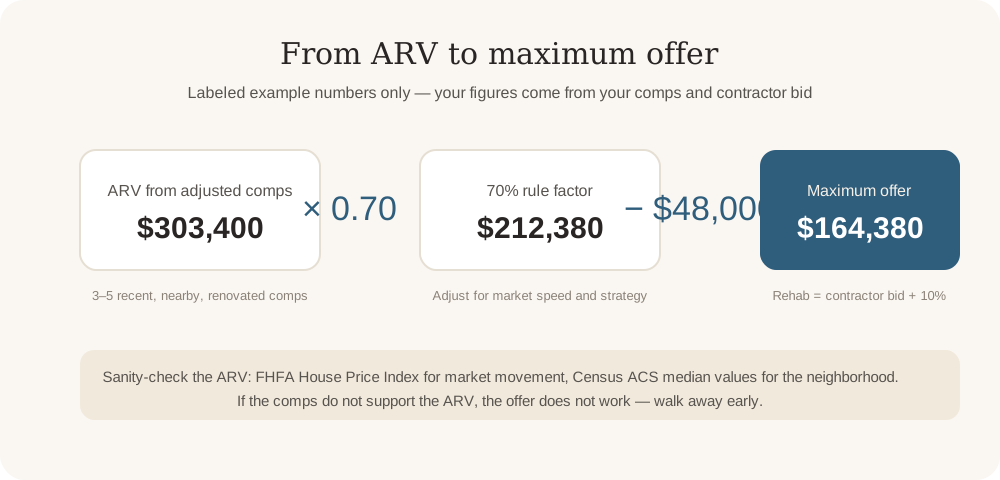
ARV alone does not set your offer — the 70% rule does. It backs out rehab cost and your required margin so the purchase price leaves room for holding costs, closing costs and profit. The numbers below are an illustrative example only.
| Line (example only) | Amount |
|---|---|
| ARV from adjusted comps | $303,400 |
| × 70% rule factor | $212,380 |
| − Rehab budget (contractor bid + 10% contingency) | −$48,000 |
| Maximum allowable offer (MAO) | $164,380 |
Adjust the 70% factor to your market and strategy: hot markets with fast resale sometimes justify 75%, while slow or rural markets can demand 65%. Buy-and-hold investors should cross-check the result against rent support — our county rent-to-value study and cash flow guide cover that side. For a neighborhood-level sanity check, the Census Bureau's American Community Survey publishes median home values down to small geographies. [2]
Which ARV mistakes cost investors money?
- Comping to today's condition: ARV describes the finished house; using as-is sales as comps understates it, and using pristine new builds overstates it.
- Stretching the radius: a comp across a highway or school-district line can belong to a different market.
- Ignoring time: a sale from eight months ago needs a market-movement adjustment.
- Rounding the rehab: a guessed rehab number makes the MAO meaningless. Get a real bid first.
Does ARV matter for buy-and-hold deals?
Yes, twice over. First, the purchase still has to make sense against the finished value — overpaying because "rents will cover it" is how negative-equity rentals happen. Second, ARV is the number a refinance appraisal is measured against. In a BRRRR-style buy-and-hold play, the refinance that returns your capital is sized from the appraised value after repairs, so an inflated ARV means a smaller loan than you planned and cash stuck in the deal. Our delayed financing guide covers the six-month refinance window and its documented-investment cap, and the cash flow analysis guide shows how to stress-test the rent side once the value side is honest.
How does ARV show up on DispoKey deals?
Every deal on the DispoKey marketplace carries the wholesaler's ARV with supporting comps, so you can re-run the calculation before you offer. Marketplace access requires team approval — apply as a buyer and we will walk you through the first deals by call or email. When you are ready to browse, the marketplace lists current off-market deals.
When DispoKey may not be your best option
If you need financing contingencies or want to inspect every property for weeks before deciding, off-market timelines will feel tight. And if your strategy depends on listed properties with full seller disclosures, the MLS fits better. Our deals move quickly because the pricing already reflects condition.
Key takeaways
- ARV is the finished value, built from 3–5 adjusted, recent, nearby comps.
- Average adjusted price per square foot, then multiply by finished size.
- The 70% rule turns ARV into a maximum offer: ARV × 0.70 − rehab.
- Document market movement with the FHFA index and sanity-check with Census data.
Frequently asked questions
What is the formula for ARV?
ARV equals the average adjusted price per square foot of 3–5 recent comparable sales, multiplied by the subject property's finished square footage. Adjust each comp for size, condition and feature differences before averaging.
What is the 70% rule in real estate?
It caps your purchase price at 70% of ARV minus the rehab budget, leaving room for holding costs, closing costs and profit. Adjust the factor up or down for your market's speed and your strategy.
How many comps do I need for ARV?
Three solid comps are a minimum; five is better. Drop any sale you cannot explain — a foreclosure auction or a family transfer is not market evidence.
Is ARV the same as an appraisal?
No. ARV is your working estimate; an appraisal is a licensed appraiser's formal opinion, often required by a lender. A careful ARV and an appraisal should land close together if the comp work is honest.
References
- FHFA House Price Index — Federal Housing Finance Agency.
- American Community Survey — U.S. Census Bureau.
- What is an appraisal? — CFPB.