
Quick answer: A 1031 exchange timeline has two hard deadlines: identify replacement property within 45 days of selling, and receive it within 180 days or by your tax return due date, whichever is earlier. Neither moves for a slow deal. DispoKey's approved buyers can line up off-market rentals before day zero.
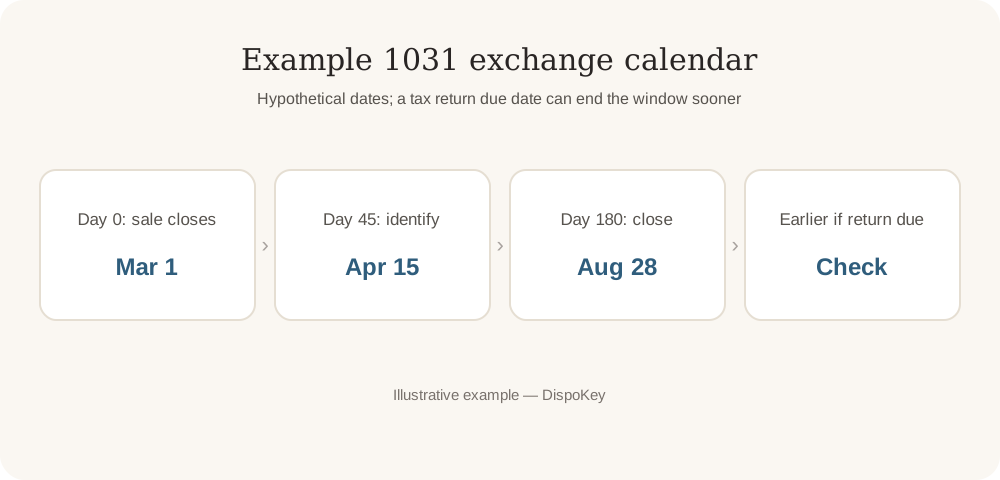
- Day 0: the property you gave up transfers.
- Day 45: written identification is due.
- Day 180: replacement property must be received.
- Earlier if your tax return is due first.
Most failed exchanges do not fail on tax law. They fail on inventory: an investor sells a rental, starts shopping on day one and runs out of calendar. This guide maps the timeline day by day, explains the identification rules in plain terms and shows how Buy & Hold investors build a replacement list before they ever close the sale. For the basics, see our 1031 exchange definition.
What is the timeline for a 1031 exchange?
The clock starts the day you transfer the relinquished property. You then have 45 days to identify and 180 days to close on the replacement.
The IRS Form 8824 instructions state that replacement property must be identified within 45 days after the property given up is transferred, and received within 180 days or by the due date of your return including extensions, whichever is earlier. [1] The two periods run at the same time; the 180 days are not added after the 45.
Why does the tax return due date matter?
A sale late in the year can lose part of its 180 days if the return is filed first. Filing an extension usually preserves the full window.
Labeled example: a rental sold on December 1 reaches day 180 in late May, but an April return due date without an extension would end the exchange period sooner.
| Day | Deadline | What must happen |
|---|---|---|
| Before day 0 | Planning | Hire a qualified intermediary; build a target list |
| 0 | Transfer | Relinquished property closes; proceeds go to the intermediary |
| 45 | Identification | Signed written identification delivered as the rules require |
| 180 or return due date | Receipt | Replacement property closes |
How do you identify replacement property?
You list the property in a signed written document delivered to the right party by day 45. Most investors use the three-property rule.
IRS Publication 544 lists the limits: you may identify up to three properties regardless of value, or more under alternative rules, including one where you actually receive at least 95% of the total value of everything identified. [3] Description matters; a street address or legal description is the normal standard.
Open the identification checklist
- Write the full address or legal description of each property.
- Sign the document.
- Deliver it to the person required by the rules, typically your qualified intermediary, by day 45.
- Keep proof of delivery.
- Choose backups: a second and third property protect you if the first falls through.
Do I need a qualified intermediary?
For a standard deferred exchange, yes. The intermediary holds the sale proceeds so you never receive them.
The Form 8824 instructions note that related parties and your agents are generally disqualified from serving as the intermediary, and that if a deadline is missed because of the intermediary, the transaction may not qualify. [1] Ask how the intermediary holds funds and what happens if it fails.
Which properties qualify?
Real property held for business use or investment, exchanged for other such property. After the 2017 tax law change, only real property qualifies.
The IRS says real properties are generally like-kind regardless of whether improved or unimproved, but property held primarily for sale does not qualify, and U.S. property is not like-kind to foreign property. [2] That is why Buy & Hold rentals fit the rule and short-term flips usually do not.
What is boot in a 1031 exchange?
Boot is cash or non-like-kind property you receive. You recognize gain to the extent of the boot.
Labeled example: if you sell for $600,000 and buy for $560,000, the $40,000 you do not reinvest is generally taxable. Debt paid off and new debt taken on also enter the calculation; the Form 8824 lines walk through it.
How to beat the 45-day deadline
Start shopping before you list the relinquished property. The best exchanges identify on day 10, not day 44.
- Set your buy box first. Price range, markets, unit count and minimum cash flow. Our cash flow analysis guide shows the math.
- Underwrite three targets now. Use rent-to-value data by county to screen markets.
- Line up financing. A DSCR loan keeps qualification tied to rent.
- Add off-market supply. Off-market rentals are less likely to vanish to a bidding war mid-window.
Approved DispoKey buyers can browse vetted off-market deals in markets like Houston and Columbus. Marketplace access requires team approval.
When DispoKey may not be your best option
If your exchange depends on a financing contingency or long due-diligence periods, an off-market cash deal may not suit your timeline; a listed property with standard contingencies may fit better. Off-market deals work best when your funds and lender are ready before day zero.
How DispoKey helps exchange buyers
Apply once, our team reviews your buy box and, once approved, you receive credentials by call or email. You then see vetted Buy & Hold deals that match your markets. Apply to the buyers network.
Key takeaways
- Identify within 45 days; receive within 180 days or by the return due date.
- The periods run together and are not extended for slow deals.
- Use a qualified intermediary and keep proof of identification.
- Build your replacement list before the sale closes.
Frequently asked questions
What is the 45-day rule in a 1031 exchange?
You must identify the replacement property in writing within 45 days after transferring the property you gave up. The IRS Form 8824 instructions describe how the identification must be signed and delivered.
What is the 180-day rule in a 1031 exchange?
You must receive the replacement property within 180 days after the transfer, or by your tax return due date including extensions, whichever comes first.
Can the 45-day deadline be extended?
Not because a deal is slow. The deadlines are set by tax law; relief generally comes only through specific IRS disaster or similar announcements.
Can I do a 1031 exchange on a fix and flip?
Generally no. The IRS says real property held primarily for sale does not qualify, so most flips fall outside a like-kind exchange.