
Quick answer: Calculate cap rate by dividing annual net operating income by the stated property price or value, then multiplying by 100. DispoKey buyers should verify rent, vacancy and recurring expenses before using the percentage. Keep mortgage payments outside operating NOI, distinguish current from stabilized income and label replacement-reserve treatment consistently.
- Gather the records before committing money or dates.
- Separate verified facts from planning assumptions.
- Write down the next action, its owner and the review date.
Gather evidence before entering a percentage
Request the rent roll, executed leases, collections history, trailing operating statement, tax information and inspection records. Use a quote appropriate to your intended ownership and use for insurance rather than assuming the seller’s old premium continues unchanged. Keep the advertised inputs next to your revised inputs so each adjustment remains explainable.
A seller’s cap rate is a calculation claim, not a permanent property characteristic. The purchase price, income period and expense convention all affect it. The cap-rate glossary entry owns the concise definition; this guide addresses the evidence bridge from an advertised yield to the numbers you would use in a price discussion.
Reconstruct operating NOI consistently
Start with supported annual scheduled rent and other recurring property income. Subtract vacancy and credit loss to estimate effective gross income. Subtract recurring operating expenses such as taxes, insurance, management, routine repairs and owner-paid utilities. Mortgage principal and interest are not operating expenses in this calculation; they belong in the financed cash-flow analysis.
Operating NOI equals effective gross income minus recurring operating expenses. Cap rate equals annual NOI divided by the stated price or value. This article places replacement-reserve contributions below operating NOI. Other worksheets may differ; align the convention before comparing properties. Do not silently compare one yield after reserves with another before reserves.
Tax-return profit is not a substitute. IRS Publication 527 covers depreciation and the different treatment of repairs and improvements. Those tax classifications do not prescribe an investor’s operating-yield worksheet. Keep tax reporting distinct from the property’s recurring operations and retain documents supporting both. IRS rental guidance confirms the tax distinctions.
Worked example: advertised versus verified yield
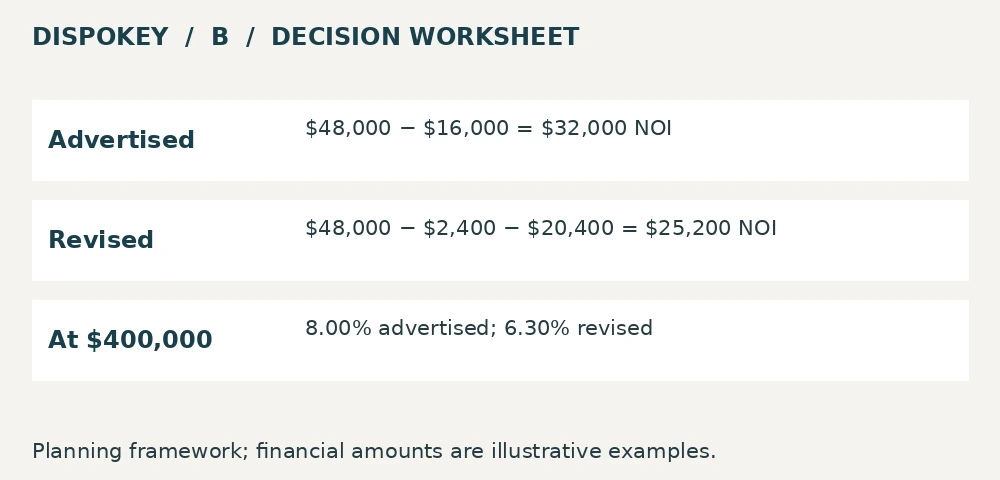
Illustrative assumptions, not an actual listing or forecast: the building is offered at $400,000. The advertised calculation uses $48,000 annual rent, $16,000 recurring expense and no vacancy allowance. Its NOI is $32,000 and the advertised cap rate is 8.00%. The arithmetic is correct for those inputs; the inputs still need verification.
In the revised scenario, a chosen 5% vacancy and credit-loss allowance is $2,400. Recurring expenses rise to $20,400 after review. Effective gross income is $45,600, NOI is $25,200 and cap rate at $400,000 is 6.30%. The difference is 1.70 percentage points, not proof that a transaction must lose money.
| Step | Decision |
|---|---|
| Advertised | $48,000 − $16,000 = $32,000 NOI |
| Revised | $48,000 − $2,400 − $20,400 = $25,200 NOI |
| At $400,000 | 8.00% advertised; 6.30% revised |
Check each expense adjustment against evidence
A higher expense estimate should have a reason: an insurance quote, tax information, service contract or recurring maintenance history. Owner self-management does not make management economically irrelevant for a buyer who plans to hire it. State the assumption rather than pretending the seller’s arrangement and your planned operation are identical.
Separate an estimate from a verified bill. If a post-sale tax amount is uncertain, identify the relevant official assessor information and retain the uncertainty instead of inserting a guessed rate as fact. If an insurance quote is incomplete, do not label it bound coverage. Cap-rate math cannot make unsupported expense inputs reliable.
Separate current and stabilized cases
A vacant or under-rented property can have both a current operating analysis and a stabilized scenario. Do not combine actual expenses with full future rent and describe the result as current yield. Show the period, supported rents, occupancy and costs for each case, plus the work and time required to reach stabilization.
An annual trailing statement may understate forward expenses if maintenance was deferred, while full asking rents may overstate current collections. Preserve the seller’s original statement, the reconciliation and the scenario assumptions. The rental cash-flow guide helps organize operations; this cap-rate workflow turns aligned NOI into a price comparison.
Connect inspection findings to the correct line
A recurring plumbing-service pattern may justify a higher annual repair allowance. A roof replacement is an immediate capital project requiring separate funding. A failing heating system can create both capital cost and temporary rent disruption. Record those effects separately so you do not hide major work inside a smooth annual expense percentage.
Illustrative inspection scenario: the example needs a $30,000 roof and $10,000 of transaction and other initial costs. At the $400,000 asking price, total acquisition-and-work cost is $440,000. The unchanged $25,200 NOI divided by $440,000 is 5.73%. Label this yield on total cost, not conventional cap rate at the asking price.
Reverse the formula for a price discussion
After choosing a comparison rate supported by relevant market evidence, divide verified NOI by that rate. In an illustrative 7% test, $25,200 divided by 0.07 indicates $360,000 before separately considering immediate work and other factors. Seven percent is an example input, not a recommended market benchmark or an appraisal conclusion.
At $360,000, adding the illustrative $30,000 roof and $10,000 initial costs yields $400,000 total cost. NOI divided by total cost is 6.30%, even though purchase-price cap rate is 7%. Avoid subtracting the same condition effect twice if the chosen valuation method already incorporates it. State exactly what the indicated price includes.
Review financing and cash reserves separately
Cap rate does not measure your mortgage burden. After the operating analysis, model principal and interest, closing cash and dedicated reserves. The CFPB Closing Disclosure explainer helps separate payments and cash to close for covered mortgages; business-purpose investment loans may use different disclosures. Request complete loan terms either way.
Compare cash-on-cash return for financing-sensitive annual cash yield and Buy & Hold strategy for the broader ownership decision. A property with an attractive operating yield may still leave inadequate cash after debt service. Capital reserves remain important even when shown below NOI rather than deducted inside it.
When DispoKey may not be your best option
Cap rate works best for income-producing properties with comparable income periods, expense definitions, condition and market context. It is weaker for construction-heavy projects or speculative future rent. For Fix & Flip, use resale value, rehabilitation, financing, holding and selling costs instead of relying on an imagined rental yield.
DispoKey supports Fix & Flip and Buy & Hold buyers. Explore buyer opportunities and apply for marketplace access. Team approval is required; approved credentials are delivered by call or email, never text. If financing contingencies are essential and incompatible with an opportunity, another purchase route may fit better. No calculation guarantees investment performance.
Key takeaways
- Make the decision from documented inputs, not a headline promise.
- Keep costs, timing and responsibilities visible.
- Recalculate when material facts change.
Frequently asked questions
Does cap rate include mortgage payments?
No. It measures operating income relative to price or value before financing. Analyze debt service in a separate cash-flow worksheet.
Is a higher cap rate always better?
No. Check vacancy, condition, income support and expense assumptions. A higher quoted percentage can reflect greater risk or incomplete inputs.
Should I use asking price or market value?
Use the denominator appropriate to your question and label it: asking price tests the advertised purchase, while an offer or market-value scenario answers a different question.