

Quick answer: Property management fees usually combine a monthly fee, often quoted as a percentage of collected rent, with separate charges for leasing, lease renewals and maintenance markups. Compare managers on total annual cost per door, not the headline rate. DispoKey Buy & Hold buyers should model these fees before making an offer, because they change cash flow and cap rate.
- List every fee in the management agreement, not just the monthly rate.
- Convert each fee to an annual cost per unit.
- Plug the total into your cash flow before you buy.
What property management fees include
A management fee pays a company to market vacancies, screen applicants, collect rent, coordinate repairs and handle tenant communication. The monthly fee is only one line; the agreement usually lists several others.
Common categories are the monthly management fee, a leasing or placement fee when a new tenant signs, a renewal fee, a maintenance coordination markup on vendor invoices, a setup fee, and sometimes vacancy or eviction coordination fees. Read the property management entry for the role itself. Fees are negotiable and vary by market and property type, so quote figures here are examples, not benchmarks.
Percentage of rent vs flat fee
A percentage fee rises and falls with collected rent, while a flat fee stays fixed. Ask whether the percentage applies to rent collected or rent due; collected rent is better for the owner when a tenant pays late or not at all.
Flat fees are easier to forecast and can favor higher-rent homes. Percentage fees align the manager's income with collections. Either way, the comparison that matters is total cost per door per year, including the leasing and renewal charges that a low monthly rate can hide.
Total annual cost: a worked example
Turning every fee into an annual number shows the real cost. Here is the calculation with labeled example terms from two hypothetical managers.
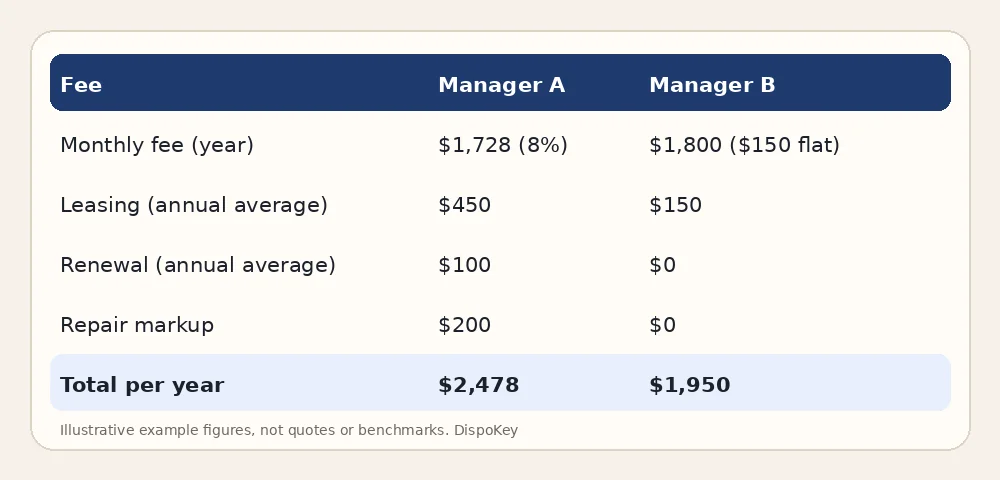
Illustrative only, for one house renting at $1,800 a month. Manager A charges 8% of collected rent, a leasing fee of 50% of one month's rent once every two years, a $200 renewal fee in the off year and a 10% markup on $2,000 of annual repairs. Year cost: $1,728 + $450 average leasing + $100 average renewal + $200 markup = $2,478. Manager B charges a $150 flat monthly fee, a $300 leasing fee every two years and no markup: $1,800 + $150 + $0 = $1,950. The lower headline rate is not always the lower bill.
| Fee | Manager A | Manager B |
|---|---|---|
| Monthly fee (year) | $1,728 (8%) | $1,800 ($150 flat) |
| Leasing (annual average) | $450 | $150 |
| Renewal (annual average) | $100 | $0 |
| Repair markup | $200 | $0 |
| Total per year | $2,478 | $1,950 |
How fees change cash flow and cap rate
Management fees are an operating expense, so they reduce net operating income and therefore cap rate and cash flow. Leave them out and every return looks better than it will be.
Using the example above, a $2,478 annual fee on $21,600 of gross rent is about 11.5% of rent once all charges are counted. Model that figure in your cash flow analysis and in the cap rate calculation, even if you plan to self-manage, so the deal still works if you later hire help. The net operating income entry explains what belongs above the debt line.
Check local rent levels before trusting a rent estimate
Fees are a share of rent, so a wrong rent estimate distorts both the fee and the return. Compare the projected rent with public benchmarks before you rely on it.
HUD Fair Market Rents publish annual estimates by metro area and unit size, which are useful as a cross-check. Local listings and a manager's rent survey add current detail. Our rent-to-value ratio by county guide shows how rent compares with price in different markets.Questions to ask before you sign
Ask for the full fee schedule in writing and the termination terms. A low fee with a costly exit clause can lock you in.
How do you screen tenants?
A manager should apply consistent written criteria and follow fair housing law. HUD's Fair Housing Act overview lists the protected classes, and the FTC's guide for landlords explains notice duties when a consumer report affects a decision. Our tenant screening guide covers the process.
What repair amount needs my approval?
Set a dollar limit above which the manager must call you, and ask whether vendor invoices carry a markup.
What reports will I receive?
Monthly owner statements, year-end summaries and access to invoices make tax time easier.
Are property management fees deductible?
Ordinary and necessary expenses of managing a rental are generally deductible against rental income. IRS Publication 527 describes rental expenses and how they are reported on Schedule E. Keep the manager's statements as your record, and confirm treatment of setup or leasing fees with your tax preparer.
Buyers looking for rentals can apply for vetted Buy & Hold deals through the buyer application; access is granted after team approval. City pages such as Columbus, Ohio show local rent context.
When DispoKey may not be your best option
If you need a financed purchase with long inspection and appraisal periods, an off-market cash deal may not fit your plan. Turnkey rentals with an existing manager in place may suit a buyer who wants no setup work. If you live near the property and have time for tenant calls, self-managing may save the fee entirely, as long as you budget for vacancy and repairs.
Key takeaways
- Compare managers on total annual cost per door.
- Ask whether percentage fees apply to collected or due rent.
- Model management fees even if you plan to self-manage.
Frequently asked questions
What is a typical property management fee?
It varies by market and property. Compare written quotes as total annual cost per unit rather than relying on a national average.
Do property managers charge when the unit is vacant?
Some do and some do not. Check the agreement for vacancy, setup and minimum monthly fees.
Is a leasing fee the same as a management fee?
No. A leasing fee is a one-time charge when a new tenant signs; the management fee is ongoing.
Are property management fees tax deductible?
Generally yes, as a rental expense reported on Schedule E. Confirm specific fees with your tax preparer.
Official references
- IRS Publication 527: Residential Rental Property
- HUD User: Fair Market Rents
- HUD: Fair Housing Act overview
- FTC: Using consumer reports, what landlords need to know