
Quick answer: Rental property tax deductions let landlords subtract ordinary and necessary rental expenses from rental income on Schedule E: mortgage interest, property taxes, insurance, repairs, management, utilities and depreciation over 27.5 years for residential buildings. Improvements are capitalized, not deducted at once. Passive loss rules may limit losses. DispoKey's approved buyers find off-market Buy & Hold rentals.
- Report rental income and expenses on Schedule E.
- Separate repairs from improvements.
- Keep receipts and mileage logs all year.
How rental property deductions work
The IRS lets you deduct the ordinary and necessary expenses of managing, conserving and maintaining a rental property. Most individual landlords report income and expenses on Schedule E, and the net result flows to their tax return.
Deductions do not reduce taxes dollar for dollar; they reduce taxable rental income. Keep records that show what you paid, when and why, because you will need them if the IRS asks. IRS Publication 527 is the main official guide for residential rentals, and Tax Topic 414 summarizes the basics.
What expenses can landlords deduct?
Common deductible rental expenses include:
- Mortgage interest on loans used to buy or improve the rental.
- Property taxes and local assessments for maintenance.
- Insurance premiums for the rental.
- Repairs and maintenance that keep the property in working condition.
- Management fees, advertising and tenant screening costs.
- Utilities you pay for the tenant.
- Legal and professional fees related to the rental.
- Travel to the property for rental business, with records.
See our property management fees guide for what managers usually charge.
Depreciation: the largest non-cash deduction
You cannot deduct the purchase price in one year, but you can depreciate the building, not the land. Residential rental buildings are generally depreciated over 27.5 years using the method in Publication 527.
Improvements are depreciated too, often over the same period. Depreciation lowers taxable income each year but is generally recaptured when you sell. Our guide to rental property depreciation walks through the math.
Repairs vs. improvements
A repair keeps the property in its normal working condition and can usually be deducted in the year you pay it. An improvement makes the property better, restores it or adapts it to a new use, and must be capitalized and depreciated.
Fixing a leak or replacing a broken window pane is usually a repair. A new roof, new HVAC system or a kitchen remodel is usually an improvement. The IRS tangible property rules also include a de minimis safe harbor that lets eligible taxpayers without an applicable financial statement deduct items costing up to $2,500 per invoice or item if they elect it.
Can rental losses offset other income?
Rental activities are generally passive, so losses may be limited. IRS Publication 925 explains a special allowance of up to $25,000 for taxpayers who actively participate, which phases out as modified adjusted gross income rises from $100,000 to $150,000.
Losses you cannot use are carried forward to future years. Real estate professionals who meet strict tests are treated differently. These rules are detailed, so read Publication 925 or use qualified tax software or a preparer.
Worked example: rental income after deductions
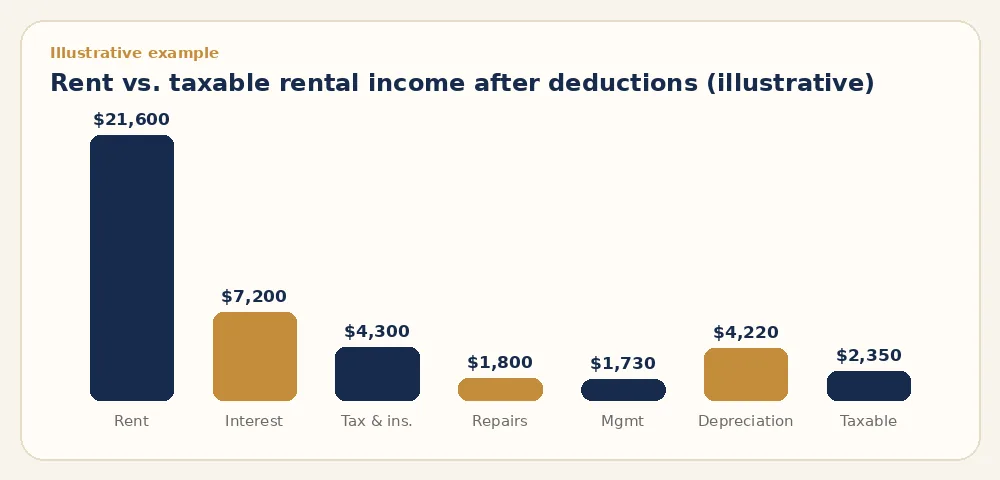
The illustrative example in this guide shows a rental with $21,600 in yearly rent. After interest, taxes, insurance, repairs, management and depreciation, taxable rental income falls to $2,350. The example numbers are labeled and simplified; your own return depends on your records.
| Yearly line (illustrative rental example) | Amount |
|---|---|
| Rent collected | $21,600 |
| Mortgage interest | -$7,200 |
| Property taxes and insurance | -$4,300 |
| Repairs and maintenance | -$1,800 |
| Management | -$1,730 |
| Depreciation | -$4,220 |
| Taxable rental income | $2,350 |
Records landlords should keep
Keep closing statements, receipts, invoices, bank statements, leases, mileage logs and depreciation schedules. Separate a business bank account makes tracking easier. Keep purchase records for as long as you own the property and for several years after you sell, since they determine basis and gain.
Deductions to plan for when you buy a rental
Your purchase sets up years of deductions, so plan them on day one.
- Split land and building: only the building is depreciated, so record a reasonable allocation, often supported by the county assessor's values.
- Capitalize settlement costs: many closing costs are added to basis rather than deducted at once, as Publication 527 explains.
- Track the rehab separately: improvements made before the rental is placed in service are added to basis.
- Note the placed-in-service date: depreciation starts when the property is ready and available for rent.
Good records from the start make tax time simple and support your numbers when you sell or refinance.
A year-end checklist for landlords
- Reconcile rent received against bank deposits.
- Sort expenses into Schedule E categories.
- Flag any large purchases as repairs or improvements.
- Update the depreciation schedule for new improvements.
- Collect Forms 1098 and 1099 you received.
- File Forms 1099 you owe to contractors, where required.
State and local taxes
Federal rules are only part of the picture. Many states tax rental income and follow federal depreciation rules with some differences, and some cities charge rental registration or business license fees. Check your state revenue department and city rules each year, and keep those fees with your rental expense records.
Finding Buy & Hold rentals through DispoKey
DispoKey's marketplace lists off-market Buy & Hold and Fix & Flip properties for approved cash buyers. Access requires team approval. Apply as a buyer to see deals in your markets.
When DispoKey may not be your best option
If you want a move-in-ready rental with a tenant in place and financing contingencies, a listed property may fit better. Our deals suit cash buyers comfortable with some work.
Key takeaways
- Ordinary and necessary rental expenses are deductible on Schedule E.
- Residential buildings are depreciated over 27.5 years.
- Improvements are capitalized; repairs are usually deducted.
- Passive loss rules may limit rental losses.
Frequently asked questions
What can I deduct on a rental property?
Mortgage interest, property taxes, insurance, repairs, management, utilities you pay and depreciation, among others.
Is a new roof a repair or an improvement?
Usually an improvement, so it is capitalized and depreciated rather than deducted at once.
What is the de minimis safe harbor?
An election that lets eligible taxpayers deduct items up to $2,500 per invoice or item under IRS tangible property rules.
Can rental losses offset my salary?
Possibly up to $25,000 if you actively participate, phasing out between $100,000 and $150,000 of modified AGI.