
Quick answer: Rental property depreciation lets you deduct the cost of a residential rental building, not the land, over 27.5 years under the IRS general depreciation system. Multiply the purchase price and eligible costs by the building share, divide by 27.5 and apply the mid-month rule in year one. DispoKey buyers use this to estimate after-tax cash flow on Buy & Hold deals.
- Separate land from building value; land is never depreciated.
- Start when the rental is placed in service, not when you bought it.
- Report on Form 4562 and Schedule E, and track it for the eventual sale.
What rental property depreciation is
Depreciation is an annual deduction that recovers the cost of a building that wears out over time. The IRS treats a residential rental building as property with a set recovery period, so you spread its cost across those years instead of deducting it all at purchase.
IRS Publication 527 explains that residential rental property placed in service after 1986 generally uses the Modified Accelerated Cost Recovery System, a 27.5-year recovery period and the straight-line method under the general depreciation system. The deduction reduces taxable rental income on paper even when no cash leaves your account, which is why it shapes after-tax returns. See the depreciation glossary entry for the short definition.What you can and cannot depreciate
You can depreciate the building and certain improvements; you cannot depreciate land. Land does not wear out, so its share of the purchase price stays in your basis until you sell.
Your starting basis usually includes the purchase price plus certain settlement costs, such as title fees and recording charges, as described in Publication 527. Improvements that add value or extend life, like a new roof, are depreciated separately once placed in service; routine repairs are generally deducted as expenses in the year paid. IRS Publication 946 covers how depreciable property is classified and when an asset is considered placed in service.
How to split land and building value
Use a reasonable, documented method to allocate the price between land and building. Many owners use the ratio from the county assessor's land and improvement values, then apply it to the actual purchase price.
Assessor records are public. The Cook County Assessor, the Harris Central Appraisal District and the Los Angeles County Assessor each publish land and improvement values by parcel. Keep a copy of the page you used. An appraisal that separates land value is another accepted source, and it may be more accurate where assessments lag the market.
Worked example: year-one and full-year deduction
Here is the calculation with labeled example numbers. The pattern is the same for any single-family rental or small multifamily building.
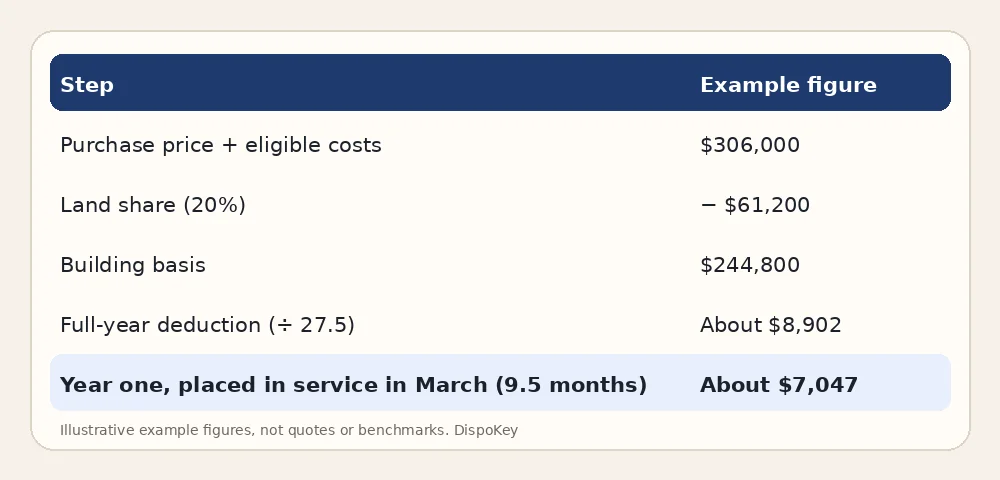
Illustrative only: you buy a duplex for $300,000 and pay $6,000 in eligible settlement costs, for a $306,000 basis. The assessor ratio puts land at 20%, so the building basis is $244,800. Dividing by 27.5 gives about $8,902 a year. You place the property in service in March. Under the mid-month convention, March counts as half a month, so year one covers 9.5 months: $8,902 × 9.5 ÷ 12 is about $7,047. Publication 527 includes a percentage table that produces the same result.
| Step | Example figure |
|---|---|
| Purchase price + eligible costs | $306,000 |
| Land share (20%) | − $61,200 |
| Building basis | $244,800 |
| Full-year deduction (÷ 27.5) | About $8,902 |
| Year one, placed in service in March (9.5 months) | About $7,047 |
Reporting depreciation and keeping records
Report the first-year deduction on Form 4562 and carry the total to Schedule E with your other rental income and expenses. After the first year, the yearly amount usually flows to Schedule E without a new Form 4562 unless you add property.
The IRS Schedule E page lists the current form and instructions. Keep the closing statement, the allocation evidence, improvement invoices and a running depreciation schedule. You will need them when you sell, because the deductions you were allowed reduce your adjusted basis.
What happens to depreciation when you sell
When you sell, depreciation you were allowed lowers your basis and raises your gain, and part of that gain can be taxed at a different rate than ordinary capital gain. Owners often call this depreciation recapture.
IRS Publication 544 explains how gain on the sale of business and rental property is figured and reported. A like-kind exchange can defer gain if the rules are met; our 1031 exchange timeline walks through the identification and closing windows. Ask your tax preparer how recapture applies to your facts before you price a sale.Using depreciation in deal analysis
Depreciation does not change cash flow; it changes the tax you owe on cash flow. Underwrite the deal on cash first, then estimate the tax effect as a second layer.
Start with net operating income and debt service using rental cash flow analysis, check the return with cash-on-cash return, then estimate how much rental income depreciation may shelter. Some owners order a cost segregation study to separate shorter-life components; weigh its fee against the benefit. Approved buyers can review vetted Buy & Hold deals after team approval through the buyer application.
When DispoKey may not be your best option
If you need a financed purchase with appraisal and financing contingencies, an off-market cash deal may not suit you. DispoKey deals are typically bought with cash or fast private funding, so a conventional loan timeline may not fit. If you have no taxable rental income to offset yet, or plan to sell within a year or two, the tax benefit may be smaller than projected, so weigh the deal on cash flow alone first.
Key takeaways
- Only the building and improvements are depreciated, never land.
- Residential rentals generally use 27.5 years, straight-line, mid-month.
- Allowed depreciation reduces basis and affects tax at sale.
Frequently asked questions
How many years do you depreciate a rental property?
Residential rental buildings generally use 27.5 years under the IRS general depreciation system.
Can you depreciate land?
No. Land does not wear out, so only the building and qualifying improvements are depreciable.
When does rental depreciation start?
When the property is placed in service, meaning it is ready and available to rent, not the purchase date.
Do I have to take depreciation?
The IRS reduces your basis by depreciation allowed or allowable, so skipping it can still raise your taxable gain at sale.
Official references
- IRS Publication 527: Residential Rental Property
- IRS Publication 946: How to Depreciate Property
- IRS: About Schedule E (Form 1040)
- IRS Publication 544: Sales and Other Dispositions of Assets