

Quick answer: Calculate cash on cash return by dividing annual pre-tax cash flow after debt service by cash invested, then multiplying by 100. DispoKey buyers should reconcile closing costs, initial work and starting reserves before comparing loans. Label reserve-adjusted results separately, and keep appreciation and future sale proceeds outside this annual cash-yield calculation.
- Gather the records before committing money or dates.
- Separate verified facts from planning assumptions.
- Write down the next action, its owner and the review date.
Start with a cash-investment checklist
Collect the purchase price, proposed loan amount, itemized closing estimate, contractor scope and starting reserve budget. Then collect leases, operating expenses, vacancy assumptions and written loan terms. A complete denominator matters as much as the rental forecast: leaving out closing costs makes the same property appear to earn more without changing its actual cash generation.
Use the rental cash-flow guide to build operations first. This article focuses on reconciling cash committed and comparing financing. The cash-on-cash definition supplies terminology; the workflow here is the document-to-worksheet audit that makes a percentage reproducible.
Build the cash-invested ledger
For this acquisition comparison, include down payment, buyer-paid transaction costs, initial improvements and dedicated starting reserves. Label the reserve convention explicitly. Do not include every dollar in your personal savings merely because a lender asks to see it. Available liquidity and cash deliberately committed to this property are related but different questions.
Reconcile earnest money to the closing estimate. If the deposit is credited against cash to close, adding it again can double count it. Check lender and seller credits, prepaid amounts and any cash already spent on initial work. Keep each line tied to a document and note whether the amount is quoted, paid or still assumed.
A refundable tenant deposit is not freely distributable investor income. IRS Publication 527 distinguishes deposits intended to be returned from amounts retained under relevant conditions. Keep deposit treatment and obligations separate from acquisition equity and ordinary rent. Tax rules do not define this worksheet’s investment denominator; they explain a different accounting question. Publication 527 provides the official tax guidance.
Subtract debt service once
Begin with operating net operating income, then subtract annual mortgage principal and interest to obtain pre-tax cash flow. If taxes and insurance already appear as operating expenses, do not subtract them again through an escrow-inclusive payment. Split the payment into principal, interest and escrow before using it in the worksheet.
Replacement-reserve contributions are shown below operating NOI in this article. A reserve-adjusted cash yield deducts planned additional funding before division. Some worksheets use different conventions, so label both inputs rather than calling two unlike results the same metric. An opening reserve account belongs to committed acquisition cash here; additional annual funding is a separate line.
Worked example: reconcile the full denominator
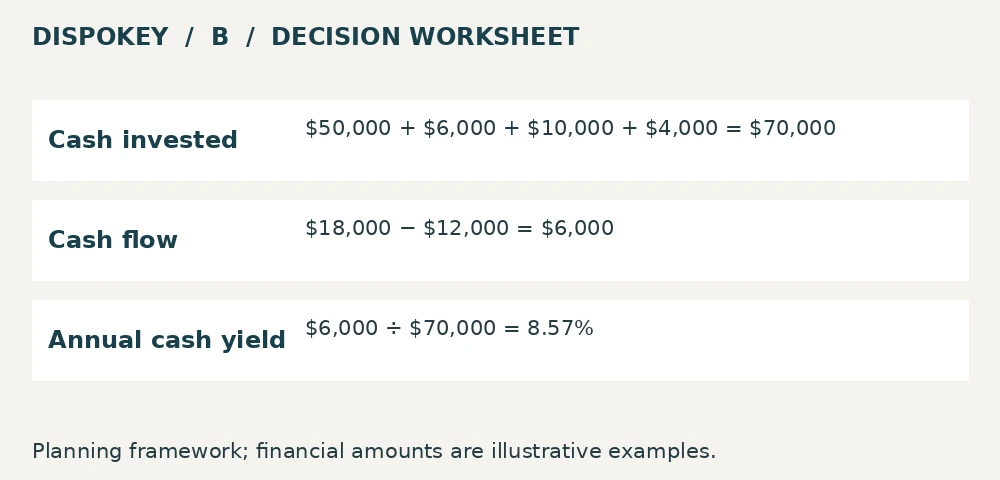
Illustrative assumptions, not a property listing, lender quote or projected result: purchase price is $200,000, down payment $50,000, buyer-paid costs $6,000, initial work $10,000 and dedicated opening reserves $4,000. Total committed cash is $70,000. Annual operating NOI is assumed at $18,000 and principal-and-interest payments at $12,000.
Standard annual pre-tax cash flow is $18,000 minus $12,000, or $6,000. Divide $6,000 by $70,000 and multiply by 100: 8.57%. If you omit the $20,000 beyond the down payment, the worksheet would show 12%. That difference is a missing-input effect, not an improvement in the rental.
| Step | Decision |
|---|---|
| Cash invested | $50,000 + $6,000 + $10,000 + $4,000 = $70,000 |
| Cash flow | $18,000 − $12,000 = $6,000 |
| Annual cash yield | $6,000 ÷ $70,000 = 8.57% |
Show reserve-adjusted cash yield separately
Assume the example also needs $1,800 of additional annual replacement funding. Reserve-adjusted cash flow becomes $4,200, and $4,200 divided by $70,000 is 6.00%. Show the standard 8.57% and reserve-adjusted 6.00% beside each other with their conventions. The extra reserve is a liquidity planning choice, not a claimed universal requirement.
When reconciling actual results, do not subtract the same roof expenditure and the reserve-funded payment twice. State whether the numerator represents operating cash after reserve contributions or actual cash after capital spending. Neither label should silently turn a major replacement into a recurring operating expense. A comparison is useful only when another reader can follow the treatment.
Compare financing with unchanged property inputs
Illustrative second package: committed cash rises to $80,000 while annual debt service falls to $10,800. Keeping NOI and annual replacement funding unchanged gives $18,000 minus $10,800 minus $1,800, or $5,400 of reserve-adjusted cash flow. Dividing by $80,000 produces 6.75%. More cash remains annually, but more capital is tied up initially.
Do not select a loan from that percentage alone. Compare liquidity after closing, payment changes, maturity, balloon terms, fees and any prepayment provisions. The CFPB Closing Disclosure explainer separates loan payments and cash to close for covered mortgages. Business-purpose loans may use different documents; request an itemized equivalent rather than assuming every investment loan uses the same form.
Stress-test the numerator
Reduce the first scenario’s NOI by $2,400 while leaving committed cash and debt service unchanged. Reserve-adjusted cash flow falls from $4,200 to $1,800, and the yield becomes 2.57%. This is sensitivity arithmetic, not a probability forecast. A small rent or expense change can have an outsized effect when debt service consumes most operating income.
Test one downside at a time: lower collected rent, higher recurring expense or a temporary vacancy. Then test a combined case if useful. Keep the base scenario intact so you can see what changed. Avoid compensating for a weak downside by assuming appreciation or a successful refinance; those uncertain events are outside annual cash yield.
Keep tax profit and total return separate
Cash-on-cash return is not taxable rental profit. IRS rental guidance discusses depreciation, repairs and improvements under tax rules. Depreciation may affect taxable income without a current cash payment, and some improvements receive different treatment from repairs. Do not import the tax-return bottom line into the cash-flow numerator without understanding those distinctions. IRS Topic 414 covers rental reporting.
Annual cash yield also excludes appreciation, sale proceeds and equity created by principal repayment. A property can have modest cash yield and a different total-return profile, or a high quoted percentage with fragile liquidity. For a Fix & Flip project, use project costs and holding-period profit rather than presenting short-term resale proceeds as annual rental income.
When DispoKey may not be your best option
This metric fits Buy & Hold financing comparisons with supportable operating income. It is less informative during major construction, before stabilization or after refinancing changes the cash denominator. If you need financing contingencies that do not fit an opportunity, another purchase channel may be better. A calculated percentage does not guarantee returns.
DispoKey supports Fix & Flip and Buy & Hold. Review buyer opportunities or apply for access; team approval is required and credentials arrive by call or email, never text. Compare the Buy & Hold strategy guide and your own documented worksheet before committing.
Key takeaways
- Make the decision from documented inputs, not a headline promise.
- Keep costs, timing and responsibilities visible.
- Recalculate when material facts change.
Frequently asked questions
Is cash-on-cash return the same as ROI?
No. It measures annual cash yield on committed cash under a stated convention, not appreciation, sale proceeds or a complete lifetime return.
Should closing costs be included?
Include buyer-paid acquisition costs and reconcile deposits and credits. State whether dedicated opening reserves are included so another buyer can reproduce the result.
Can cash-on-cash return be negative?
Yes. When annual cash outflows exceed inflows, the numerator is negative and additional capital may be needed.