
Quick answer: Buy and hold real estate means buying a property, renting it out and keeping it for years so rent covers costs while the loan is paid down and value grows. A workable deal usually shows positive cash flow after a 5–10% vacancy reserve and 8–12% for repairs. DispoKey's Buy & Hold buyers see off-market rentals after team approval.
- Return comes from four sources: cash flow, loan paydown, appreciation and tax treatment.
- Underwrite with conservative rent, vacancy and repair figures.
- BRRRR is a Buy & Hold method that recycles your cash with a refinance.
- Your purchase price is the one number you control most.
Buy and hold is the slow, durable side of real estate investing. Instead of earning once on a resale, you earn every month and every year you own the property. This guide explains how the strategy makes money, how to underwrite a rental with labeled example numbers, and how to decide whether a deal belongs in a long-term portfolio. It builds on rental property cash flow analysis and the buy and hold definition.
How does a buy and hold strategy make money?
A rental produces return in four ways at once, and a good deal works even if only the first two show up. Treat appreciation as a bonus, never as the reason a deal works.
What is rental cash flow?
Cash flow is rent collected minus every operating cost and the loan payment. It is the return you can spend, and the cushion that keeps you solvent through vacancies and repairs.
How does loan paydown build equity?
Each mortgage payment the tenant's rent covers reduces your principal balance. Over a 30-year loan, the paydown accelerates in later years, so long holds compound this return.
Should you count on appreciation?
No. Appreciation varies widely by market and decade. The FHFA House Price Index lets you check how a state or metro has actually moved over time, which is a better guide than a seller's projection. [3]
How are rental properties taxed?
Rental income is taxable, but you can deduct ordinary expenses and depreciate the building. IRS Publication 527 explains rental income and expenses, and IRS Publication 946 sets the recovery period for residential rental property at 27.5 years under the general depreciation system. [1] [2] Land is not depreciable.
How do you underwrite a buy and hold rental?
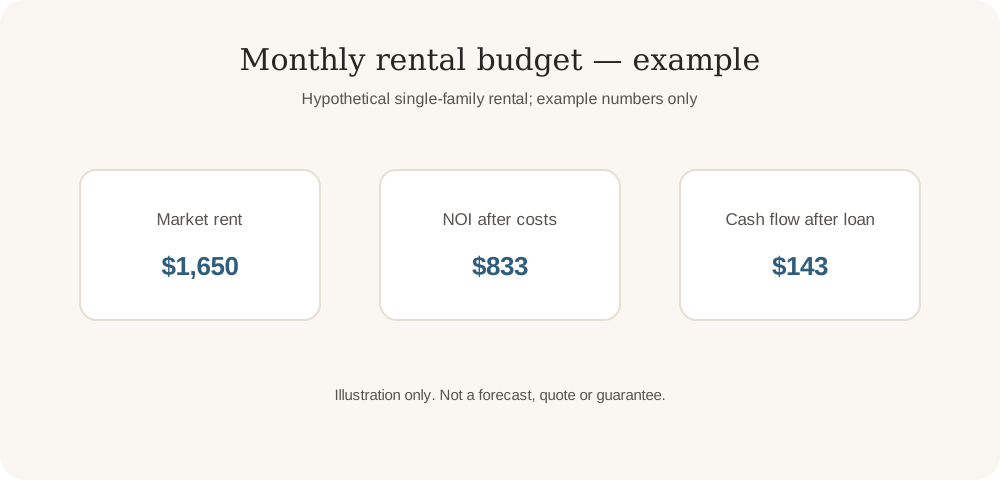
Underwriting means building a realistic yearly budget before you offer. Start with market rent, subtract every expense with reserves, and only then subtract the loan payment.
| Step | Action | Example (labeled) |
|---|---|---|
| 1 | Set market rent from comparable rentals | $1,650 per month |
| 2 | Subtract vacancy reserve (8%) | −$132 |
| 3 | Subtract repairs and capital reserve (10%) | −$165 |
| 4 | Subtract taxes, insurance, management | −$520 |
| 5 | Net operating income (NOI) | $833 per month |
| 6 | Subtract loan payment | −$690 → $143 monthly cash flow |
How do you estimate market rent?
Use current comparable rentals of the same size and condition nearby, then cross-check against HUD Fair Market Rents, which HUD publishes every year by metro area and bedroom count. [4] If your rent assumption sits far above the FMR, you need strong evidence. Our county rent-to-value study shows how rent compares with price.
Why include vacancy and repair reserves?
Every rental eventually sits empty and needs a roof, a water heater or a furnace. Budgeting reserves monthly — even when nothing breaks — turns those surprises into planned costs instead of emergencies.
Which metrics matter for buy and hold?
Three numbers tell most of the story. Use them together; any one alone can mislead.
| Metric | Formula | Example (labeled) |
|---|---|---|
| Cap rate | Annual NOI ÷ purchase price | $9,996 ÷ $165,000 = 6.1% |
| Cash-on-cash return | Annual cash flow ÷ cash invested | $1,716 ÷ $45,000 = 3.8% |
| DSCR | NOI ÷ annual debt payment | $9,996 ÷ $8,280 = 1.21 |
Many DSCR lenders look for a ratio around 1.2 or higher, so this example sits near the edge. Learn the definitions in the cap rate and DSCR glossary entries.
How does BRRRR fit into buy and hold?
BRRRR — buy, rehab, rent, refinance, repeat — is a Buy & Hold method, not a separate strategy. You buy a property that needs work below market, renovate it, place a tenant, then refinance based on the new value to pull out much of your cash for the next deal.
What is the main risk with BRRRR?
The refinance appraisal. If the after-repair value comes in low, less cash comes back and your money stays trapped. Size the deal so it still works as a plain rental if the refinance disappoints. How to calculate ARV covers the valuation side, and delayed financing explains one refinance route.
Where do buy and hold investors find deals?
Margins in buy and hold come from the purchase price, so off-market sourcing matters. Properties bought below retail start with equity and better cash flow than the same house bought at full price on the open market.
DispoKey's buyer network sends off-market properties to approved Buy & Hold buyers. Access requires team approval, and you review each property and its numbers yourself before making any decision. Explore markets through the state and city buyer pages or apply to join.
What mistakes sink buy and hold investors?
Most failed rentals fail on underwriting, not on bad luck. These four mistakes show up again and again, and every one is avoidable before you sign.
- Using asking rent instead of achieved rent. Listing sites show what landlords hope for; signed leases show what tenants pay.
- Skipping capital reserves. A $9,000 roof with no reserve can erase three years of cash flow in the example above.
- Ignoring property tax reassessment. Many counties reassess after a sale, so budget taxes on your purchase price, not the seller's bill.
- Self-managing without counting your time. Even if you manage yourself, budget a management fee so the deal still works if you hire help later.
When DispoKey may not be your best option
If you need financing contingencies, a long due-diligence window or a move-in-ready retail listing, off-market deals may not suit you; many sellers here expect a cash-ready buyer with a firm timeline. If you are buying your first rental with a low-down-payment owner-occupant loan, a traditional purchase may be the better fit.
Key takeaways
- Buy and hold earns through cash flow, paydown, appreciation and tax treatment.
- Underwrite with vacancy and repair reserves before the loan payment.
- Check rent against comparable rentals and HUD Fair Market Rents.
- Use cap rate, cash-on-cash return and DSCR together.
- BRRRR is a Buy & Hold method; size it to survive a low appraisal.
Frequently asked questions
What is a buy and hold real estate strategy?
It is buying a property to rent out and keep for years, earning from monthly cash flow, loan paydown and long-term value growth rather than a quick resale.
Is buy and hold a good strategy?
It can be when the purchase price supports positive cash flow after realistic reserves. It is slower than flipping and depends on steady management, so it suits patient investors.
How long should you hold a rental property?
There is no fixed rule. Many investors hold five years or longer so loan paydown and any appreciation outweigh purchase and sale costs.
Is BRRRR the same as buy and hold?
BRRRR is a Buy & Hold method. It adds a rehab and refinance step to recycle cash, but the end result is a long-term rental.
Related reading
- How to qualify for a DSCR loan
- Screen tenants with written, fair criteria
- Trading up rentals: the 1031 exchange timeline
- How to Calculate Cash on Cash Return: Rental Math
- Rental Property Depreciation: 27.5-Year Guide
- House Hacking: Live in One Unit, Rent the Rest
- How to Buy a Duplex as an Investment Property
- BRRRR Method: Buy, Rehab, Rent, Refinance, Repeat
- Rental Property Tax Deductions Landlords Should Know
- Turnkey Rental Property: How to Vet a Finished Deal