Quick answer: Rental property cash flow analysis means taking market rent, subtracting a vacancy allowance, operating expenses, capital reserves and the loan payment to see what truly stays in your pocket each month. A deal that looks like $500 a month on rent minus mortgage often shrinks to $100 once repairs, capex and management are counted. DispoKey buy-and-hold buyers run this before every offer.
Most rental mistakes happen in a spreadsheet, not at the property. Someone estimates rent at the high end, forgets that a roof eventually needs replacing, leaves management out because they plan to self-manage, and then wonders why the account never grows. A disciplined cash flow analysis is the single most protective habit a buy-and-hold investor can build.
Step 1: Estimate market rent honestly
Use real comparables: similar homes with the same bedroom count and condition, rented in the last six months, within a mile. Listing sites show asking rents, not signed rents, so lean conservative. HUD Fair Market Rents and Census ACS median gross rent give a useful sanity check for the area, though they lag the market and do not reflect condition.
Step 2: Subtract vacancy and credit loss
No rental is occupied 100% of the time. Budget for turnover time and for tenants who stop paying. Many investors use 5% to 10% of gross rent depending on the market and the property's tenant base. A property with long-term tenants and strong demand can justify the low end; a property in a soft rental market needs the high end.
Step 3: List every operating expense
| Line item | How to estimate (examples) | Why it gets missed |
|---|---|---|
| Property taxes | Actual bill from the county, adjusted for reassessment after sale | Reassessment can raise taxes after purchase |
| Insurance | Landlord policy quote, not owner-occupied | Landlord policies cost more |
| Repairs and maintenance | 5%-10% of rent | Small repairs feel random until they add up |
| Capital expenditures | 5%-10% of rent for roof, HVAC, water heater | Big items are rare but certain |
| Property management | 8%-10% of rent plus leasing fees | Skipped by self-managers |
| Utilities and services | Water, trash, lawn if owner-paid | Varies by city and lease |
| HOA, if any | Actual dues | Special assessments |
Why capital reserves matter most
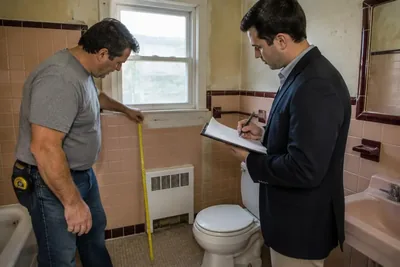
A roof, furnace or water heater does not fail every year, so it is easy to leave out. But a $12,000 roof on a house you hold for 10 years is $100 a month whether you save for it or not. Estimate the remaining life of each major system during the walkthrough and budget reserves accordingly.
Step 4: Calculate net operating income
Gross rent minus vacancy minus operating expenses equals net operating income, or NOI. NOI excludes the mortgage, so it lets you compare properties regardless of financing. Dividing annual NOI by price gives the cap rate, a quick way to compare deals in the same market.
Step 5: Subtract debt service
Subtract the monthly principal and interest payment. If you plan to buy with cash or hard money and refinance later, run the numbers at the expected refinance rate and loan amount, not only the purchase loan. A deal that works only at today's hard money terms is not a long-term hold.
Worked example (illustrative numbers)
A three-bedroom off-market house, $165,000 purchase after a $20,000 rehab, renting for $1,650 a month. These are labeled example figures, not a forecast.
- Gross rent: $1,650. Vacancy at 7%: minus $116. Effective rent: $1,534.
- Taxes $210, insurance $110, repairs 8% ($132), capex 8% ($132), management 9% ($149), lawn and water $40. Total operating expenses: $773.
- NOI: $761 per month, $9,132 a year, a cap rate of about 5.5% on the all-in $165,000.
- Loan: 75% of $165,000 ($123,750) at 7.25% for 30 years is about $844 per month.
- Cash flow: $761 minus $844 = negative $83 per month.
The rent-minus-mortgage view showed $806. The full analysis shows a monthly loss at this price and leverage. To make it work, you would need a lower price, less leverage, higher rent or a different property. This is why the analysis has to happen before the offer. Our buy and hold calculators run these lines side by side.
Returns to track beyond cash flow
- Cash-on-cash return: annual cash flow divided by the cash you invested.
- Debt service coverage ratio: NOI divided by debt payments; lenders often want 1.2 or higher on investment loans.
- Depreciation: residential rental buildings are generally depreciated over 27.5 years under IRS Publication 946, which can reduce taxable income but is recaptured at sale.
- Equity growth: loan paydown and appreciation build wealth but do not pay the bills.
Stress-test the deal before you offer
A single cash flow number assumes everything goes to plan. Run three versions instead. In the base case, use your best estimates. In the soft case, lower rent by 5%, raise vacancy to 10% and add a reassessed property tax bill. In the hard case, add a major repair in year one, such as a $7,000 HVAC replacement, and a two-month vacancy. If the soft case is still positive and you have reserves to survive the hard case, the deal is sturdy. If only the base case works, you are betting on everything going right.
How much to hold in reserve
Many investors keep three to six months of total expenses per property in cash, plus the capital reserves built into the monthly budget. Reserves are what keep a temporary vacancy from becoming a forced sale. Lenders on investment loans may also require reserves, so check before closing.
Finally, check insurance and taxes with real quotes, not estimates from the listing. Landlord policies in storm-prone areas have risen sharply, and a reassessment after sale can raise taxes far above the seller's bill.
When DispoKey may not be your best option
DispoKey deals are off-market and sold as-is without financing contingencies. If you need a contingency or want a turnkey home with tenants and a property manager already in place, a turnkey provider or a listed property may suit you better. If you want value-add rentals with room to force equity, apply for marketplace access; approval is reviewed by our team.
Key takeaways
- Use signed-rent comparables and lean conservative.
- Always include vacancy, repairs, capex and management.
- NOI excludes the mortgage; cash flow does not.
- Run the numbers at the long-term loan, not the short-term one.
- If the full analysis is negative, change the price or pass.
Looking for value-add rentals? Apply to join the DispoKey buyer network, browse markets we cover, or read how to estimate rehab costs and how hard money loans work.
Related reading
- How to qualify for a DSCR loan on this rental
- Lead paint disclosure checklist for pre-1978 rentals
- See how county rents compare with home values before you underwrite
- Size a delayed financing refinance before you buy
- Buy and hold real estate strategy explained
- Protect cash flow with a tenant screening scorecard
- Meet the 45 and 180 day 1031 exchange deadlines
- How to Calculate Cash on Cash Return: Rental Math
- How to Calculate Cap Rate: Verify Rental NOI
- Property Management Fees: True Annual Cost
- How Much Rent Can I Charge? Price a Rental Right
- House Hacking: Live in One Unit, Rent the Rest
- How to Buy a Duplex as an Investment Property
- Turnkey Rental Property: How to Vet a Finished Deal