
Quick answer: To decide how much rent you can charge, pull 3 to 5 comparable rentals within about a mile, adjust for size, condition and amenities, and check the result against HUD Fair Market Rents and Census median rent. Price where the unit leases within about 30 days. DispoKey buyers run this before buying off-market Buy & Hold homes so the offer matches real rent.
- Comparable active and recently leased rentals nearby.
- HUD Fair Market Rent for the bedroom count and area.
- A vacancy test: one extra month empty can erase a higher rent.
Start with comparable rentals
Comparable rentals are the most reliable way to price rent. Find three to five homes with the same bedroom count, similar size and condition, ideally within a mile and leased or listed in the last 60 to 90 days.
Record the asking rent, days on market, size, bathrooms, parking, laundry, pet policy and who pays utilities. Listings that sit for weeks tell you where the ceiling is; units that lease in days tell you the market would bear more.
Adjust for differences
Adjust each comp toward your unit rather than averaging raw numbers. A garage, in-unit laundry or a fenced yard typically supports a higher rent, while an older kitchen or no central air pulls it down. Write each adjustment next to the comp so you can explain the number to a lender or partner.
Check against official rent data
Official data will not price your unit, but it catches a number that is far off the market. Use two free federal sources.
- HUD Fair Market Rents. HUD publishes Fair Market Rents every fiscal year by metro area or county and bedroom count. They are set for the voucher program and are often near the 40th percentile of local gross rents, so a market-rate unit in good condition may rent above them.
- Census American Community Survey. ACS 5-year data reports median gross rent by county, city and ZIP Code Tabulation Area. It lags the market, but it shows how your area compares with the metro.
Our rent-to-value study by county combines HUD rents with Census home values for the largest counties if you want a broader view before you buy.
Run the vacancy test
The right rent is the highest rent that still leases quickly, because vacancy costs more than a modest discount. One empty month on a $1,800 rental costs $1,800, which is the same as charging $150 less for a full year.
| Asking rent (example) | Expected vacancy | Months rented | Rent collected in year |
|---|---|---|---|
| $1,700 | 2 weeks | 11.5 | $19,550 |
| $1,800 | 1 month | 11 | $19,800 |
| $1,950 | 2.5 months | 9.5 | $18,525 |
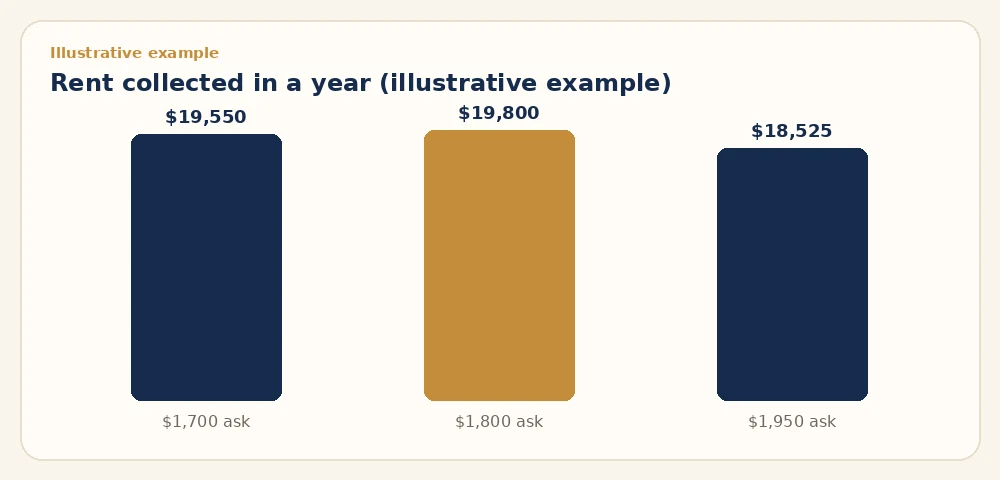
In this illustrative example, $1,800 collects the most over the year even though $1,950 looks better on paper. Use your own comps' days on market to estimate vacancy at each price.
Factor in what the tenant pays
Rent is only comparable when the cost to the tenant is comparable. If your comps include water and trash but your lease does not, a tenant compares the total monthly cost. HUD's Fair Market Rents are gross rents, meaning shelter rent plus tenant-paid utilities, so subtract an estimated utility amount before comparing.
Write down the final number and the comps behind it. That record helps you explain the rent to a lender, defend it to a partner and repeat the process quickly on the next unit.
Know the rules that limit pricing
A few rules shape what and how you can charge. Some states and cities limit rent increases on existing tenants or require advance written notice, so check your state landlord-tenant law and local ordinances before raising rent.
Advertising must also follow fair housing law: federal rules at 24 CFR 100.75 bar ads that indicate a preference or limitation based on a protected class. HUD's fair housing office explains the protected classes and how to file or avoid complaints. State and local laws may add more protected classes, such as source of income.
Turn the rent into a buying decision
For a Buy & Hold investor, the rent estimate sets the purchase price. Plug a conservative rent into your cash flow analysis, then check cap rate and cash-on-cash return. If you plan to hire help, subtract property management fees before deciding.
DispoKey shows approved buyers off-market homes in the marketplace. Apply as a cash buyer, and see city pages such as off-market properties in Houston for local context. Marketplace access requires team approval.
Revisit the rent at every renewal
Rent is not set once. Pull fresh comps 60 to 90 days before each lease ends, check the new year's HUD Fair Market Rent when it is published, and weigh a small increase against the cost of turnover. A good tenant who renews at a slightly lower rent often nets more than a vacant month, a repaint and new carpet.
When DispoKey may not be your best option
If you need a financing contingency and a long due-diligence period to confirm rents, a listed purchase may suit you better. Our off-market deals fit buyers who can price rent and repairs quickly and close on a firm timeline.
Key takeaways
- Price from three to five adjusted comps leased in the last 60 to 90 days.
- Check the number against HUD Fair Market Rents and Census median gross rent.
- Run the vacancy test; a month empty usually costs more than a small discount.
- Follow rent-increase notice rules and fair housing advertising rules.
Frequently asked questions
How do I figure out how much rent to charge?
Compare three to five similar rentals nearby, adjust for size, condition and amenities, and confirm the result against HUD Fair Market Rents and Census median rent.
Is the 1% rule a good way to set rent?
No. It is a rough screen for purchase price, not a rent-setting method. Real comparable rentals decide what a tenant will pay.
Can I charge more than Fair Market Rent?
For market-rate tenants, yes, if comparable units support it. Voucher units follow the housing agency's payment standards and rent reasonableness review.
How much can I raise rent each year?
It depends on your state and city. Some limit increases or require longer notice, so check local landlord-tenant law before raising rent.
Official references
- HUD User: Fair Market Rents
- U.S. Census Bureau: American Community Survey 5-year data
- HUD: Office of Fair Housing and Equal Opportunity
- U.S. Census Bureau: Housing Vacancies and Homeownership