

Quick answer: To screen tenants, publish written criteria first, then apply them to every applicant in the same order: identity, income (often about 3x rent), rental history, and a consumer report used under the FCRA. Treat everyone the same under the Fair Housing Act. DispoKey buyers who hold rentals use a one-page scorecard like the one below.
- Write criteria before you list the unit.
- Screen applicants in the order applications arrive.
- Verify income and landlord references directly.
- Send an adverse action notice when a report drives a denial.
Screening is where a buy and hold deal keeps or loses its numbers. One turnover with an eviction can wipe out a year of cash flow, so a fair, repeatable process matters as much as the purchase price. This guide sits with our buy and hold strategy guide and the cash flow analysis; if you buy a house that is already leased, read buying tenant-occupied property first.
Why should you write screening criteria before listing?
Written criteria make every decision consistent and explainable. They protect you from accidental discrimination claims and from talking yourself into a weak applicant.
What should screening criteria include?
Keep it to measurable items you apply to everyone: minimum income relative to rent, verifiable rental history, no unpaid judgments owed to a prior landlord within a stated period, maximum occupancy under local code, and a complete application. Post the list with the listing and hand it to every applicant.
What does the Fair Housing Act require?
HUD explains that the Fair Housing Act prohibits discrimination in housing because of race, color, national origin, religion, sex, familial status or disability. [1] Many states and cities add more protected classes, such as source of income, so check your state agency before finalizing criteria.
How to screen tenants step by step
Run the same five steps, in the same order, for every complete application. Order matters: it keeps the first qualified applicant first.
| Step | What you check | Evidence |
|---|---|---|
| 1. Application | Complete, signed, fee paid | Dated application |
| 2. Identity | Name matches ID | Photo ID |
| 3. Income | Meets your stated ratio | Pay stubs, offer letter, bank statements |
| 4. Rental history | Paid on time, left in good standing | Calls to prior landlords |
| 5. Consumer report | Credit, eviction and criminal records under the FCRA | Screening company report |
How do you verify a tenant's income?
Ask for two recent pay stubs or an offer letter, and for self-employed applicants, recent bank statements or tax returns. Call the employer using a number you look up yourself, not the one on the stub. A common example ratio is gross monthly income of about 3x rent; whatever ratio you choose, apply it to everyone.
How do you check rental history?
Call the previous two landlords, not just the current one; a current landlord who wants a problem tenant gone may give a glowing reference. Ask the same questions each time: rent paid on time, notice given, any damage beyond normal wear, would you rent to them again.
What rules apply to tenant background checks?
The FTC states that tenant background check reports are consumer reports, so landlords who use them must comply with the Fair Credit Reporting Act. [2] If you deny an application, require a co-signer or charge a higher deposit because of a report, you must give the applicant an adverse action notice naming the screening company and telling them they can get a free copy and dispute errors. [3]
Worked example: a simple tenant scorecard
A scorecard turns your criteria into a pass or fail record you can file with each application. The numbers below are an example for a $1,600-a-month rental.
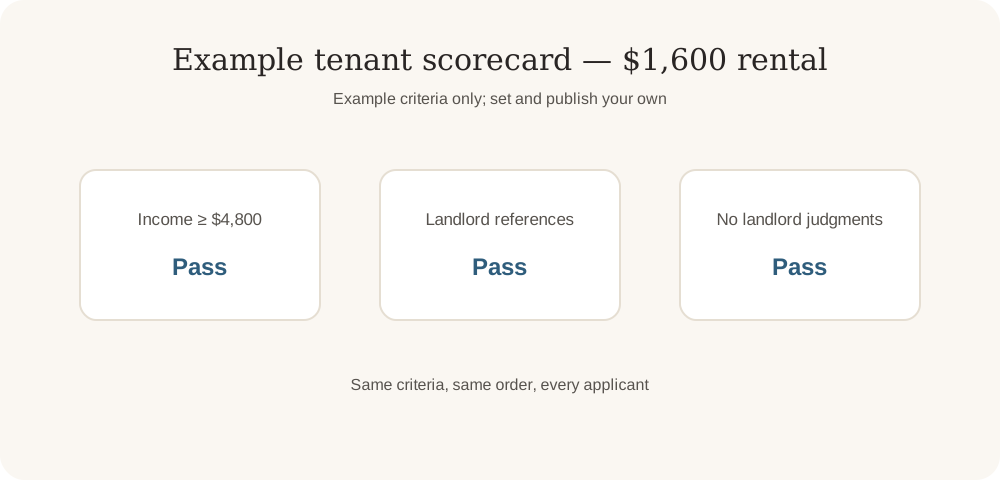
| Criterion (example) | Applicant | Result |
|---|---|---|
| Income ≥ 3x rent ($4,800) | $5,100 verified | Pass |
| Two landlord references | Two, on time | Pass |
| No unpaid landlord judgments | None in report | Pass |
Because every criterion was published first, an approval or denial here is easy to explain and easy to defend. Keep the scorecard with the application for your records.
What are the red flags when screening tenants?
Red flags are facts you can verify, not impressions. Focus on gaps between what the applicant says and what the evidence shows.
- Pay stubs that do not match the employer's phone verification.
- A current landlord who will not confirm dates or rent amount.
- Pressure to skip the application and move in this week with cash.
- Unpaid judgments owed to a prior landlord.
Why should you document every decision?
A dated record of each application, the evidence you checked and the result lets you show that every applicant met the same standard. Keep denied files as long as your state requires, and never write notes about anything unrelated to your published criteria.
What happens after you approve a tenant?
Sign the lease, collect the deposit and first month in certified funds, and complete a move-in condition report with dated photos. For pre-1978 homes, provide the federal lead disclosure; our lead paint disclosure guide lists what to hand over.
When DispoKey may not be your best option
If you need financing with appraisal and inspection contingencies, or you want a turnkey rental with a tenant and manager already in place, a retail listing or a turnkey provider may suit you better. DispoKey's off-market deals fit buy and hold investors who buy with cash or fast private money and are comfortable placing tenants themselves after a renovation.
Where can you find off-market rentals to hold?
Approved buyers get vetted off-market properties sent by city. Apply as a buyer; the team reviews every application and sends credentials by call or email. Browse Houston buy and hold deals or check numbers with the buy and hold definition.
Key takeaways
- Publish written criteria before you list.
- Screen in order and verify income and landlords yourself.
- Follow the Fair Housing Act and send FCRA adverse action notices.
- File a scorecard with every application.
Frequently asked questions
What is the best way to screen tenants?
Publish written criteria, then apply them in the same order to every complete application: identity, income, rental history and a consumer report used under the FCRA.
What income should a tenant have?
Many landlords use gross monthly income of about three times rent as an example standard. Whatever ratio you pick, write it down and apply it to everyone.
Do landlords have to tell applicants why they were denied?
If a consumer report contributed to the denial, the FCRA requires an adverse action notice naming the screening company and explaining the applicant's right to a free copy and to dispute errors.
Can a landlord refuse a tenant with no rental history?
You can set criteria, but apply them consistently. Many landlords accept first-time renters who meet income standards or provide a qualified co-signer.