
Quick answer: Delayed financing lets a cash buyer take a cash-out refinance soon after closing instead of waiting the usual ownership period. Under the Fannie Mae exception, the purchase must be within the past six months, arms-length, documented by a settlement statement showing no mortgage, and the new loan is capped near your documented investment. DispoKey buyers use it to recycle cash between Fix & Flip or Buy & Hold deals.
- Close with documented cash and a clean settlement statement.
- Refinance within six months of the purchase date.
- Expect the loan to be capped at what you actually put in.
Paying cash wins deals. Sellers like the certainty, and you skip appraisal and financing contingencies on the purchase. The cost is that your capital sits in one property. Delayed financing is a way to get much of that cash back out quickly, so it can fund the next purchase or the rehab budget. This guide explains the rule most conventional lenders work from, the paperwork that makes or breaks the file, and how to size the loan before you buy.
What is delayed financing?
It is an exception to normal cash-out refinance rules for borrowers who bought a property without a mortgage. It allows a refinance within six months of purchase, as long as the original cash purchase is fully documented.
The Fannie Mae Selling Guide states that borrowers who purchased the subject property within the past six months are eligible, measured from the purchase date to the disbursement date of the new mortgage loan. [1] Outside this exception, the guide's general cash-out rules require that at least one borrower has been on title for at least six months before the new loan disburses. [1] Individual lenders can add their own stricter requirements, called overlays, so ask each lender for its written delayed financing criteria.
What are the requirements for delayed financing?
The core conditions are an arms-length purchase, a settlement statement showing no mortgage financing was used, documented sources of the purchase funds and a title report showing no existing liens.
The Selling Guide lists each of these. The original purchase must be an arms-length transaction, and the settlement statement must confirm that no mortgage financing was used to obtain the property. [1] The source of the purchase funds must be documented, for example with bank statements, personal loan documents or a HELOC on another property. [1] The preliminary title search must confirm there are no existing liens on the subject property. [1] The refinance also comes with its own title work and closing services, which you can often shop for, [2] and a new lender's title policy that protects the lender's loan rather than your equity. [3]
Open the delayed financing document checklist
- Final settlement statement from the cash purchase
- Bank statements showing where the purchase money came from
- Loan documents if you borrowed against another asset
- Recorded deed showing your ownership
- Preliminary title report showing no liens
- Rehab invoices, if your lender counts improvements toward value
What if you borrowed the money for the purchase?
You can still qualify, but the refinance proceeds must repay that loan. Fannie Mae requires the refinance settlement statement to show the cash-out proceeds paying off or paying down the loan used to buy the property. [1]
This is common when buyers use a HELOC on a rental or a line of credit to close fast. Plan for it: the refinance will first retire that debt, and only what is left reaches your account. Gift funds used for the purchase cannot be reimbursed through the refinance. [1]
Can you use delayed financing if you bought in an LLC?
Often yes, with a title transfer. The guide permits an initial purchase through an LLC owned 100% by the borrowers, but title must be moved into the individual borrowers' names before the refinance closes. [1]
Moving title out of an LLC has its own legal, insurance and tax consequences. Talk to your attorney and insurance agent before closing on the purchase, not after. If you plan to keep the property in an entity long term, a business-purpose loan such as a DSCR loan may fit better than a conventional refinance.
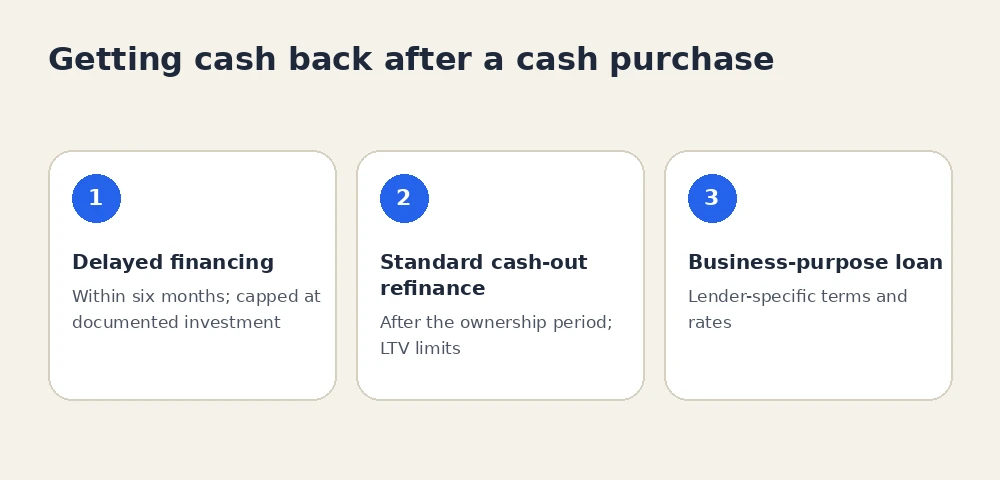
| Path | When you get cash back | Main limit |
|---|---|---|
| Delayed financing | Within six months of purchase | Loan capped at documented investment |
| Standard cash-out refinance | After the ownership period | Seasoning and loan-to-value limits |
| Business-purpose loan | Lender-specific | Higher rates, entity-level terms |
How much cash can you take out with delayed financing?
Usually no more than your documented investment in the purchase plus the costs of the new loan, and still within the lender's loan-to-value limits. It returns your cash; it does not pay you for the value you added.
Fannie Mae's wording is that the new loan amount can be no more than the actual documented amount of the borrower's initial investment in purchasing the property plus financed closing costs, prepaid fees and points on the new loan, subject to its loan-to-value limits. [1] The figures below are invented examples for illustration, not a loan offer or a typical deal.
Suppose you buy a rental for $150,000 cash and pay $3,000 in purchase closing costs. If your settlement statement and bank records document $153,000, that is roughly your ceiling before new-loan costs. Now assume the lender's maximum loan-to-value on an appraised $200,000 is 75%, or $150,000. The smaller of the two numbers wins, so the loan would be about $150,000 plus or minus how the lender treats the new loan's costs. If the appraisal came in at $180,000, the same 75% limit would cap the loan near $135,000, leaving $18,000 of your cash in the property.
The lesson for underwriting: run the refinance math before you buy. If the deal only works after you pull all your cash back out, test it against a lower appraisal and a lower loan-to-value. Our guide to rental property cash flow analysis shows how the new payment changes the numbers, and hard money loans for fix and flip covers the short-term alternative.
How does delayed financing fit a Buy & Hold plan?
It shortens the wait between buying and refinancing a rental, which is why investors pair it with the BRRRR approach. The cap on loan size is the catch: rehab value usually stays in the property until a later refinance.
A standard cash-out refinance after the seasoning period can count the improved value, subject to its own rules. Many investors therefore use delayed financing to recover purchase cash quickly and keep the rehab equity for later. Read the cash-out refinance entry for the general mechanics.
When DispoKey may not be your best option
If you need financing contingencies or plan to buy with a mortgage from day one, an off-market cash purchase may not suit you. Our deals usually require cash or hard money and fast closings.
If you buy with cash and want to recycle it, apply to the buyer network. Applications are reviewed by the team before marketplace access is granted, and each deal page shows the numbers you need to plan a refinance. Lending rules change; confirm current requirements with your lender before you rely on them.
Key takeaways
Delayed financing returns documented purchase cash within six months, capped by your investment and the lender's loan-to-value limits. Keep a clean settlement statement, document every dollar and run the refinance math before you buy. This is educational information, not lending, legal or tax advice.