Quick answer: To buy tax lien properties, register with a county that holds lien sales, research every parcel on its list, bid within its rules and pay on time. You receive a certificate earning interest, not the house; most owners redeem. DispoKey buyers who want finished deals can apply for vetted off-market Fix & Flip and Buy & Hold properties instead.
- Find out whether your state sells liens, deeds or both.
- Read the county's bidder rules and calendar.
- Research title, value and condition of each parcel.
- Track redemption deadlines in writing.
Tax lien investing is often sold as buying houses for pennies. In practice you buy a debt. The county wants its taxes now; you supply the cash and earn interest set by state law while the owner has time to pay you back. Owning the house is the exception, and it comes with legal steps and costs. This guide covers how a sale works, how to research parcels and a labeled example of the return. For definitions, see tax lien certificate and tax deed sale.
Tax lien sale or tax deed sale: which does your state use?
A lien sale sells the unpaid tax debt; a deed sale sells the property. Your state's law decides which, and some states use both.
Arizona counties hold lien sales; Maricopa County's Treasurer runs registration for tax lien bidders online. [1] Illinois counties hold an annual tax sale of delinquent taxes; the Cook County Treasurer publishes the schedule and sale rules. [2] Other states sell deeds after a redemption period has already run.
| Feature | Tax lien sale | Tax deed sale |
|---|---|---|
| What you buy | Certificate for the unpaid taxes | The property, subject to state rules |
| Main return | Interest or penalty set by law | Equity if bought below value |
| Owner's right to pay | Redemption period runs after the sale | Usually ended before the sale |
| Main risk | Worthless parcel, long wait | Title defects, occupants, condition |
How to buy tax lien properties, step by step
Work from the county's own rules, not a course. Each county sets registration, deposit, bidding and payment deadlines.
Open the seven-step checklist
- Pick a county. Start with one you can drive to and where you understand property values.
- Read the bidder rules. Registration, tax ID forms, deposits, bidding method and payment deadline.
- Download the delinquent list. Counties publish parcels weeks before the sale.
- Research each parcel. Value, condition, use and other liens (see below).
- Set a maximum per parcel. Include fees and the chance you hold the certificate for years.
- Bid and pay on time. Late payment can void a purchase and cost your deposit.
- Track redemption. Calendar every deadline and notice requirement in your state.
How to research a tax lien parcel
Most losses come from parcels that were never worth the lien: slivers of land, landlocked lots, condemned buildings. Research every one.
- Assessor records: size, use, value and building data. The Los Angeles County Assessor and Cook County Assessor publish parcel lookups. [3] [4]
- Recorder records: mortgages, other liens and ownership history.
- Maps and street view: confirm the parcel has road access and a building, if listed.
- Code enforcement and demolition lists: a demolition order changes the math entirely.
- A drive-by: look from the street; do not enter the property.
What return does a tax lien earn? A worked example
The return is the interest or penalty your state allows, on the amount you paid, for the time until redemption.
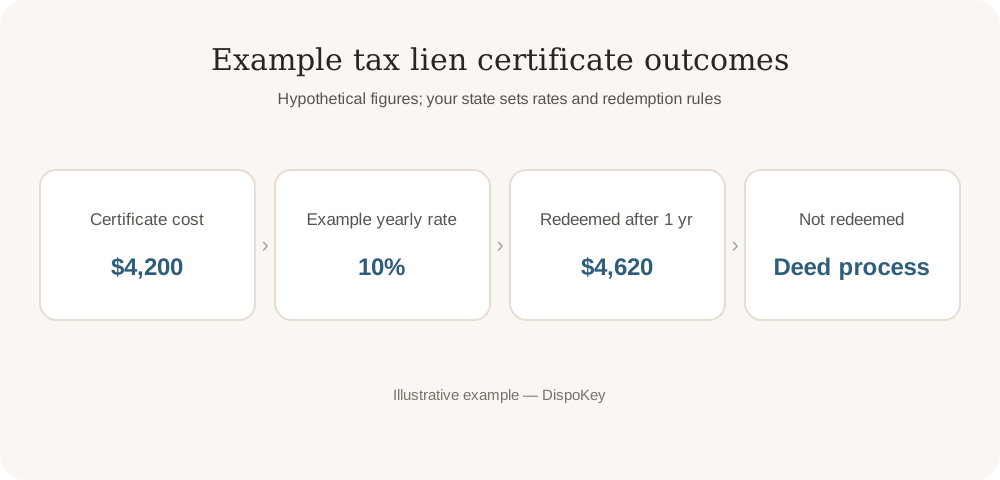
- Example certificate cost: $4,200
- Example yearly rate: 10%
- Redeemed after one year: $4,620 returned
- Not redeemed: you may start the state's deed process, with its own costs
Bidding can push the rate far below the legal maximum where buyers bid down interest, and fees reduce the net. Treat any figure you see on a course page as an example, not an expectation.
What happens during the redemption period?
The owner, or anyone with an interest, can pay the taxes plus interest to clear the lien. You receive your money back with the interest due.
If the period ends without redemption, the next step depends on state law; it may require notices to owners and lienholders, court filings or a county application. Budget time and legal costs for it.
Tax liens vs buying off-market properties
Tax liens are a slow interest play; off-market deals are a way to own a property now. They suit different goals.
If your plan is Fix & Flip or Buy & Hold, you need a house with a clear path to title and a known condition. Our off-market properties guide and fix and flip analysis guide cover that path. Approved buyers can review deals in markets like Phoenix and Chicago.
When DispoKey may not be your best option
If you want a passive interest return and are happy to wait years, tax lien certificates may suit you better than buying properties. If you need financing contingencies on a purchase, our cash-oriented off-market deals may not fit either.
How DispoKey helps investors who want the property
Apply to the buyers network with your buy box. After team approval you receive credentials by call or email and see vetted off-market Fix & Flip and Buy & Hold deals. Apply to the buyers network.
Key takeaways
- A tax lien certificate is a debt, not a deed.
- Your state decides lien sale, deed sale, rates and redemption.
- Research every parcel; worthless land is the main loss.
- Calendar every redemption and notice deadline.
Frequently asked questions
How do you buy a tax lien property?
Register with the county that holds the sale, research the parcels on its list, bid by its rules and pay on time. You receive a certificate, not the house, until any redemption period ends.
Do you own the house when you buy a tax lien?
No. A tax lien certificate is a claim for the unpaid taxes plus interest. Ownership only becomes possible through a separate legal process if the owner never redeems.
Is buying tax liens a good investment?
It can earn interest, but most liens are redeemed, and some parcels are worthless. Research each parcel and only bid money you can leave untouched for years.
What is the difference between a tax lien sale and a tax deed sale?
A lien sale sells the debt and the right to interest. A deed sale sells the property itself. Each state uses one, the other or a mix.