

Quick answer: To buy a house at auction, pick the auction type, research title and occupancy, set a maximum bid from ARV minus repairs and costs, and bring certified funds. Most auctions sell as-is with no inspection. DispoKey offers vetted off-market Fix & Flip and Buy & Hold deals you can walk before you buy, after team approval.
- Foreclosure, tax, government and online auctions follow different rules.
- Check liens, occupancy and redemption periods before bidding.
- Set your max bid at home and never raise it in the room.
What kinds of house auctions are there?
House auctions fall into a few groups, and each has its own deposit, title and timing rules. Read the terms for the specific sale before you study the property.
- Foreclosure sales: trustee or sheriff sales after a borrower defaults, often at the courthouse or online.
- Tax sales: counties sell tax liens or tax deeds for unpaid property taxes. See how to buy tax lien properties.
- Bank-owned (REO) auctions: lenders sell homes they took back that did not sell at foreclosure.
- Government sales: HUD sells FHA-insured homes it acquired through a bidding process, with owner-occupant priority periods.
How to research an auction property
Research is the job. At many foreclosure and tax sales you cannot go inside, so your due diligence happens in public records and from the street.
Title and liens
Search the county recorder for every mortgage, lien and judgment. At some sales junior liens are wiped out; at others they survive, and some, like property tax liens, usually come ahead of everything. A title company can run a search before the sale for a fee.
Occupancy and condition
Drive by. Note whether someone lives there, the roof, windows and any signs of water damage. If it is occupied, you may need a court eviction after you buy, which adds months. Our guide to buying tenant-occupied property covers that path.
Redemption periods
In some states the former owner can redeem the property for a period after the sale. Check your state's rules before you count on reselling or renting.
How much should you bid at a house auction?
Decide your maximum bid before the auction starts. Work backward from after-repair value so excitement in the room cannot raise it.
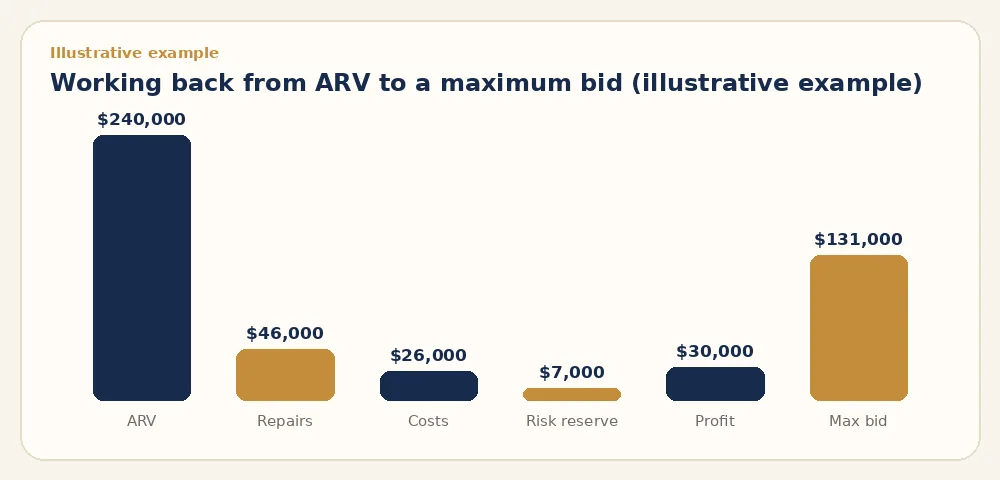
Start with ARV from recent sold comps. Subtract a repair budget with a contingency for what you could not see, holding and resale costs, possible eviction costs, liens that survive the sale, and your target profit. The result is the most you can pay and still hit your numbers.
Why auction repair budgets need a bigger contingency
When you cannot see inside, assume the worst on the systems you cannot check: roof, HVAC, plumbing, electrical and foundation. Many investors add a larger contingency to auction budgets than to deals they have walked, and some skip any property where a single hidden problem would erase the profit. Our guide on how to estimate rehab costs lists line items to price.
Read the county or trustee terms
Each county sheriff, clerk or trustee publishes its own sale terms: deposit amount, payment deadline, accepted funds and what happens if a winning bidder fails to pay. In Harris County, Texas, for example, foreclosure sale notices are filed with the county clerk, and tax sales are run under the county's own published terms. Read them for every sale, because a missed deadline can cost your deposit.
| Max-bid line (illustrative example) | Amount |
|---|---|
| After-repair value | $240,000 |
| Repairs plus 15% contingency | -$46,000 |
| Holding, closing and resale costs | -$26,000 |
| Possible eviction and surviving liens | -$7,000 |
| Target profit | -$30,000 |
| Maximum bid | $131,000 |
What to expect on auction day
Expect fast bidding and strict payment rules. Many foreclosure sales want a deposit or full payment in certified funds the same day, and some online platforms add a buyer's premium on top of the bid.
Register early, bring the exact forms of payment the terms require, and stop at your maximum. If you win, you usually receive a trustee's deed, sheriff's deed or certificate, depending on the sale. Some deeds carry no title warranty, so plan to buy title insurance once the title can be insured.
Can you finance a house bought at auction?
Usually not at the sale itself. Most auctions require cash or cash-equivalent funds on short deadlines, so investors use their own capital, a line of credit or a hard money loan lined up in advance.
HUD home sales are an exception: they work more like a normal purchase, and buyers can use financing. After you own an auction property free of title problems, a refinance or DSCR loan can replace short-term money.
Auction deals vs. vetted off-market deals
Auctions can offer discounts, but you trade them for blind risk. An off-market deal usually lets you walk the house, review photos and check comps before you commit.
DispoKey's marketplace lists off-market Fix & Flip and Buy & Hold properties for approved cash buyers. Access needs team approval, and you can review each deal on its own terms. Apply as a buyer or see city deal pages such as Houston.
When DispoKey may not be your best option
If you need a financing contingency, a long inspection period or a retail home to live in, neither auctions nor our cash marketplace will suit you. A traditional purchase with a lender and an agent fits better. HUD's owner-occupant bidding periods are also worth a look for a home you plan to live in.
Key takeaways
- Each auction type has different deposit, title and redemption rules.
- Research liens, occupancy and condition before auction day.
- Set a maximum bid from ARV and stick to it.
- Most auctions need cash; arrange funds before you bid.
Frequently asked questions
Can you inspect a house before an auction?
Often not inside. Many foreclosure and tax sales are as-is, so investors rely on public records and exterior review.
Do you need cash to buy a house at auction?
Most foreclosure and tax sales require certified funds on short deadlines. HUD home sales allow financing.
Are liens wiped out at a foreclosure auction?
Some are and some are not. Property tax liens usually survive, so run a title search before bidding.
What is a buyer's premium?
It is a fee some auction platforms add on top of the winning bid. Include it in your maximum.
Official references
- HUD: Buying a HUD home
- HUD Home Store
- CFPB: Foreclosure guidance
- USA.gov: Government auctions and sales