Quick answer: Driving for dollars means driving neighborhoods to log distressed properties, then finding and contacting the owners. Plan a route of 100 to 200 homes, record distress signs, look up owners in county records and follow up lawfully. Once you have an off-market contract, DispoKey's 72-hour buyer-match guarantee helps you sell it.
- Pick a route with older homes and owners likely to be absentee.
- Log each property with photo, address and distress signs.
- Look up the owner of record in county tax records.
- Reach owners by mail first; call or text only within the rules.
Lists bought from data vendors are shared by everyone in your market. A vacant house you spotted yourself on a Tuesday afternoon may not be on any of them yet. That is the case for driving for dollars: it is slow, but it finds deals your competitors have not mailed. This guide covers route planning, what to log, owner lookup, lawful outreach and a labeled example of what one route can produce. For the broader picture, see motivated seller.
What is driving for dollars?
It is a field method for finding distressed properties. You drive set routes, note houses that look neglected and contact the owners.
It works best in neighborhoods with older housing, a mix of owner-occupied and rental homes, and prices your buyers already target. Start with neighborhoods your cash buyers say they want.
Which distress signs should you look for?
Look for signs that the owner is absent, behind or overwhelmed. Several signs on one property raise the odds.
Open the distress-sign checklist
- Tall grass, overgrown shrubs or dead landscaping
- Boarded or broken windows
- Piled-up mail, newspapers or notices on the door
- Tarps on the roof or visible roof damage
- Utility shut-off tags or no lights for weeks
- Code-violation or vacancy notices posted by the city
- Peeling paint, rotted trim, sagging porches
- Abandoned vehicles or debris in the yard
Score each property from 1 to 3 on how strong the signs are. Mail and call the 3s first. One sign alone, like long grass in a wet month, means little; two or three together, seen on two separate drives, usually mean an owner who has stopped managing the house. Note the date of every sighting so you can show change over time.
How to plan a driving for dollars route
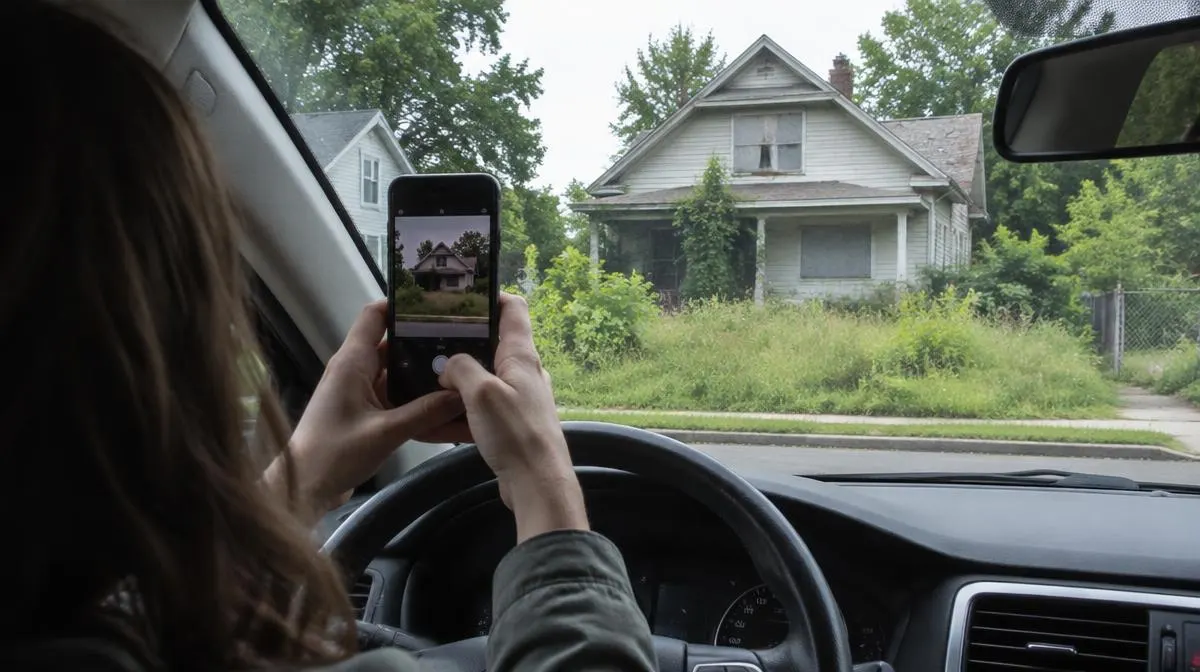
A route of 100 to 200 homes takes about two hours. Drive the same routes monthly to catch new vacancies.
- Choose the zone: start where your buyers buy, using your recent comps as a guide.
- Drive with a partner: one drives, one logs. Never type while driving.
- Use an app or a spreadsheet: address, photo, score, date seen.
- Repeat: a second sighting a month later confirms vacancy.
How do you find the owner of a property?
The county assessor or appraisal district lists the owner of record and the tax mailing address. That address is your first contact point.
In Harris County, Texas, the appraisal district publishes owner names and mailing addresses by account. [1] In Cook County, Illinois, the Assessor's site shows property characteristics and values by address. [2] When the mailing address differs from the property address, the owner is likely absentee, which is a strong signal. For phone numbers, see our skip tracing guide.
| Step | Source | Output |
|---|---|---|
| Spot | Your drive | Address, photo, distress score |
| Owner | County assessor or appraisal district | Owner name, mailing address |
| Liens and loans | County recorder | Mortgages, liens, recent transfers |
| Contact | Mail first, then lawful calls | Conversation and appointment |
How to contact owners lawfully
Start with mail; it carries the fewest rules. Before calling or texting, check do-not-call and consent requirements.
The FTC's Telemarketing Sales Rule guidance explains National Do Not Call Registry obligations for sellers and telemarketers. [3] The FCC explains consent rules for autodialed and prerecorded calls and texts. [4] Never enter a property, look in windows from the yard or leave flyers inside mailboxes; stay on public sidewalks and streets. For what to say once an owner answers, see our wholesaling scripts.
What can one route produce? A worked example
Driving for dollars is a numbers game measured in contracts, not sightings. Here is a hypothetical month.
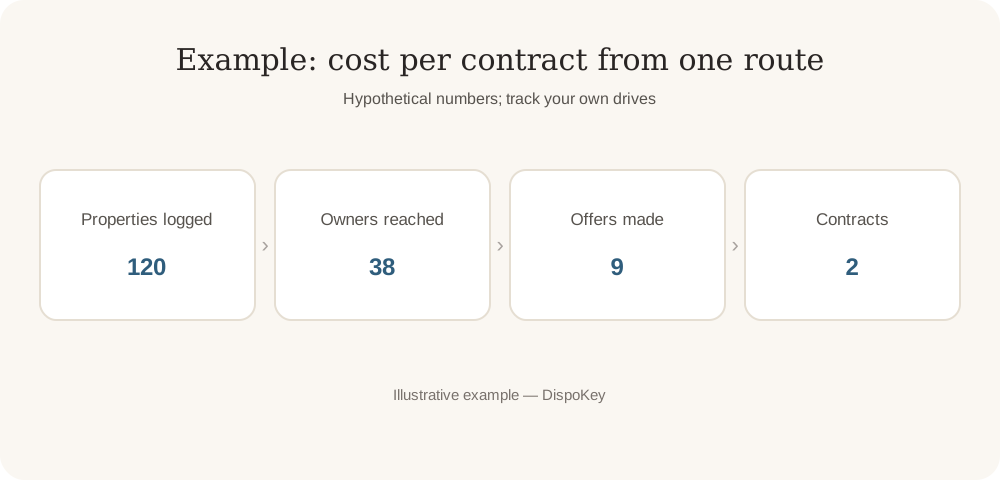
- Properties logged: 120
- Owners reached by mail or phone: 38
- Offers made: 9
- Contracts signed: 2
- Example costs: fuel $180, data $120, mail $260, so $560 total, or $280 per contract
Compare that cost per contract with your other channels. Our cost per contract guide shows how to measure it.
After you sign: getting the deal sold
A contract is only worth something once a cash buyer closes. Price it from the buyer's maximum offer, not your hopes.
Use our MAO calculator and pricing guide before you sign. DispoKey accepts off-market contracts only; deals already listed on the MLS are not accepted.
When DispoKey may not be your best option
If you already have a strong buyer for the property who will close on your terms, you may not need a disposition partner. DispoKey fits best when you need more buyers fast or want a guaranteed match window.
How DispoKey helps you sell the contract
Submit the deal with $0 upfront. We guarantee a buyer match within 72 hours, and the fee splits 60/40 in your favor. Text (802) 618-0015 with your DK ID for updates. Submit a deal or read how it works for wholesalers.
Key takeaways
- Drive the same routes monthly and score distress signs.
- Find owners through county assessor or appraisal records.
- Mail first; follow do-not-call and consent rules before calling or texting.
- Measure cost per contract, not properties logged.
Frequently asked questions
What is driving for dollars?
Driving for dollars is driving neighborhoods to spot properties showing distress, such as overgrown yards or boarded windows, then contacting the owners about selling.
Does driving for dollars work?
It can, because it finds properties other lists miss. Results depend on the route, how many owners you reach and how consistently you follow up.
Is driving for dollars legal?
Looking at and photographing property from a public street is generally lawful. Entering the property, or calling and texting owners in ways that break telemarketing rules, is not.
How do I find the owner of a house I found driving for dollars?
Look up the address in the county assessor or appraisal district records, which list the owner of record and mailing address used for the tax bill.