

Quick answer: Skip tracing is finding a property owner's current phone number or address from public and commercial data. Wholesalers use it to reach absentee and distressed owners, but calling rules apply: scrub numbers against the National Do Not Call Registry, follow the TCPA's consent rules for autodialed or prerecorded calls to cell phones, and keep your own do-not-call list. DispoKey's 72-hour buyer-match guarantee starts once your contract is signed.
- Build the list first; trace only records worth calling.
- Scrub against the DNC registry and known litigator lists.
- Log every call, outcome and opt-out request.
- Measure right-party contact rate, not dials.
Skip tracing is the bridge between a list of addresses and a real conversation. Done well, it turns county records into signed contracts. Done carelessly, it creates legal exposure and burned lists. This guide covers the workflow and the federal calling rules that shape it. For the marketing side, see wholesale marketing permissions.
What is skip tracing in wholesaling?
Skip tracing matches a property owner's name and mailing address to current contact information — phone numbers, email addresses and sometimes relatives or associates. The name comes from debt-collection work, where "skips" are people who have moved without leaving a forwarding address. For wholesalers, the typical targets are absentee owners, heirs, long-tenure owners and owners of vacant or tax-delinquent properties.
Where does skip-trace data come from?
Providers aggregate public records — county assessor and recorder files, voter rolls where public, utility connections — with commercial data sources. Quality varies widely, which is why the hit rate matters more than the price per record. A cheap list of wrong numbers costs more in dialer time than an expensive accurate one.
What calling rules apply to skip-traced numbers?
Two federal frameworks govern the calls you make after a trace. The Telephone Consumer Protection Act, implemented by 47 CFR 64.1200, restricts calls using an automatic telephone dialing system or an artificial or prerecorded voice to cell phones without prior express consent — and telemarketing calls of that kind require prior express written consent. [1] The FTC's Telemarketing Sales Rule separately prohibits telemarketing calls to numbers on the National Do Not Call Registry, and requires sellers and telemarketers to maintain their own internal do-not-call lists. [2] Some states add stricter rules of their own, so check the law in the states you call into.
Do you have to scrub against the Do Not Call Registry?
If your calls are telemarketing — and cold-calling owners to buy their house is solicitation — the safe practice is to subscribe to the registry for your area codes and scrub your lists before dialing. The FTC's telemarketer Q&A explains access, subscription and compliance duties. [3] Keep records of when each list was scrubbed.
Does dialing by hand change the rules?
Manual dialing avoids the TCPA's autodialer restrictions, but the DNC registry and internal do-not-call duties still apply to telemarketing calls. Text messages are treated as calls under the TCPA, so the same consent analysis applies to SMS follow-ups.
What about litigator lists and reassigned numbers?
Two quieter risks deserve a place in your process. First, serial TCPA plaintiffs: professional litigants who answer cold calls specifically to build claims. Scrubbing against a known-litigator list before dialing is standard practice among professional callers. Second, reassigned numbers: a number traced to an owner today may belong to someone else tomorrow. The FCC maintains a Reassigned Numbers Database that callers can check to see whether a number has been disconnected and reassigned since a given date — useful evidence that a consent or contact record had gone stale. [4] Neither scrub is optional once you dial at any real volume, and both are cheap compared with a single TCPA demand letter.
A skip-tracing workflow that holds up
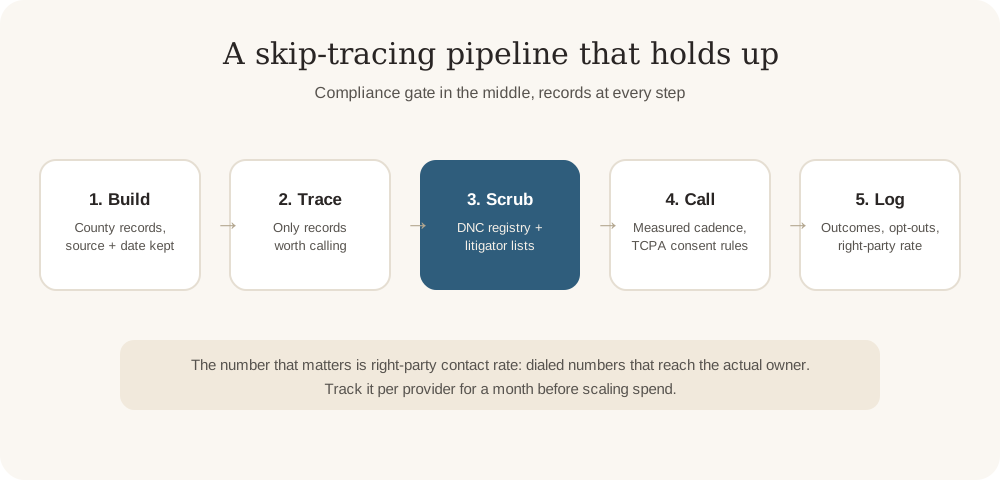
Treat tracing as a pipeline with a compliance gate in the middle, not a bulk download.
| Step | Action | Record to keep |
|---|---|---|
| 1 | Build the target list from county records | Source, date pulled, filter used |
| 2 | Trace the records worth calling | Provider, cost per record, hit rate |
| 3 | Scrub against DNC and litigator lists | Scrub date and service used |
| 4 | Call in a measured cadence | Attempts, outcomes, right-party contacts |
| 5 | Log opt-outs to your internal DNC list | Name, number, date, source list |
What should skip tracing cost?
Providers commonly charge per record, with volume discounts, and advertise hit rates that deserve skepticism. The only number that matters is your right-party contact rate: of the numbers you dial, how many reach the actual owner. Track it per provider for a month before committing. As a labeled example only: 500 traced records at $0.12 each cost $60; if 8% reach the right owner, that is 40 conversations at $1.50 each — cheap if one becomes a contract, waste if the data is stale.
What happens after a good conversation?
A signed contract is where DispoKey takes over the hard part. Submit your deal and our team matches it to vetted cash buyers within 72 hours, on a 60/40 split that favors you, with $0 upfront. We only take off-market contracts. Submit a deal or read how the JV split works. Questions? Text your DK ID to (802) 618-0015.
When DispoKey may not be your best option
If you already have a strong buyer relationship for a specific deal, direct assignment may net you more. And if your contract is on-market or listed, we cannot take it — our buyer network expects off-market deals only.
Key takeaways
- Skip tracing turns county records into contactable owners; hit rate beats price per record.
- TCPA consent rules restrict autodialed and prerecorded calls to cell phones.
- Scrub telemarketing lists against the DNC registry and keep an internal do-not-call list.
- Measure right-party contact rate per provider before scaling spend.
Frequently asked questions
Is skip tracing legal for wholesalers?
Tracing itself uses public and commercial data and is legal. The regulated part is what you do with the numbers: telemarketing calls must respect the Do Not Call Registry, and autodialed or prerecorded calls to cell phones need prior express consent under the TCPA.
What is a good skip-trace hit rate?
Judge providers by your own right-party contact rate — the share of dialed numbers that reach the actual owner. Track it per provider for a month; advertised hit rates are marketing, not measurement.
Can I text skip-traced numbers?
Text messages are treated as calls under the TCPA, so the same consent rules apply. Manual, one-to-one texts to numbers not on the DNC registry carry less risk than automated campaigns, but keep opt-out records either way.
How often should I re-scrub my list?
Scrub before every calling campaign, not once per list. Registry data changes, and your records should show the scrub date for any list you dial.
References
- 47 CFR 64.1200 Delivery restrictions — eCFR.
- Complying with the Telemarketing Sales Rule — FTC.
- Q&A for Telemarketers & Sellers About DNC Provisions in TSR — FTC.
- Reassigned Numbers Database — FCC.
Related reading
- Scripts for the first call after skip tracing
- How to price a wholesale deal buyers will take
- What to say once a seller picks up
- Driving for dollars: find owners before the lists do
- Eight public-record lists for motivated sellers
- Virtual Wholesaling: Run Deals in Any Market
- Absentee Owner List: Build, Filter and Market It
- Probate Leads: How Wholesalers Find and Work Them
- Tax Delinquent Properties: Find Leads Before the Sale
- Bird Dog Real Estate: Finding Deals for Investors