

Quick answer: Email marketing for real estate investors works best as permission-based nurture, not unsolicited prospecting. DispoKey Growth Lab readers should separate homeowner and buyer preferences, record the subscription promise, suppress unwanted mail and assign a reply owner. Measure useful conversations and appointments, not opens alone, and keep email assistance separate from original acquisition credit.
- Gather the records before committing money or dates.
- Separate verified facts from planning assumptions.
- Write down the next action, its owner and the review date.
Check readiness before sending
Confirm the subscription wording, source and date; audience preference; recognizable sender; monitored reply address; authentication status; and a working unsubscribe process. Attractive design does not fix missing permission records or an unattended inbox. Start with a named owner for responses and a backup when that person is unavailable.
A homeowner planning next spring needs different information from a buyer requesting rental opportunities. Do not merge them into one generic newsletter. Save what each person actually requested and build the sequence around that expectation. A property inquiry and a request for ongoing marketing updates are different events in the relationship.
Use an explicit subscription promise
A clear invitation might offer a preparation checklist and one monthly planning note. Save the exact wording used, where the person subscribed and when. This guide uses opt-in as its operating standard. Google recommends clear consent for commercial or bulk sending; that recommendation is not a claim that US CAN-SPAM universally requires prior opt-in for every commercial email.
Exclude purchased addresses, scraped owner records and old spreadsheets with unknown subscription history from this nurture workflow. A larger list is not useful if nobody can explain why its recipients should hear from you. Keep source, timestamp, promised topic, audience and suppression status practical and auditable.
Separate audiences without overcomplicating segments
For homeowners, requested topic and timing may be enough. For buyers, geography and Fix & Flip versus Buy & Hold preferences help relevance. Segmentation is not seller qualification; use the qualification guide when a reply becomes a property conversation.
A buyer update should describe a real authorized opportunity or useful information, not invented scarcity or projected returns. A homeowner message should answer the requested selling question without exposing disposition mechanics. Each audience has a different next step, so mixing them also makes reporting harder to interpret.
Start with a short useful sequence
An illustrative sequence is welcome, practical follow-up, preference check and occasional relevant update. Match the timing to the subscription promise rather than assuming a universal cadence. Deliver the requested resource first, identify the business and explain what comes next. Follow with one useful planning question, not a long promotional catalogue.
| Step | Decision |
|---|---|
| Subscribe | Save promise, source and audience |
| Nurture | Welcome, useful help, preference check |
| Exit | Unsubscribe enters shared suppression |
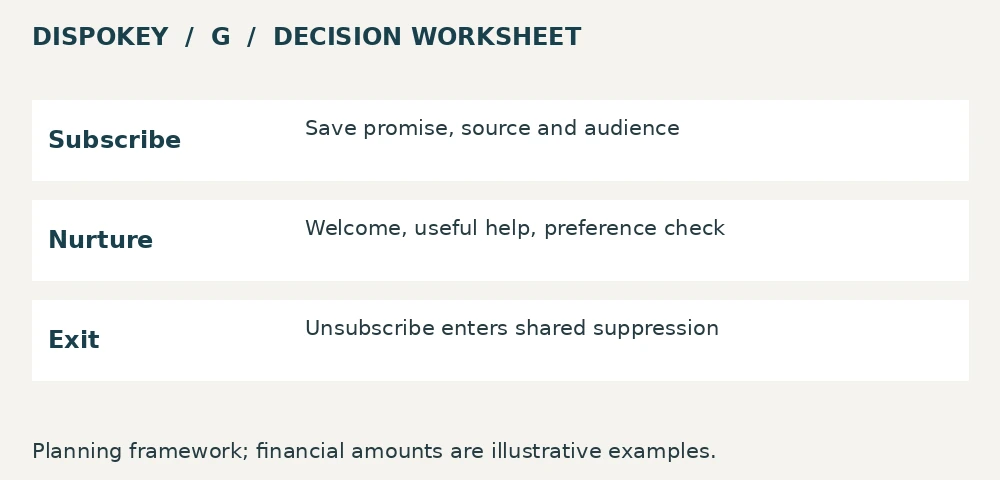
A simple homeowner message can deliver the checklist, ask whether timing changed and provide a clear unsubscribe path. One clear next step is easier to evaluate than several competing buttons. If only the resource was wanted, the recipient should not have to justify leaving the ongoing sequence.
Keep compliance and deliverability separate
The FTC says CAN-SPAM covers commercial email, including business-to-business messages. Requirements include accurate header information, non-deceptive subjects, advertising identification as applicable, a valid physical postal address and a clear opt-out mechanism. Opt-outs must be honored within ten business days. Hiring another sender does not remove responsibility. The official FTC guide states these duties.
Suppress promptly where the tools support it and verify that imports cannot reactivate unsubscribed contacts. Every automation should consult the same status. A message being technically deliverable is not evidence that the recipient wants it. Keep bounce handling and marketing suppression distinct while ensuring both prevent inappropriate continued sending.
Google requires SPF or DKIM for all senders to personal Gmail accounts. Senders above 5,000 messages daily have additional requirements including SPF, DKIM and DMARC. Applicable marketing or subscribed messages require one-click unsubscribe and a visible unsubscribe link. Google’s sender guidelines explain the volume and message qualifications; authentication is not an inbox-placement guarantee.
Test suppression and reply ownership
Before a campaign, use an authorized internal test address to confirm unsubscribe behavior, preference changes and reply routing. Do not enroll real homeowners or buyer applicants merely to test a sequence. Recheck after changes to integrations, sender settings or imports. The operational test should demonstrate the intended state, not just that a button appears.
Assign a named person to substantive replies and keep the response task attached to the contact. A successful email that produces unanswered questions exposes an ownership failure, not a subject-line problem. If complaints or unexpected delivery failures rise, pause the affected sequence and investigate expectations and sending configuration before increasing volume.
Worked example: nurture operating costs
Illustrative planning amounts, not price quotes or performance benchmarks: an email platform costs $80 monthly and six coordinator hours at an assumed $30 cost $180. Total monthly activity cost is $260 and three months total $780. Suppose twelve substantive replies and four held appointments occur during that hypothetical period.
$780 divided by four held appointments is $195 per held appointment for this nurture activity. It is not total acquisition cost: original campaigns, other sales work and broader expenses are excluded. A later closing would not prove email independently caused it. Preserve the original source and record nurture touches separately rather than assigning all credit to the most recent message.
If the same spending produces no held appointments, do not report a zero cost per appointment. There is no meaningful denominator. Report spending and the absence of the outcome instead. A smaller subscriber list may justify a simpler sequence; automating more messages is not itself evidence of better economics.
Review useful outcomes rather than opens alone
Each week, inspect unanswered replies, broken links and suppression failures. Each month, examine held appointments, relevant progression and unsubscribes alongside delivery data. Opens are a supporting signal, not proof that a person read, understood or acted. Use consistent definitions so a reply, scheduled appointment and held appointment are not counted interchangeably.
Offer a preference change or stop sending when the content no longer fits. If a useful topic produces conversations, retain the factual pattern without promising the same results elsewhere. For the handoff from the website, see the investor website guide; that article owns page structure, while this one owns the subscription lifecycle.
When DispoKey may not be your best option
Opt-in nurture fits a legitimate subscriber base, useful information and a team able to respond. It is not a substitute for permission, a functioning inbox or acquisition demand. If there is no budget for several months of ads and response handling, a managed acquisition commitment may not fit yet.
DispoKey Growth Lab costs $1,500 per month. Clients own leads and contracts; DispoKey dispo is an optional safety net. No lead counts or ROI are guaranteed. Confirm the scope of any email work rather than assuming it is included. This guide does not launch or send any campaign.
Key takeaways
- Make the decision from documented inputs, not a headline promise.
- Keep costs, timing and responsibilities visible.
- Recalculate when material facts change.
Frequently asked questions
How often should investors email subscribers?
Start with the cadence promised at signup and adjust for relevance and preferences. A monthly update is an option, not a universal rule.
Can imports restore unsubscribed contacts?
The process should prevent that. Preserve suppression across imports and integrations and verify that an unsubscribe stops all applicable marketing sequences.
Does a small list justify automation?
Sometimes. A simple welcome and a managed reminder may be enough; automate repetitive work only while replies and exceptions remain monitored.