

Quick answer: Real estate text message marketing works best with leads who asked to hear from you. The FCC treats texts as calls, so autodialed marketing texts need prior express written consent; register business numbers for 10DLC, honor STOP replies and text only between 8 a.m. and 9 p.m. Growth Lab builds compliant follow-up for $1,500/mo.
- Collect clear written consent on your forms before marketing texts.
- Register your sending numbers and brand for 10DLC.
- Send short, useful texts and process opt-outs right away.
Why texting works for seller leads
Texting is fast and personal. A seller who fills out a form at night may not answer a call the next morning but will often reply to a short text.
Text is best for follow-up, not cold outreach. Use it to confirm an appointment, send a link to your process, or check in after an offer. Our guide to speed to lead explains why the first reply matters so much.
Texting also fills gaps between calls. A seller at work can answer a two-line text in a meeting, and a written thread gives both sides a record of times, addresses and next steps. Treat it as one part of a follow-up plan that also includes calls, email and mail, not as the whole plan. Sellers who opted in to texts still expect a real person to call before anyone talks about price.
What consent do you need to text sellers?
Get prior express written consent before sending marketing texts with an autodialer or automated platform. The FCC says the Telephone Consumer Protection Act covers text messages as calls.
Written consent should be a clear, separate statement on your form that names your business, says the person agrees to receive marketing texts at the number provided, and says consent is not a condition of selling. Keep a record of when and how each lead agreed. Our TCPA guide for real estate covers the wider rules, including the Do Not Call Registry, which also applies to telemarketing texts.
Quiet hours
FCC rules bar telephone solicitations before 8 a.m. or after 9 p.m. in the recipient's local time. Some states set narrower windows, so schedule by the lead's time zone.
What is 10DLC registration?
10DLC is the system U.S. carriers use for business texting from standard 10-digit numbers. You register your brand and each campaign through your texting provider.
Carriers review the use case and sample messages. Unregistered or mismatched traffic can be filtered or blocked, so describe your campaign accurately, for example as follow-up with leads who requested a cash offer. Industry messaging principles published by CTIA describe the consent and opt-out practices carriers expect.
| Follow-up step (illustrative sequence) | Timing | Channel |
|---|---|---|
| Form submitted with written consent | Minute 0 | Web form |
| Confirmation text with business name and STOP | Within 5 minutes | Text |
| Call attempt | Within 15 minutes | Phone |
| Missed-call text | Same day, before 9 p.m. local | Text |
| Offer follow-up | Day 3 | Text or email |
What texts get replies?
Short, specific and human. Name the property, say who you are and ask one easy question.
- First reply: Thanks for your request about 412 Elm. Is now a good time for a 5-minute call?
- Missed call: Sorry I missed you. Would tomorrow morning or afternoon work better?
- After an offer: Any questions on the offer I sent? Happy to walk through the numbers.
Add your business name and Reply STOP to opt out in the first message and periodically after that.
What not to text
Do not send long offer details, contracts or personal financial questions by text. Move those to a call, email or secure document link. Avoid misleading lines that imply you are a lender, a government office or a neighbor, and never invent deadlines. The FTC Act prohibits deceptive practices in any channel, and honest messages also get better replies.
How often should you text a seller lead?
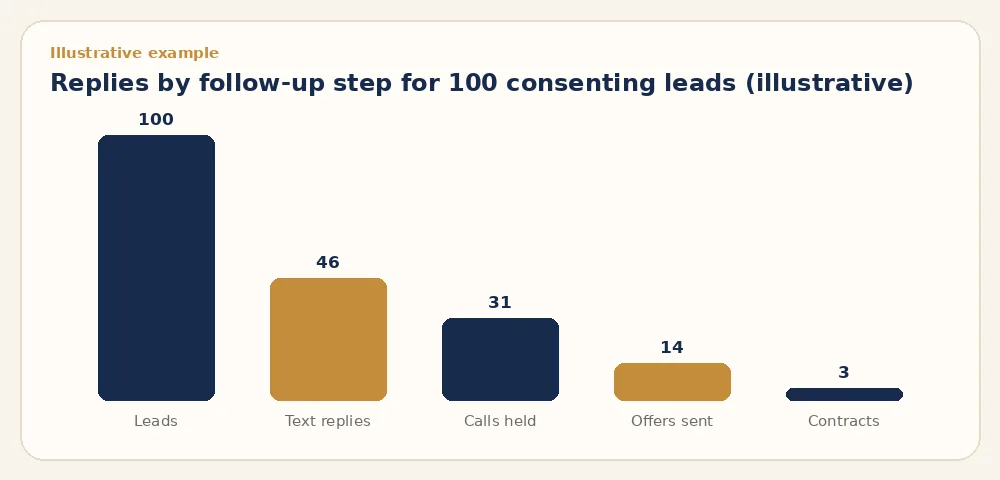
Fewer texts with real value beat daily nudges. A common pattern is several touches in the first week while the request is fresh, then a check-in every few weeks. Stop when the lead asks, and log every message so a teammate does not double up.
How to handle opt-outs and records
Honor opt-outs right away and keep proof, including the date and the exact reply the lead sent. A STOP reply means no more marketing texts to that number from any of your campaigns.
Sync opt-outs into your CRM so callers and mailers see them too. Our guide to choosing a real estate investor CRM covers consent fields. Keep consent records, message logs and opt-out dates for as long as your counsel and state rules suggest.
How Growth Lab handles texting
DispoKey Growth Lab runs motivated-seller ads and follow-up for investors for $1,500/mo. We build consent language into your forms, set up compliant follow-up and route replies to your team.
You own every lead and every contract. Using DispoKey for dispo is optional. We do not promise lead counts or returns; we report what each channel costs per lead and per contract. Book a Growth Lab call.
When DispoKey may not be your best option
If you plan to text purchased or skip-traced lists without consent, we are not the right partner, and that approach carries real legal risk. If you lack budget for at least three months of ads, start with free follow-up on the leads you have.
Key takeaways
- The FCC treats texts as calls under the TCPA.
- Get prior express written consent for automated marketing texts.
- Register for 10DLC and keep messages within 8 a.m. to 9 p.m.
- Honor STOP immediately and sync it everywhere.
Frequently asked questions
Can I text motivated sellers without permission?
Automated marketing texts need prior express written consent under FCC rules, so text leads who agreed on your form.
What is 10DLC?
It is the carrier registration system for business texting from 10-digit numbers. Your provider submits your brand and campaigns.
What hours can I send real estate texts?
FCC rules bar telephone solicitations before 8 a.m. or after 9 p.m. local time; some states are stricter.
Does Growth Lab own my leads?
No. Growth Lab clients own every lead and contract, and using DispoKey for dispo is optional.
Official references
- FCC: Stop unwanted robocalls and texts
- National Do Not Call Registry for telemarketers
- CTIA: Messaging Principles and Best Practices