

Quick answer: Seller closing costs usually include any agent commission you agree to, title and escrow fees, state or local transfer taxes, your mortgage payoff, and prorated property taxes. Together they often take a meaningful share of the price. Read your settlement statement line by line before closing. With DispoKey, the seller pays $0 to DispoKey and you can close in as little as 21 days.
- List every cost before you accept an offer, not after.
- Ask for a written estimate of your net proceeds.
- Compare offers on what you keep, not the headline price.
What are seller closing costs?
Seller closing costs are the fees and charges taken out of your sale price at closing. They are listed on your settlement statement, and whatever is left after your mortgage payoff is what you receive.
Some costs are fixed by law, such as transfer taxes in places that charge them. Others are negotiable, such as agent commissions and who pays certain title fees. Local custom matters too: in some areas sellers usually pay for the buyer's title insurance policy, and in others the buyer does. Because the mix changes by state and county, the safest approach is to ask the title or escrow company for an itemized estimate before you sign a contract.
Which closing costs does the seller usually pay?
Most sellers see some version of the same list on their statement.
- Agent commission: if you list with an agent, the amount you agree to in the listing agreement. Commissions are negotiable.
- Title and escrow fees: settlement, document preparation and, in many areas, the owner's title policy.
- Transfer taxes: charged by some states, counties or cities when a deed is recorded.
- Mortgage payoff: your remaining balance, interest through the payoff date and any lender fees.
- Prorated property taxes and HOA dues: your share up to the closing date.
- Repairs or credits: anything you agreed to after the buyer's inspection.
- Recording and courier fees: small charges to record releases and send documents.
How transfer taxes differ by state
Transfer taxes are set by law, so they vary widely. Some states charge none, some charge a flat rate, and some use graduated rates that rise with the price.
Washington, for example, charges a real estate excise tax that the Department of Revenue publishes rates for, and New York's Department of Taxation and Finance publishes its real estate transfer tax rules. Many counties and cities add their own tax on top of the state's. Check your state revenue department's website, or ask your title company which taxes apply to your address and who customarily pays them.
How to read your settlement statement
Your settlement statement shows every dollar in and out of the sale. Read it before closing day, not at the table.
Check that the sale price matches your contract, that your payoff figure matches your lender's written payoff statement, and that prorations use the right dates. Question any fee you do not recognize. Buyers using a mortgage receive a Closing Disclosure, which federal rules require them to get at least three business days before closing; sellers often receive their own version or a separate statement from the title company. Our guide on how to sell a house with a mortgage explains payoff statements in more detail.
Worked example: what a seller actually keeps
The fastest way to compare offers is a simple net sheet. Start with the price, subtract each cost, then subtract the payoff.
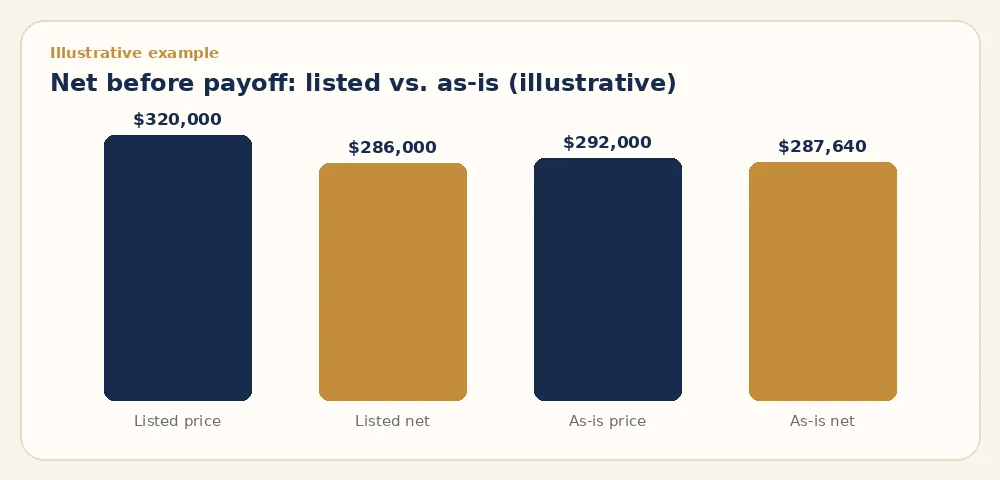
The illustrative example in this guide compares a listed sale with an as-is cash sale. Even when the listed price is higher, commission, repairs and extra months of holding costs can narrow the gap. Use your own numbers: your payoff, your county's transfer tax and real quotes for any repairs.
| Line item (illustrative example) | Listed sale | As-is cash sale |
|---|---|---|
| Sale price | $320,000 | $292,000 |
| Commission (5.5%) | -$17,600 | $0 |
| Title, escrow and recording | -$2,900 | -$2,900 |
| Transfer tax (example 0.5%) | -$1,600 | -$1,460 |
| Repairs and credits | -$6,500 | $0 |
| Three extra months of holding costs | -$5,400 | $0 |
| Net before mortgage payoff | $286,000 | $287,640 |
Who pays what: buyer vs. seller
Which side pays a given fee is partly law and partly local custom, and the purchase contract can change it. Read the cost section of your contract before you sign.
- Often the seller: any listing commission you agreed to, your mortgage payoff, prorated taxes up to closing and, in many areas, the owner's title policy.
- Often the buyer: lender fees, appraisal, the lender's title policy and prepaid escrow for taxes and insurance.
- Varies by area: transfer taxes, escrow or settlement fees and recording charges.
A buyer may ask you to pay part of their costs as a seller credit. That credit reduces your net just like any other fee, so treat it as part of the price.
How can a seller reduce closing costs?
You cannot avoid taxes set by law, but you can often reduce the rest.
- Negotiate commission or choose a sale path without one.
- Shop title and escrow fees where you are allowed to choose the provider.
- Limit repair credits by selling as-is with clear disclosures.
- Close sooner to cut mortgage interest, utilities and insurance.
- Request your payoff early so there are no surprises.
Keep records of selling expenses. IRS Publication 523 explains that selling expenses reduce the amount realized when you figure gain on a home sale.
Closing costs when you sell with DispoKey
DispoKey's buyers purchase homes as they are. You pay $0 to DispoKey, there are no repair requests, and a Seller Success Manager gives you a written net that shows what you keep. Customary title costs, any transfer taxes and your payoff still appear on your statement. You choose the closing date, as soon as 21 days out. Start on the cash offer page.
When DispoKey may not be your best option
If your home is move-in ready, your market is strong and you have time to list, a traditional sale may leave you with more even after commission. A cash offer fits best when repairs, timing or certainty matter more than the last dollar.
Key takeaways
- Seller costs include commission, title fees, transfer taxes, payoff and prorations.
- Transfer taxes are set by state and local law.
- Read your settlement statement before closing day.
- Compare offers on net proceeds.
Frequently asked questions
What closing costs does a seller pay?
Usually any agreed commission, title and escrow fees, transfer taxes where charged, the mortgage payoff and prorated taxes.
Are seller closing costs tax deductible?
Selling expenses reduce the amount realized on the sale, as IRS Publication 523 explains, which can lower taxable gain.
Can a seller negotiate closing costs?
Many can be negotiated, including commission and some title fees. Taxes set by law cannot.
Does DispoKey charge sellers a fee?
No. Sellers pay $0 to DispoKey; customary title costs, taxes and your payoff still apply.
Official references
- IRS Publication 523: Selling Your Home
- CFPB: What is a Closing Disclosure?
- Washington DOR: Real estate excise tax
- New York Tax Department: Real estate transfer tax