

Quick answer: Evaluate a real estate PPC agency by inspecting account access, fee transparency, lead ownership, measurement quality and exit terms before signing. DispoKey Growth Lab charges $1,500 monthly management, with ad spend separate. Require evidence that your team can inspect performance and retain its leads and contracts when the relationship ends.
- Inspect the live account and billing structure.
- Define qualified leads and reporting obligations.
- Put ownership and handoff terms in the contract.
This procurement checklist asks whether a vendor can manage your budget under terms you can audit and leave.
What should you request before the sales call?
Request a sample agreement, itemized pricing, an account-access plan, a reporting sample, and an exit checklist. Ask each candidate for the same materials so that differences in scope do not disappear behind a single monthly price.
Early procurement details checklist
- Business entity, named account lead, and escalation contact.
- Management fee, media budget, setup charges, and third-party software costs.
- Google Ads customer account structure and proposed access levels.
- Ownership and export terms for leads, creative, domains, and landing pages.
- Qualified-lead definition, duplicate rules, and attribution documentation.
- Reporting cadence, budget approval limits, and change history access.
- Cancellation notice, handoff deliverables, and access-removal sequence.
Mark each answer as demonstrated, contractually committed, or merely discussed. Put material obligations in writing; do not rely on verbal assurances alone.
What does Google's third-party policy require?
Google's third-party policy requires transparency about advertising costs and performance, and requires a separate account for each end-advertiser. Use those requirements as a baseline for vendor diligence, not as a certification that an agency is effective. [1]
Ask the agency to explain which charges are Google advertising costs and which are management or other fees. Request reporting that lets you identify Google's cost, clicks, and impressions separately from the agency's service charges. A blended invoice without a clear breakdown makes it difficult to reconcile media delivery with your own financial records. [1]
The policy also addresses misleading or unrealistic claims. A forecast should identify its assumptions and uncertainty, rather than imply that a specific number of signed contracts is guaranteed. Ask what happens when a market produces fewer qualified opportunities than the planning scenario assumes. [1]
Who should control the advertising account?
Your business should retain practical administrative control and direct visibility into its client account. Distinguish that procurement requirement from Google's technical designation of an owner manager account.
Google explains that an owner manager has extensive administrative privileges but does not take data ownership or administrative rights away from the client account. The client account still owns its data and can remove ownership access by unlinking. A manager linking an existing account does not automatically receive ownership; a manager creating a new account automatically becomes its owner manager. [2]
Ask why owner-manager privileges are needed and how your administrator will unlink the manager. Google notes that ownership is transitive through higher managers. Verify the real hierarchy. [2]
How do you test access before onboarding?
Have your designated administrator demonstrate the permissions the business needs, including reviewing users and managers and controlling manager links. Use individual invitations rather than sharing a personal login.
Google's access-level table distinguishes read-only, standard, billing, email-only, and admin capabilities. Admin access includes managing access levels and accepting, rejecting, or unlinking manager accounts. Standard access supports campaign work but is not equivalent to admin control. Verify your assigned level in the live account before media spend begins. [3]
Document an internal backup administrator and an offboarding owner. Also review access to analytics, landing pages, domains, and the CRM separately; a Google Ads permission does not prove control of those systems.
| Procurement item | Acceptable evidence | Reason to pause |
|---|---|---|
| Media transparency | Platform costs separated from service fees | Only a blended monthly total |
| Account control | Client administrator demonstrates permissions | Dashboard access replaces account access |
| Lead ownership | Contract defines use and export rights | Rights end when the retainer ends |
| Reporting | Lead-level reconciliation and definitions | Click totals presented as signed deals |
| Exit | Named handoff tasks and dates | Assets or history treated as leverage |
What reporting proves the service is usable?
Usable reporting connects platform spending to identifiable leads and subsequent business outcomes without treating every inquiry as qualified. Require a reproducible reconciliation, not just a visually appealing dashboard.
Define a qualified seller lead before launch: relevant geography, ownership or decision authority, valid contact information, and the agreed property criteria. Decide how repeat submissions, spam, existing CRM contacts, and inquiries outside your market will be classified.
During vendor selection, ask for a redacted sample that traces one lead from source through qualification and disposition. Then ask who corrects duplicate events, how disputed lead classifications are resolved, and which date anchors each reporting cohort. Your sales team must supply outcome updates; the agency cannot manufacture reliable contract reporting from missing CRM records.
Information gain: how do you compare total acquisition cost?
Compare total acquisition cost per qualified opportunity and per signed contract, not media cost per form alone. Include the service fee and agreed required tools in both proposals.
Labeled hypothetical math: Proposal A uses $4,500 media plus $1,500 management, totaling $6,000. If it generates 60 inquiries, 20 qualified leads, and two signed contracts, costs are $100 per inquiry, $300 per qualified lead, and $3,000 per contract. Proposal B costs $5,500 total and produces 80 inquiries, ten qualified leads, and one contract: $68.75 per inquiry, $550 per qualified lead, and $5,500 per contract.
Proposal B looks cheaper only at the inquiry level. These figures are invented to demonstrate the comparison, not performance projections. Signed contracts are not funded closings, and a small monthly sample can fluctuate sharply. Evaluate mature cohorts, cancellation outcomes, and collection timing before concluding that either vendor is profitable.
Reconcile spending monthly and investigate unexplained discrepancies. Do not set termination thresholds from hypothetical numbers.
What belongs in the contract and exit plan?
The contract should identify scope, budget authority, ownership, reporting deliverables, cancellation terms, and the handoff sequence. An exit clause is incomplete if it says the relationship can end but leaves operating assets undefined.
List lead export fields, file formats, landing-page deliverables, account identifiers, creative rights, and outstanding invoices. Establish who pauses campaigns and when agency access is removed. Keep platform data ownership distinct from ownership of licensed templates or vendor software; those rights need explicit contractual treatment.
When DispoKey may not be your best option
Growth Lab is not a fit if you need guaranteed lead volume, guaranteed contracts, or outsourced responsibility for every sales outcome. It may also be premature if you cannot budget for three or more months of advertising, or if your team cannot respond to and qualify the leads it receives.
DispoKey Growth Lab charges $1,500 per month for management, with advertising spend separate. Clients own their leads and contracts, and disposition support is optional, not a condition of keeping those leads. There are no performance guarantees. Use this same procurement checklist to review DispoKey rather than treating its positioning as an exemption from diligence.
Visit the Growth Lab hub and request a fit review. Read cost per contract and duplicate conversion diagnostics. The cost-per-lead glossary entry provides a definition to align with your reporting terms.
Key takeaways
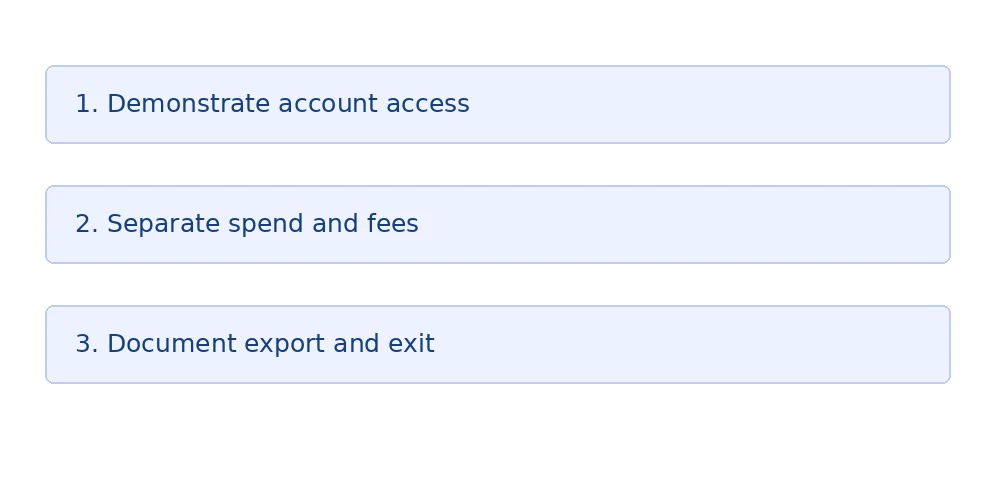
Demonstrate access, separate fees from media costs, preserve client ownership and document exit deliverables before signing.