


Quick answer: Real estate retargeting ads show your message again to sellers who visited your site but did not submit. Build audiences from site visitors and form starters, follow Meta and Google housing ad rules, cap frequency, and measure cost per contract. Growth Lab runs retargeting with prospecting for $1,500/mo, and you own every lead.
- Install your pixel or tag with a clear privacy notice and consent.
- Retarget by intent: offer-page visitors first, blog readers second.
- Exclude people who already submitted and cap how often ads show.
How retargeting ads work
Retargeting uses a tracking pixel or tag on your site to build an audience of visitors. Ad platforms then show those people your ads elsewhere.
Most sellers do not submit on the first visit. They compare options, talk to family and come back later. Retargeting keeps your name in front of them during that window. Because the audience already knows your name, retargeting ads can be simpler and cheaper than cold prospecting, but they only work at a useful scale once enough people visit. It does not create demand; it recovers people who already showed interest through search ads, Facebook ads or SEO.
Housing ad rules that limit targeting
Ads about selling or buying homes fall under special rules on major platforms. Plan your campaigns around them before you build audiences.
Meta's Special Ad Category
Meta requires advertisers to declare a Special Ad Category for housing ads. That category limits targeting by age, gender and ZIP code and changes how custom and lookalike audiences work, so check Meta's current options when you build a campaign.
Google's personalized advertising policy
Google restricts personalized targeting for housing ads in the U.S. and Canada, including by gender, age, parental status, marital status or ZIP code. Review the policy for what remains allowed.
Fair housing law also applies to your ad copy and images. HUD enforces the Fair Housing Act, which prohibits discriminatory housing advertising.
Which retargeting audiences to build
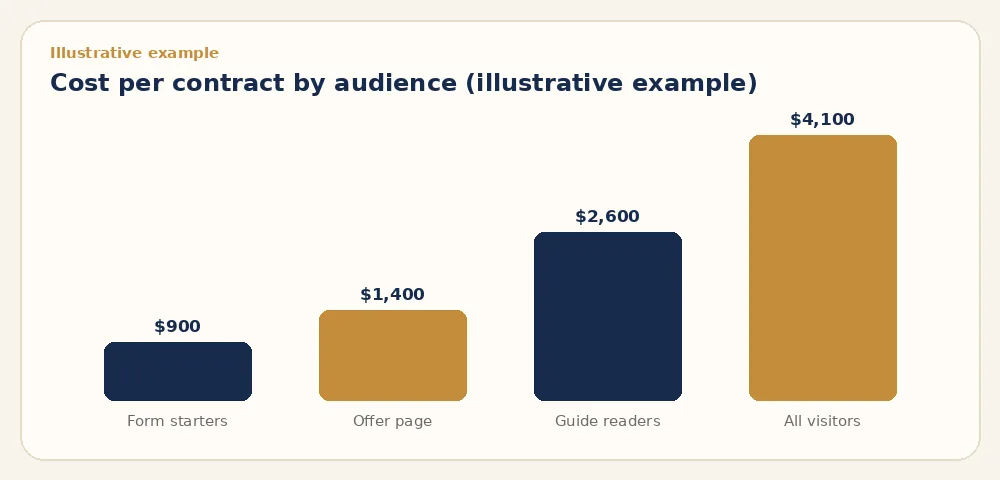
Segment by how close the visitor came to submitting. The closer they got, the more you can spend to bring them back.
- Form starters: began the offer form but did not finish.
- Offer-page visitors: saw your cash offer or process page.
- Guide readers: read a seller guide on a specific situation.
- Exclusions: anyone who submitted, plus existing clients.
Use the platform's audience options that remain available under housing rules. If a platform blocks a segment, use a broader one rather than a workaround.
| Audience (illustrative example) | Window | Relative bid | Exclude |
|---|---|---|---|
| Form starters | 14 days | Highest | Submitted leads |
| Offer or process page visitors | 30 days | High | Submitted leads |
| Seller guide readers | 60 days | Moderate | Submitted leads, clients |
| All visitors | 90 days | Low | Submitted leads, clients |
What should a retargeting ad say?
Answer the question that stopped them. A visitor who left the offer page may be unsure about price, timing or trust.
- Show how your process works in three steps.
- Explain that there are no repairs or showings, if true.
- Link back to the exact page they left, ideally with the address field ready.
Test two or three versions at a time and rotate creative every few weeks and cap frequency so the same person does not see you every hour. Seeing the same ad many times a day feels like being followed and can push a seller toward a competitor. Use real photos of your team or process rather than stock images of luxury homes, and keep the promise in the ad identical to what the landing page delivers. Our landing page guide covers what the return visit should land on.
Privacy and consent for tracking pixels
Tell visitors what you track, who receives the data and how to opt out. Your privacy policy should describe pixels, cookies and ad partners.
The FTC has acted against companies whose tracking did not match their privacy promises. Some states require opt-outs for targeted advertising. Load tags only as your consent setup allows, and do not send sensitive form fields, such as financial details, to ad platforms.
How to measure retargeting
Measure signed contracts, not clicks or impressions, and give each audience at least a few weeks of data before you judge it. Retargeting often looks cheap per lead because it reaches warm visitors, so compare it on cost per signed contract.
Use call tracking and CRM stages to see which leads closed. Our guide to call tracking and cost per contract covers the setup.
Check that retargeting adds new contracts
Some people a retargeting ad reaches would have come back anyway. To see the real effect, compare contract volume in periods with and without retargeting, or use a platform's lift test where housing rules allow it. If contracts do not change when the ads pause, move that budget to prospecting.
Retargeting with Growth Lab
DispoKey Growth Lab builds prospecting and retargeting campaigns for investors for $1,500/mo, inside each platform's housing rules. You own every lead and contract, and DispoKey dispo is optional. We report cost per lead and per contract; we never guarantee lead counts or returns. Book a call.
When DispoKey may not be your best option
Retargeting needs traffic. If your site gets only a few hundred visitors a month, audiences will be too small to run well. Build search or social prospecting first, and plan on three or more months of ad budget.
Key takeaways
- Retargeting recovers warm visitors; it does not replace prospecting.
- Housing ads face targeting limits on Meta and Google.
- Segment by intent and exclude people who already submitted.
- Judge campaigns by cost per contract.
Frequently asked questions
Do retargeting ads work for real estate investors?
They can recover sellers who visited but did not submit. Results depend on traffic volume and message, so track cost per contract.
Are real estate retargeting ads restricted?
Yes. Meta's housing Special Ad Category and Google's housing policy limit some targeting options in the U.S.
How long should a retargeting window be?
Shorter for high-intent visitors, such as 14 to 30 days, and longer for guide readers. Test against your own data.
Does Growth Lab guarantee leads?
No. Growth Lab costs $1,500/mo, never guarantees lead counts or ROI, and clients own every lead.
Official references
- Meta Business Help: About Special Ad Categories
- Google Ads: Personalized advertising policy
- HUD: Fair housing rights and obligations