

Quick answer: Facebook and Instagram can produce motivated-seller leads, but real estate ads fall under Meta's special ad category for housing, which restricts targeting by age, gender, ZIP code and detailed demographics. Build campaigns around geography and broad audiences, send leads to a fast form, and judge results on cost per signed contract — not cost per lead. DispoKey's Growth Lab runs this for $1,500/mo and you own every lead.
- Declare the housing special ad category on every campaign.
- Target by geography; demographic targeting is restricted.
- Use lead forms for volume, landing pages for quality.
- Track cost per contract, not cost per lead.
Meta is the second major paid channel for seller leads after search, and it behaves differently: people are not searching for you, so the creative and the follow-up speed do the heavy lifting. This guide covers the rules that shape real estate campaigns, a structure that works within them, and honest measurement. It pairs with direct mail vs PPC and call tracking.
What is Meta's special ad category for housing?
Meta requires ads that promote housing opportunities or related services — including real estate and house-hunting services — to run under a declared special ad category. [1] Campaigns in this category lose access to age, gender and ZIP-code targeting, and detailed demographic, behavior and interest options are limited. Lookalike audiences are replaced by special ad audiences built without those attributes.
This is not just platform policy. HUD's Office of Fair Housing and Equal Opportunity has published guidance on how the Fair Housing Act applies to housing ads delivered through digital platforms, including algorithmic targeting that can steer ads toward or away from protected classes even without the advertiser's intent. [2] The Act itself, at 42 U.S.C. 3604, prohibits discriminatory housing advertising. [3] The practical takeaway: keep your audiences broad and your creative neutral, and never write copy that excludes or preferences any group of people.
A campaign structure that works within the rules
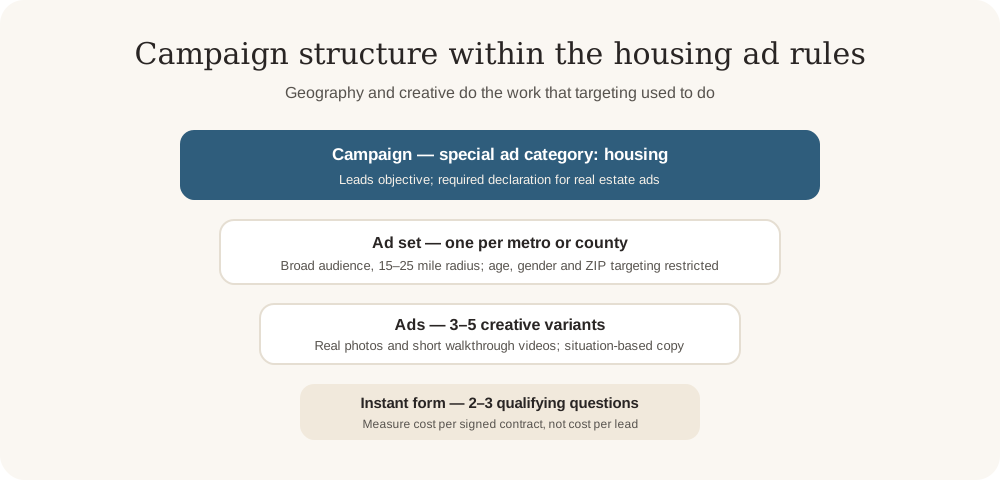
With targeting restricted, structure does the segmentation work.
| Level | Setting | Why |
|---|---|---|
| Campaign | Special ad category: housing; leads objective | Required for real estate; leads objective matches the goal |
| Ad set | One per metro or county; broad audience, 15–25 mile radius | Geography is the main allowed lever |
| Ad | 3–5 creative variants per ad set | Creative, not targeting, finds the motivated sellers |
| Form | Instant form with 2–3 qualifying questions | Volume with a light quality filter |
What creative works for seller leads?
Seller-facing creative should speak to situations, not demographics: inherited homes, repairs the owner does not want to make, a fast and simple sale. Real photos of real houses outperform stock-looking graphics, and short video walkthroughs of actual rehabs build trust fast. Avoid any wording that implies you know personal facts about the viewer — "we know you're behind on payments" style copy is both a policy problem and a trust killer.
Lead forms or a landing page?
Instant forms produce more leads at a lower cost per lead because the user never leaves the app; landing pages produce fewer, better-qualified leads because the extra step filters casual clicks. Run both for a month and compare them on cost per qualified conversation, not cost per lead. Whichever you use, speed to contact decides the outcome — our speed-to-lead data shows why minutes matter.
How should you measure Meta campaigns?
Cost per lead is a vanity metric in this business. The chain that matters is: spend → leads → qualified conversations → appointments → signed contracts. Track each step in your CRM and reconcile it against ad-platform numbers monthly, because the platforms count differently than your books do — see why Ads and CRM counts disagree. As a labeled example only: $3,000 of spend producing 60 leads, 12 qualified conversations and 1 signed contract is a $3,000 cost per contract — good or bad only against your average assignment fee.
How do you attribute phone calls from ads?
Seller leads often call instead of filling a form, so give each campaign its own tracking number and record the source before the conversation starts. Without that, Meta campaigns get credit for nothing and your cost-per-contract math is fiction. The full setup is in our call tracking guide, including the federal recording-consent rules.
How much budget do you need?
Plan for a learning period, not instant results. A common working floor is enough monthly spend to generate a statistically meaningful number of leads in your market — for most metros that means a four-figure monthly budget sustained for at least three months before judging the channel. If that commitment is not available, direct mail or organic channels may fit better; cost per contract by channel compares them honestly.
What does Growth Lab do differently?
Growth Lab is DispoKey's in-house ad program for wholesalers and investors: $1,500 per month, and you own every lead and every contract. We build and run the campaigns, handle the special ad category setup and report on cost per contract. DispoKey disposition is an optional safety net — if your own buyers take the deal, you keep 100%. See how Growth Lab works.
When Growth Lab may not be your best option
If you cannot sustain at least three months of ad spend plus management, paid social will disappoint you. If your deal flow already exceeds your capacity, fix disposition first. And if you want someone to guarantee a lead count, we are the wrong fit — we do not guarantee lead counts or ROI, and neither should anyone else.
Key takeaways
- Real estate ads must run in Meta's housing special ad category, with restricted targeting.
- Fair housing law applies to digital ad delivery, not just to the words you write.
- Geography and creative do the segmentation work that targeting used to do.
- Judge campaigns on cost per signed contract, reconciled against your CRM.
Frequently asked questions
Do Facebook ads work for motivated sellers?
They can, but the leads are interruption-based, not search-based, so quality varies more than with search ads. Fast follow-up and honest measurement on cost per contract decide whether the channel pays.
What is the special ad category for housing?
Meta's required classification for ads promoting housing opportunities or related services. It removes age, gender and ZIP-code targeting and limits detailed demographic and interest options, to reduce discriminatory ad delivery.
How much should I spend on Facebook ads?
Enough to generate a meaningful number of leads per month in your market, sustained for at least three months. For most metros that is a four-figure monthly budget; below that, results are too noisy to judge.
Lead forms or landing pages?
Run both for a month. Instant forms win on volume and cost per lead; landing pages win on lead quality. Compare them on cost per qualified conversation, not cost per lead.
References
- About ads for housing — Meta Business Help Center.
- Guidance on Application of the Fair Housing Act to Advertising through Digital Platforms — HUD Office of Fair Housing and Equal Opportunity.
- 42 U.S.C. 3604 Discrimination in the sale or rental of housing — GovInfo.