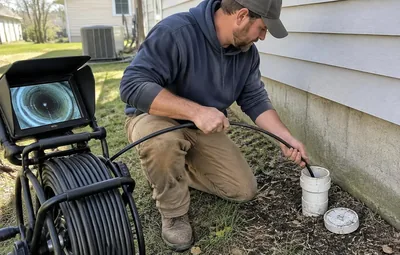
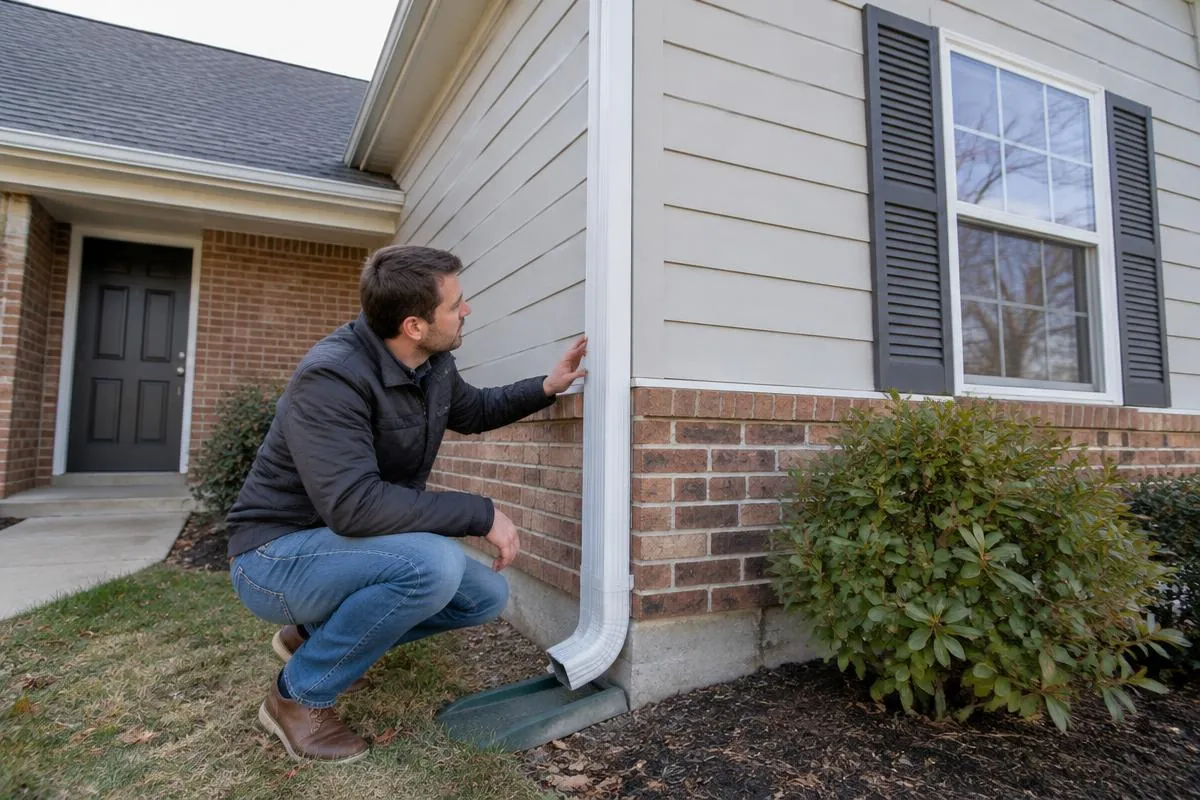
Check home insurance claims history before buying a rental by asking the seller for a property-specific CLUE report, matching reported losses to repair records, and having your insurance agent review the intended rental use. DispoKey recommends resolving missing evidence before committing; CLUE can contain up to seven years of claims.
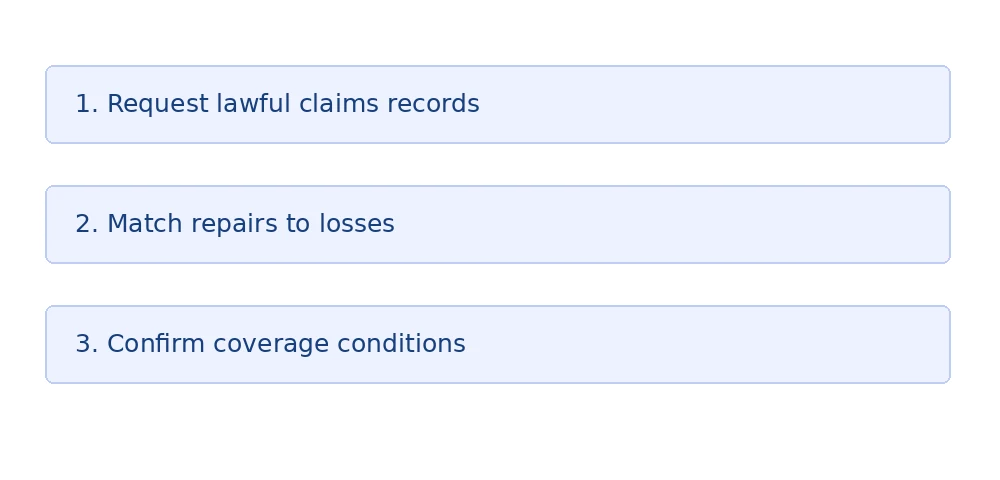
- Request the seller’s report through a lawful disclosure process.
- Connect each loss to repairs and remaining questions.
- Confirm rental-use underwriting and coverage conditions separately.
Start with a claims-evidence checklist before making commitments
Build a small evidence file before relying on a premium estimate. The useful deliverable is not simply a report: it is a documented connection between the reported loss, the repair, and the insurer’s current requirements.
Open the rental acquisition claims-history checklist
- Confirm the exact street address, unit designation, seller, and report date.
- Ask the seller to obtain and share the property’s relevant CLUE information.
- Record each loss date, loss type, payment, and claim status where shown.
- Request repair invoices, permits where required, warranties, and completion evidence.
- Tell your agent about rental occupancy, vacancy, planned work, and ownership structure.
- Track open underwriting questions, responsible people, and contractual decision deadlines.
Keep personal identifiers out of a broadly shared acquisition folder. Ask for only the relevant property information, and use a secure channel for documents that contain policyholder details.
Ask the seller for CLUE information; do not impersonate an owner
A prospective purchase does not make the seller’s consumer report yours to order. Ask the owner to obtain and share the relevant report, and let your licensed agent explain any lawful insurer-side inquiry.
The Washington Office of the Insurance Commissioner specifically advises buyers to ask the current owner for a CLUE report because a prospective buyer cannot obtain the owner’s report independently. It also explains that insurers use claims history when deciding whether to offer coverage and at what price. [2]
For an entity-owned rental or a property insured commercially, ask the agent whether carrier loss runs or other loss-history records are needed in addition to personal-property CLUE information. Do not assume a consumer disclosure covers every prior ownership or policy arrangement. If the seller cannot supply records, document that gap rather than describing the property as claim-free.
Read loss details rather than treating every claim equally
Use the report to identify what needs verification, not to assign a universal pass-or-fail score. Washington lists fields including date of loss, type of loss, amount paid, policy information, and the covered property’s description. [2]
Separate a single repaired event from repeated losses that may point to an unresolved source. A payment is not a repair certificate. Likewise, a denied claim does not prove the underlying condition was harmless; ask what happened and what, if anything, was corrected.
Match every material loss to repair evidence and underwriting
Connect each relevant claim to a repair record and a current insurance question. A clean-looking room cannot establish whether the water source was fixed, while a contractor invoice alone cannot establish that your intended policy will cover future losses.
For water damage, ask whether the source was plumbing, roof leakage, drainage, or another cause. Request the scope of work and completion date. Where facts warrant it, obtain an appropriate specialist’s assessment through whatever access the parties actually authorize.
For roof or fire losses, reconcile the reported event with replacement records and any applicable permits. Ask your agent which documents the underwriter needs and whether unresolved conditions affect eligibility, deductibles, exclusions, or the ability to bind coverage. Those answers are carrier- and property-specific.
The CFPB says CLUE collects and reports up to seven years of home insurance and personal-property claims for underwriting and pricing. That historical window is useful, but it is not a warranty that every defect or uninsured repair appears. [1]
Use a decision table to separate evidence gaps from deal economics
Choose the next action from the unresolved evidence, not from the claim count alone. This buyer workflow is an editorial decision aid, not an insurer’s underwriting rule.
Labeled example: turn a claims finding into a cash-flow adjustment
A claims review can change both recurring expenses and one-time cash needs. The following hypothetical numbers illustrate the calculation; they are not DispoKey deal results, quotes, or market averages.
Assume your preliminary rental model uses $1,800 annual insurance and shows $300 monthly cash flow. After reviewing a prior water loss and the intended rental use, the agent supplies a comparable-coverage indication of $3,000 annually. The increase is $1,200 annually, or $100 monthly, reducing modeled cash flow to $200.
If a specialist also recommends a $2,500 correction, record that separately in acquisition cash or the repair budget. Do not divide it into the premium or count it twice. Then test whether the deal still meets your own return and reserve requirements. A cheaper indication with a different water exclusion is not an equivalent comparison.
Correct errors, but do not assume a dispute secures coverage
Ask the person whose report contains the error to pursue correction with the reporting company and the information provider. The CFPB explains the right to dispute inaccurate or incomplete consumer-report information and receive a reasonable investigation without charge. [1]
If an insurer takes adverse action against a consumer based partly or entirely on information in a consumer report, the Fair Credit Reporting Act requires an adverse-action notice. The notice must identify the reporting agency and explain the consumer’s rights to obtain a free report from that agency within 60 days and dispute inaccurate or incomplete information. These are consumer-report protections, not guaranteed approval or a promise that your purchase deadline will change. [3]
When DispoKey may not be your best option
DispoKey may not fit if you require guaranteed insurance eligibility, a financing contingency, or an assured inspection period. Buyers must establish their own property condition, coverage, numbers, and contractual protections.
For Buy & Hold acquisitions, make loss-history review part of repeatable diligence; Fix & Flip buyers should also disclose their actual renovation and occupancy plans. Explore DispoKey’s buyer process or submit a buyer application. Marketplace access requires team approval; applying does not provide instant access.
Keep the report, repair trail, and coverage decision separate
A CLUE report starts the investigation; it does not finish it. Preserve three distinct conclusions: what was reported, what was repaired, and what coverage is available for your use.
Related reading: rental property cash flow analysis , renovation insurance, and the due diligence period glossary. Your signed agreement controls available rights and deadlines.