Quick answer: For a rental purchase, a sewer scope is useful only when you know what was inspected and what remains unseen. Request the dated recording, written findings, access point and endpoint. If the camera stopped early, treat the unviewed segment as unresolved; obtain a documented next step before relying on a repair allowance.
- Match footage to the correct property and lateral.
- Record where inspection began and ended.
- Separate visible findings from unviewed sections.
- Price a defined repair scope, then preserve completion evidence.
The buying decision is not simply whether to order a camera inspection. It is whether the resulting evidence supports the budget you are about to accept. This guide owns incomplete or poorly documented footage in a rental acquisition. The sewer-scope glossary entry retains the broader definition and general inspection overview.
Define coverage before booking the scope
Ask which lateral or laterals the appointment covers, how the operator expects to gain access and what deliverables you will receive. A duplex address does not prove both units share one complete drain route. Request a simple property sketch if the layout is unclear, and mark each route as confirmed or still to be established.
Springfield, Missouri describes sewer laterals as the connection from a building to the public sanitary sewer system and recommends homebuyers schedule a lateral inspection. Its guidance identifies physical condition, visible defects, obstructions and root interference as inspection targets. That supports obtaining condition evidence, not assuming a short video proves every segment is sound. [1]
For occupied properties, coordinate the appointment through the transaction's authorized access process. Do not invent tenant-entry rights or promise access on a particular day. Use the broader tenant-occupied purchase checklist for the surrounding acquisition file, while keeping this inspection request tied to a specific system.
Inspect the inspection file before reading the conclusion
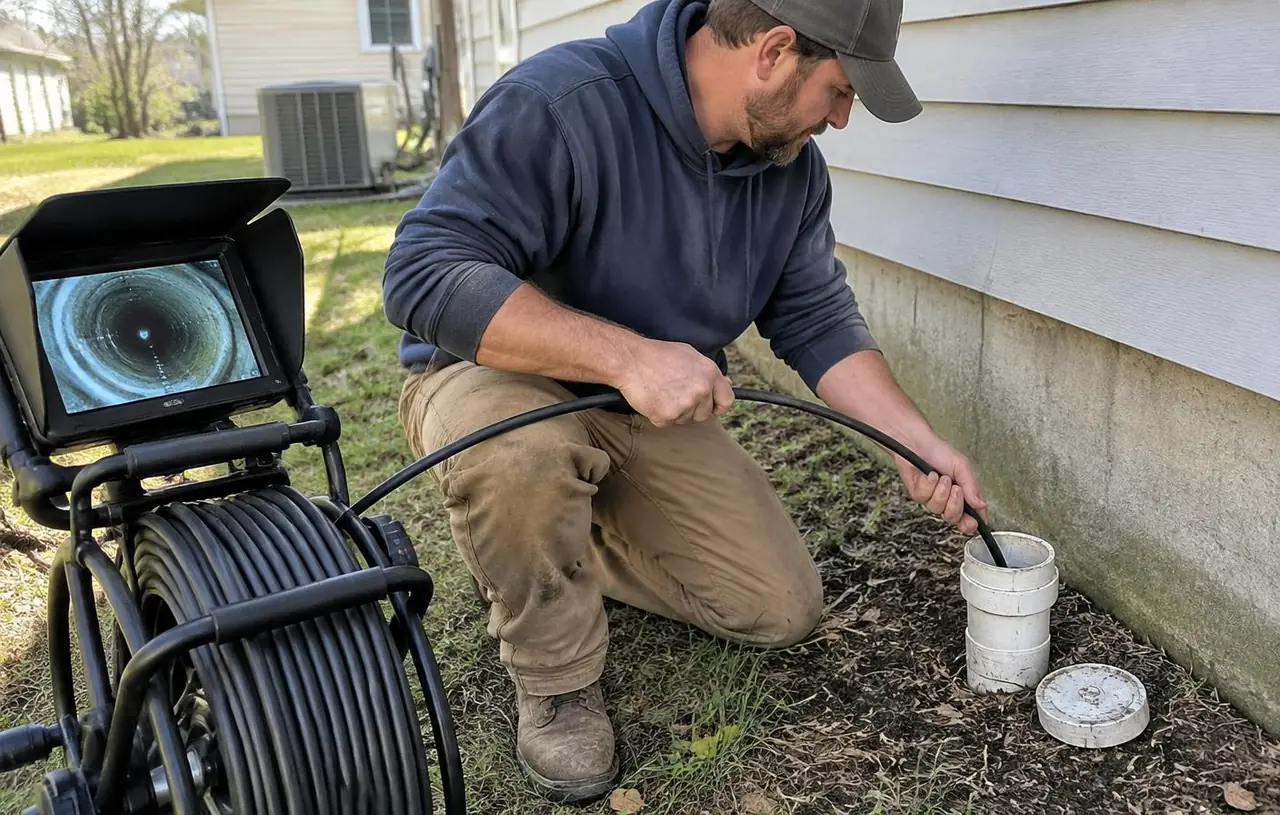
Check the property identifier, date, operator, access point and recorded endpoint. Save the original recording and a readable written summary together. If the report says only “line inspected,” ask what that means geographically. The operator should distinguish what the camera reached from what someone assumes lies beyond it.
Open the footage acceptance checklist
- Correct property and appointment date.
- Access point and inspected route identified.
- Endpoint described rather than presumed.
- Distances or other finding locations provided where available.
- Visible findings separated from interpretation.
- Unviewed sections and recommended follow-up recorded.
- Report, video and any estimate refer to the same route.
Do not personally diagnose a collapsed pipe from one frozen frame. Ask the operator to explain the observed finding and its limits. A clear record can say “camera could not pass this location” without proving why. Preserve that distinction when discussing price, cleaning or a second appointment.
What if the camera stops before the intended endpoint?
Mark the inspected segment complete only to the documented stopping point. Ask what prevented further travel, whether another access point is available and what action would allow a useful follow-up. These are requests for an inspection plan, not instructions to perform cleaning or excavation yourself.
| Starting point | Next step | Outcome | |
|---|---|---|---|
| Footage received | — | Confirm address, route and endpoint | |
| Complete documented route | Review findings | Obtain defined repair scope if needed | |
| Camera stopped early | Record unseen segment → Plan follow-up | Reassess evidence | |
| Repair completed | Collect invoice and follow-up record | Update acquisition budget |
Separate camera evidence from local compliance
A private inspection report is not automatically the document a local sewer authority requires. Identify the actual service provider and ask which records, tests or certificates apply to the address. Avoid borrowing a nearby city's requirements because its website is easier to find.
Ventura's published change-of-ownership FAQ describes its own inspection-record process and recognizes certain permit records for repairs or replacement within its stated period. Its rule is local, not a national standard. The useful workflow is to connect the address, authority and required record rather than treating any camera clip as compliance. [2]
Oro Loma Sanitary District separately describes a sale-related certificate program for escrows entering on or after August 1, 2026, including an existing-certificate check and inspection/testing steps when needed. Verify service-area applicability before using that process. Different official programs are evidence that the acquisition file needs an address-specific answer. [3]
Turn findings into a priced scope
Ask estimates to identify the defect location, proposed method, access needs, surface restoration and excluded work. Compare estimates covering the same section. A low figure for cleaning does not compete with a replacement estimate unless both genuinely address the same documented problem.
Keep separate lines for confirmed work, further investigation and a planning reserve. In rehab cost estimating, the larger budget needs a defined scope; this inspection file supplies the evidence for one buried system. Do not use a generic cost-per-foot figure as a substitute for a property-specific quote.
Hypothetical example: an incomplete duplex inspection
Hypothetical example, not a customer result: A duplex buyer receives 38 feet of footage. The written note says the camera stopped at an obstruction and does not confirm reaching the intended endpoint. A $650 cleaning estimate and a $7,800 repair estimate arrive. Neither number alone resolves the unviewed segment.
The buyer asks both providers to identify the covered route and requests a follow-up inspection plan. A revised written proposal prices cleaning plus a second recording at $950, with repair work excluded. That is a $950 investigation option, not proof the property has only a $950 problem. The original repair estimate remains a proposal to compare against later findings.
Retain evidence after the purchase decision
Keep the baseline video, findings, accepted proposal and any completion record in the property file. If the seller arranges work, request documentation tied to the same location and route. Mark unresolved items explicitly so property management does not inherit a vague note saying only “sewer checked.”
When DispoKey may not be your best option
If your acquisition budget depends on an unviewed segment being defect-free, resolve that uncertainty before treating the deal as ready. DispoKey serves Fix & Flip and Buy & Hold buyers; participation requires team approval. Use the buyer inquiry and provide credentials by call or email, never text. No instant-access or inspection-period promise is made.
Key takeaways
Verify the inspection's identity, route and endpoint. Separate visible findings, unknown coverage and local compliance records. Price the actual proposed work and keep investigation costs distinct from repair costs. A documented unknown is more useful than a clean-sounding conclusion that the recording cannot support.
Frequently asked questions
Does an incomplete camera inspection mean the whole lateral needs replacement?
Not by itself. Ask the operator to document why inspection stopped and what follow-up would establish coverage. Keep any replacement proposal tied to its stated findings rather than treating missing footage as a diagnosis.
Is a sewer video the same as a compliance certificate?
No. Local authorities can have separate record, test or certificate processes. Identify the service area and obtain the applicable official requirements for that property; examples from another city do not establish compliance.
Can a cleaning invoice close the inspection issue?
It documents the billed service, not necessarily the condition of a previously unviewed segment. If the question was incomplete coverage, request the agreed follow-up recording and written findings before marking the evidence gap resolved.
References
- Sewer Laterals — City of Springfield, Missouri.
- Private Sewer Lateral FAQs: Change of Property Ownership — City of Ventura.
- Private Sewer Lateral Inspection Program — Oro Loma Sanitary District.