
Quick answer: Selling a house from out of state requires a local access plan and an approved signing process. DispoKey helps coordinate those responsibilities, but remote signing is an option to confirm, not assume. Establish the settlement professional, document requirements, secure proceeds instructions and property handoff before promising a date or booking travel.
- Gather the records before committing money or dates.
- Separate verified facts from planning assumptions.
- Write down the next action, its owner and the review date.
Start with a remote-sale control checklist
Identify every owner, anyone signing in a representative capacity and one local person who can manage authorized access. Gather ownership records, mortgage information and existing disclosures. Confirm who conducts settlement, which documents require notarization and whether originals must be delivered. Record a responsible person and completion evidence for each task, not just an intended date.
Distance makes unclear responsibility expensive. A neighbor can report an unlocked door without having permission to negotiate a repair or release keys to a buyer. Keep property oversight separate from legal authority to sign. Share a task list containing ordinary deadlines, not identity documents, full account numbers or other sensitive information.
Separate the property plan from the transaction plan
The property plan covers authorized visits, condition checks, agreed work, essential services and handoff. The transaction plan covers ownership review, sale terms, signatures, accepted documents and settlement. Connect the two through one coordinator so an access appointment does not become an informal promise that closing is complete.
A local helper should know whom to call when something changes, what may be approved without you and what requires a decision. Ask for dated photographs when useful, but do not treat a casual check as an inspection. If another person will sign, have the settlement professional confirm acceptable authority before relying on that arrangement.
Confirm the actual signing method early
Remote closing can describe electronic signatures, an approved notary visit, mailed originals or a mixture of methods. CFPB’s archived eClosing overview explains electronic access, signing and submission, but does not establish current eligibility for your state or your sale. Ask the professional conducting this transaction to approve the method and your signing location. CFPB eClosing background is context, not universal permission.
Request a written list: who signs, which documents can be electronic, which need notarization, which need originals, acceptable identity documents and delivery deadlines. Ask what happens if a signature or package is rejected. Owners in separate states may need different appointments. Do not assume travel is unnecessary until the plan is approved.
Use milestones rather than one vague closing date
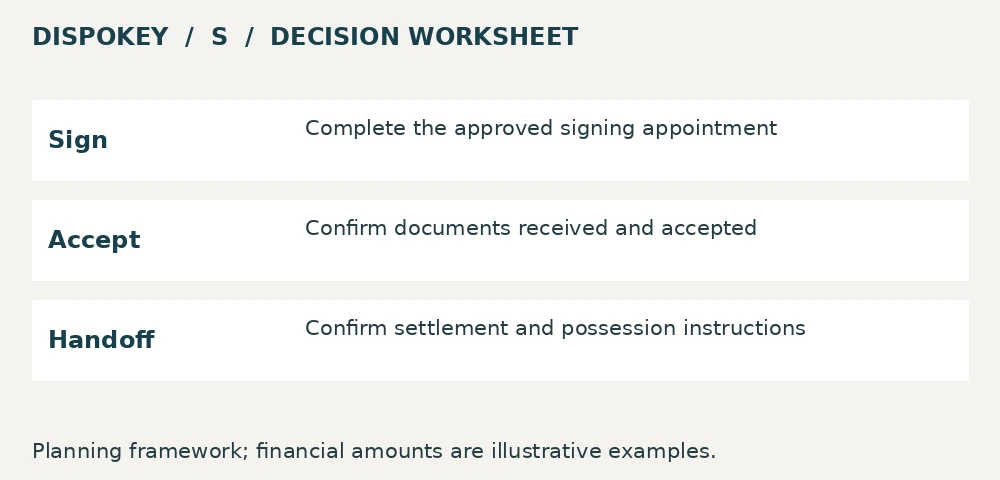
A signing appointment is not the same as documents being received and accepted. Ask the settlement office to define the milestones that matter for proceeds and possession in your transaction. Put the deadline for each original package beside the appointment date so a courier delay is visible before everyone plans around settlement.
| Step | Decision |
|---|---|
| Sign | Complete the approved signing appointment |
| Accept | Confirm documents received and accepted |
| Handoff | Confirm settlement and possession instructions |
Illustrative scenario: two owners complete separate appointments, but one original package is delayed. The coordinator confirms the affected deadline and whether the settlement date must change. The local helper waits for authorized possession instructions before releasing keys. This is a planning example, not a statement of the legal order of closing events in every state.
Keep access and property oversight controlled
Choose one access coordinator rather than spreading codes widely. Record who may enter, the purpose of entry and the expected completion report. If the house is empty, ask the insurer about the actual occupancy situation and applicable policy conditions. This article does not assume that an existing policy covers every vacancy arrangement.
Coordinate lawn care, weather checks and essential services appropriate to the house. These are practical tasks, not universal legal duties. A paid local service may be worthwhile if no reliable helper is available. Compare the move-timing questions in relocation selling options with selling with tenants when occupancy continues.
Protect proceeds from changed instructions
Establish a secure channel for identity and payment details before using it. CFPB describes closing scams involving compromised communications and false last-minute wiring instructions. Its guidance is buyer-focused; the communication pattern is also a useful warning when a seller receives unexpected requests involving proceeds. CFPB’s closing-fraud guidance explains the risk without giving a seller-specific legal procedure.
Pause on an unexpected change and verify through a previously established, independently confirmed contact. Do not rely on the new telephone number contained in the change message. Ask how the settlement office authenticates instructions and confirms receipt. A broadly shared spreadsheet should show that instructions are verified, never the complete banking details themselves.
Reconcile proceeds and tax records separately
Sale price is not the amount you keep. Request an estimate separating mortgage payoff, agreed credits, seller expenses and other deductions. If settlement moves, recheck date-sensitive amounts rather than carrying an old number forward. The changed-closing payoff guide covers that reconciliation in detail.
Moving away does not alone decide federal home-sale tax treatment. IRS Publication 523 explains ownership and use tests, exceptions and rental-use complications. Gather purchase records, improvements, occupancy dates and any rental history. Check the rules applying to your facts instead of assuming either that all gain is excluded or that moving makes all proceeds taxable. IRS Publication 523 is the official federal reference.
Compare the cost of coordination
Illustrative example only: a seller estimates $600 for local oversight, $150 for approved document delivery and $250 for one extra month of essential services. Those chosen allowances total $1,000. A second scenario requiring $800 of travel would total $1,800 if the other expenses stay unchanged. These are not quoted fees or a recommendation to avoid travel.
Ask which expenses are certain and which depend on the accepted closing method. Remote logistics can save a trip but may still require paid local help or delivery. Keep the comparison alongside the estimated proceeds and contingencies. A slightly higher offer can be less useful if it requires a schedule or access arrangement you cannot reliably support.
When DispoKey may not be your best option
A traditional listing may fit when you want broad exposure and can fund preparation and local coordination. Distance alone is not a reason to choose a cash offer. An as-is route may suit a seller who wants fewer pre-sale projects, provided the price and written terms meet the seller’s priorities.
Review DispoKey selling options and request an offer. A Seller Success Manager helps coordinate the process. The seller pays a $0 DispoKey fee; the agreement explains other expenses. Close in as little as 21 days subject to title, signing and transaction requirements, not as a guaranteed date.
Key takeaways
- Make the decision from documented inputs, not a headline promise.
- Keep costs, timing and responsibilities visible.
- Recalculate when material facts change.
Frequently asked questions
Can I sell without returning to the property?
Possibly. Confirm the acceptable signing method and arrange authorized local access; electronic signatures do not automatically eliminate notarization or original-document requirements.
Can someone else sign for me?
Ask the settlement professional to verify the required and acceptable authority before relying on another person to sign.
Does moving away eliminate the home-sale exclusion?
Not automatically. IRS eligibility depends on ownership and use history, timing, prior exclusions and other applicable rules.