


Quick answer: Selling a house during divorce takes both owners' signatures or a court order, a written payoff, and a clear rule for splitting what is left. Each qualifying owner may exclude up to $250,000 of gain under IRS rules. DispoKey buyers make as-is cash offers and can close in as little as 21 days.
- Confirm who is on the deed and the loan.
- Check whether your case limits selling shared property.
- Agree in writing on price, repairs and who pays what.
- Tell the title company how proceeds are held or split.
A divorce turns one household decision into two. The house is often the largest shared asset, and every week it sits unsold means another mortgage payment, another utility bill and another argument about the lawn. For the basic term, see our divorce sale definition.
Can I sell my house during a divorce?
Usually yes. A home can be sold during a divorce when every owner on the deed signs, or when a judge authorizes the sale.
Courts in many states issue standard orders when a case is filed that restrict selling or moving shared property without the other spouse's written consent or court permission; California's family law summons, for example, includes such standard orders. Read the orders in your own case file or ask the clerk where to find them; the Los Angeles Superior Court publishes self-help material for its family division. [3]
Does my state split the house equally?
Not always. A handful of community property states start from an equal split of marital property, while most states divide it in a way the court finds fair, which may not be 50/50.
That rule decides how proceeds are divided, not whether the sale can happen. Your agreement or judgment is what the title company follows.
| Situation | Who signs | Who decides the split |
|---|---|---|
| Both on deed, agree to sell | Both owners | Written settlement agreement |
| Both on deed, one refuses | Court order may be needed | Judge's order |
| Only one on deed, home is marital | Owner on deed, plus spouse if state law requires | Agreement or judgment |
| Divorce final, order requires sale | Parties named in the order | The final judgment |
How to sell a house during a divorce, step by step
Treat the sale like a business deal between two parties who both want the most cash and the fewest surprises. Six steps cover most cases.
Open the six-step checklist
- Pull the deed and loan. Get the recorded deed from the county recorder and the latest mortgage statement. Note every name on each.
- Read your case orders. Confirm whether you need written consent or court approval before listing or accepting an offer.
- Order a payoff. Ask the servicer for a written payoff good through a target closing date, plus any home equity line.
- Agree on price rules. Decide in writing the lowest acceptable price, who approves offers and how fast each person must respond.
- Decide who pays carrying costs. Mortgage, taxes, insurance and utilities keep running until closing.
- Give the title company instructions. Proceeds can be split at closing, paid to one attorney's trust account or held until the court rules.
What if one spouse refuses to sell?
The other spouse can ask the court to order a sale or set a buyout deadline. Judges usually want a valuation and a plan for the mortgage before deciding.
How proceeds are divided: a worked example
Closing pays the debts tied to the house first, then splits what remains by your agreement. Here is a hypothetical example with labeled numbers.
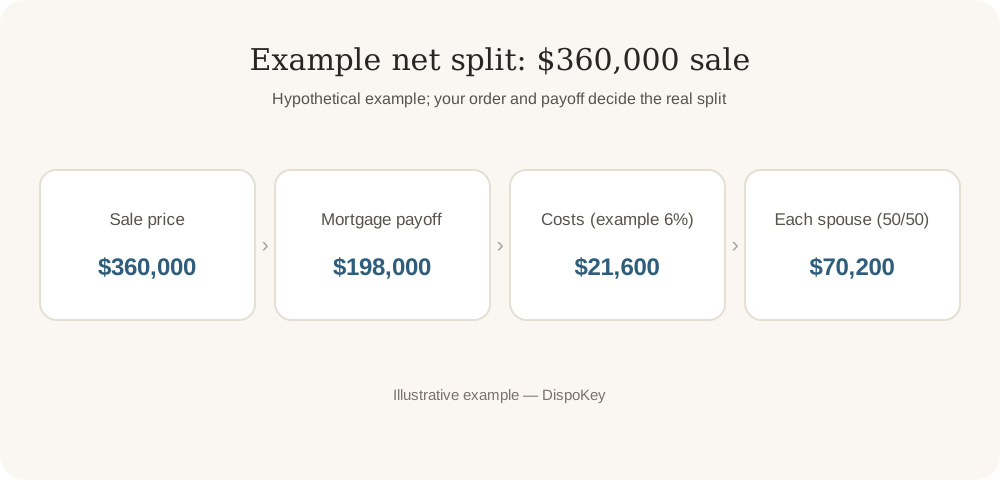
- Example sale price: $360,000
- Mortgage payoff: $198,000
- Selling costs (example 6%): $21,600
- Net proceeds: $140,400
- Each spouse at an equal split: $70,200
Unequal splits are common, for example credit for one spouse paying the mortgage alone since separation. Write credits down before closing. Test prices with our cash offer calculator.
Do we pay taxes when we sell the house in a divorce?
Often not. Each owner who meets the ownership and use tests can exclude up to $250,000 of gain, and a married couple filing jointly can exclude up to $500,000.
IRS Publication 523 sets the eligibility test: you generally must have owned and lived in the home as your main home for at least 24 months of the 5 years before the sale. It also has rules for separated and divorced taxpayers, including when a former spouse's use of the home can count toward your own. [1]
What if one spouse transfers the house to the other?
A transfer between spouses, or to a former spouse incident to the divorce, is generally treated as no gain or loss.
IRS Publication 504 explains that the receiving spouse takes over the original tax basis, so the tax question returns when that spouse later sells. [2] Keep closing statements and improvement receipts; you will need them to prove basis.
Checking the deed and tax records in your county
Before you agree on a price, confirm the facts the buyer's title company will check. County offices publish them.
In Cook County, Illinois, the Cook County Assessor lists the property characteristics, values and exemptions tied to the address. [4] In Los Angeles County, family case orders are held by the Superior Court.
Rules for selling in your state also appear on your state selling guide, including Texas and Illinois.
When a cash offer may not be your best option
If the home is move-in ready, the mortgage is current and you both agree on a listing plan, an agent sale will often bring more money. A cash offer fits better when repairs are needed, carrying costs are draining both of you or a court deadline is close.
How DispoKey handles a sale during a divorce
Enter the address for an as-is cash offer. Your Seller Success Manager sends the same written offer and updates to both owners, and the title company pays the loan and splits proceeds by your written instructions. You can close in as little as 21 days. See how a divorce sale works with us or start your cash offer.
Key takeaways
- Both owners sign, or a judge authorizes the sale.
- Debts on the house are paid first; your agreement controls the rest.
- Many owners exclude up to $250,000 of gain each under IRS rules.
- Write down credits, price rules and carrying costs before you accept an offer.
Related: updating a payoff when closing moves and selling a house with tenants.
Frequently asked questions
Can I sell my house during a divorce?
Usually yes, if both owners sign or a court authorizes the sale. Once a case is filed, many courts limit selling shared property without the other spouse's consent or a court order.
Who gets the money when a house is sold in a divorce?
The title company pays the mortgage and costs first. The rest is held or divided according to your written agreement or the court's order.
Do we pay capital gains tax when we sell during a divorce?
Many couples owe nothing. The IRS lets each qualifying owner exclude up to $250,000 of gain, or $500,000 on a joint return, if ownership and use tests are met.
Is it better to sell before or after the divorce is final?
It depends on your tax filing status, who lives in the home and what the order says. Selling before final orders needs both signatures or court permission.