
Quick answer: Selling a house with fire damage comes down to three paths: repair with the insurance payout and list, list as-is at a discount, or take a cash offer as-is. Start with your insurer's written estimate, because it sets the real repair number. DispoKey buyers make as-is offers on fire-damaged homes and can close in as little as 21 days.
- Confirm with the fire department that the house is safe to enter.
- Call your insurer before you hire anyone or throw anything away.
- Get the adjuster's estimate in writing.
- Compare nets after repairs, carrying costs and time.
A house fire turns a home into a project overnight, and the decisions that follow move real money. This guide walks through the claim, the three ways to sell, a worked net comparison with labeled example numbers, and what to tell buyers. If water from firefighting soaked floors or walls, our water damage guide covers that part, and the fire damage definition explains how buyers classify it.
What should you do first after a house fire?
Make the house safe, then document everything before anything is moved. Those first days shape your claim and every offer you get later.
When is it safe to go back inside?
Only after the fire department says so. Ready.gov tells residents to check with the fire department that the residence is safe to enter, and to contact local disaster relief such as the Red Cross for temporary housing, food and medicine. [1]
Why call your insurer before a contractor?
Ready.gov also says insured owners should contact their insurance company for detailed instructions on protecting the property, conducting an inventory and contacting restoration companies. [1] Hiring a crew first can create costs the policy does not cover.
- Photograph every room, including smoke staining on ceilings and inside closets.
- Keep receipts for board-up, tarps, lodging and meals.
- List damaged contents while your memory is fresh.
- Ask for the adjuster's estimate in writing, line by line.
What are your options when selling a fire-damaged house?
You can repair and list, list as-is, or take a cash offer as-is. Each trades cash, time and certainty differently.
| Option | Cost and time | Best when |
|---|---|---|
| Repair, then list | Repair cost; months of rebuild plus listing time | Claim covers the work, you can wait |
| List as-is | No upfront cost; listing time, financing limits | Damage is cosmetic or limited to one room |
| Cash offer as-is | No upfront cost; as little as 21 days | Structural damage or tight timeline |
When does repairing first make sense?
Repairing first fits when the insurance payout covers most of the work, contractors are available, and you can carry the mortgage, taxes and utilities through a rebuild. Keep permits and final inspection records; buyers' lenders will ask.
What happens if you list a fire-damaged house as-is?
Many lenders will not finance a house that is not habitable, so an as-is listing with major damage usually draws cash buyers and renovation loans only. Light smoke damage in one room is different and may still suit a normal listing.
How does a cash offer handle fire damage?
A cash buyer prices the rebuild into the offer and takes the house as it stands, so there is no contractor to manage and no lender to satisfy. DispoKey's buyers can close in as little as 21 days; you can request an as-is offer while the claim is still open.
Worked example: which option nets more?
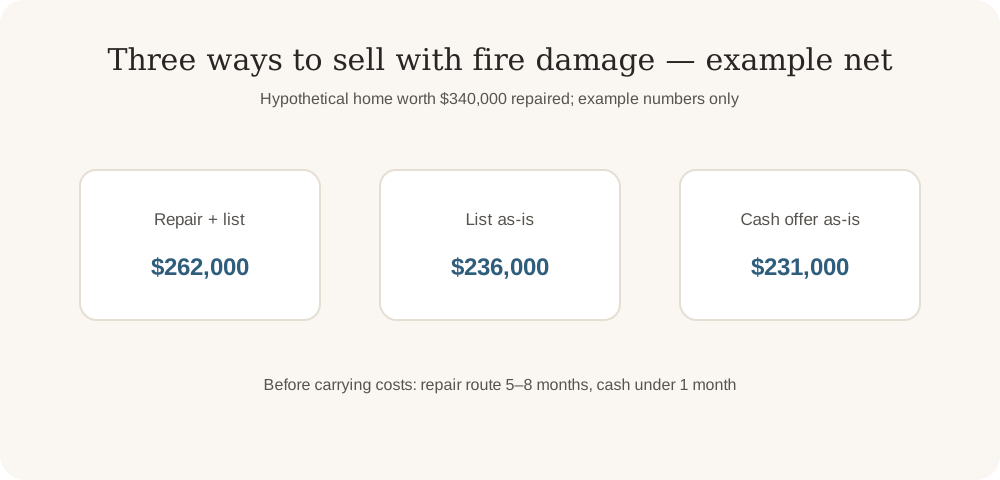
Compare net proceeds after repairs, selling costs and the months you carry the house. The figures below are a labeled example for one hypothetical home worth $340,000 repaired.
| Option (example only) | Example net | Months carried |
|---|---|---|
| Repair + list: $340,000 price, −$58,000 work not covered, −$20,000 selling costs | $262,000 | 5–8 |
| List as-is: $250,000 price, −$14,000 selling costs | $236,000 | 3–6 |
| Cash offer as-is: $231,000, no repairs or commissions | $231,000 | Under 1 |
On paper the repair route wins here, but only if the uncovered cost holds and you can fund several more months of payments. Add your own monthly carrying cost to each row; at $2,500 a month, six extra months erases $15,000 of the gap. Then compare the result with a written cash offer.
What happens to the insurance payout if you sell?
Your policy and your lender decide that, not the buyer. Read the policy's loss settlement terms and ask the adjuster how a sale affects the remaining payments.
Why is the mortgage company on the claim check?
Claim checks for the structure are often made out to you and your mortgage company together, because the lender has a stake in the house. Ask your servicer how it releases funds and whether a payoff at closing changes that.
Can you deduct a fire loss on your taxes?
Usually not for a personal residence. The IRS says personal casualty losses are generally deductible only when caused by a federally declared disaster. [2] A wildfire in a declared disaster area may qualify; a kitchen fire usually does not.
Do you have to disclose fire damage when selling?
Yes, in practice. Most state disclosure forms ask about fire, smoke and structural repairs, so answer accurately and attach repair records, permits and any clearance reports.
Should you disclose lingering smoke odor?
Yes. Smoke odor in ducts, insulation and framing often returns in humid weather, and buyers who discover it after closing have every reason to return to the disclosure. Telling them up front protects you.
What mistakes cost fire-damaged sellers the most?
Most losses come from moving too fast with the wrong people. Watch for these three.
- Signing with the first restoration crew that knocks before your insurer weighs in.
- Throwing away damaged items before they are on your inventory.
- Accepting a verbal offer without a written price and closing date.
The FTC warns homeowners to get written estimates and to be wary of contractors who solicit door to door after a disaster. [3]
When DispoKey may not be your best option
If the damage is limited to light smoke in one room, the claim covers the cleanup and you have time to list, a traditional sale will probably net you more. A cash offer is strongest when the structure is damaged, the claim is slow or short, you need to move, or you cannot carry the house through a rebuild. Compare selling as-is options before deciding.
How does selling a fire-damaged house to DispoKey work?
You share the address, what burned and where the claim stands, and a Seller Success Manager walks through it with you. Our buyers make an as-is offer that already accounts for the rebuild; there is nothing to clean out and you choose the closing date. See how the process works.
Key takeaways
- Safety first, then call your insurer before any contractor.
- The adjuster's written estimate is your real repair number.
- Compare nets after carrying costs, not headline prices.
- Disclose fire and smoke history with records attached.
Frequently asked questions
Can you sell a house with fire damage?
Yes. You can repair and list, list as-is with full disclosure, or accept a cash offer that prices in the rebuild. The best option depends on the damage, your insurance claim and your timeline.
Do you have to repair fire damage before selling?
No. You can sell as-is, but heavy damage limits financed buyers, so most as-is sales of badly burned homes go to cash buyers.
Can I sell my house while the insurance claim is open?
Often yes, but the policy and your mortgage company control how remaining claim money is paid. Ask your adjuster and servicer before you sign.
How much does fire damage lower a home's value?
There is no fixed percentage. Buyers subtract the rebuild cost, smoke remediation and risk, so a written adjuster estimate keeps the discount grounded.