

Quick answer: You can sell a house with a tax lien. The lien is usually paid from the sale proceeds at closing, so you need a written payoff figure and enough equity to cover it. Property tax liens are paid to the county; federal liens need an IRS release or discharge. DispoKey buyers make as-is cash offers and can close in as little as 21 days.
- Find out who holds the lien: county, state or IRS.
- Request a written payoff good through your expected closing date.
- Confirm your equity covers the mortgage, the lien and closing costs.
- Let the title company pay the lien from proceeds at closing.
A tax lien feels like it locks the house. In most sales it does not: closing is built to pay attached debts before anyone receives money. This guide walks through each type of lien, a worked payoff example with labeled numbers, and the mistakes that delay closings. For the basic term, see our lien definition.
Can I sell my house with a tax lien?
Yes. A lien does not stop a sale; it has to be paid or released before the buyer receives clear title.
The title company finds recorded liens during its title search. At closing, it pays them from your proceeds, along with your mortgage, using written payoff statements. What remains goes to you. The sale only stalls when nobody has a current payoff figure, or when the debts add up to more than the home is worth.
What is the difference between a property tax lien and a federal tax lien?
A property tax lien comes from unpaid county or city property taxes on that home. A federal tax lien comes from unpaid federal taxes and can reach everything you own.
The IRS describes a federal tax lien as the government's legal claim against your property when you neglect or fail to pay a tax debt, covering real estate, personal property and financial assets. [1] State tax agencies can file liens too. Property tax liens are handled locally, so the rules, interest and sale timelines differ from county to county.
| Lien type | Who you pay | What clears it at closing |
|---|---|---|
| Delinquent property tax | County treasurer or tax collector | Payoff paid from proceeds; county records payment |
| State tax lien | State revenue department | Payoff paid; state issues a release |
| Federal tax lien | IRS | Payment in full and release, or a certificate of discharge |
How to sell a house with a tax lien, step by step
Work the numbers before you sign anything. Five steps cover most sales.
Open the tax lien sale checklist
- Pull the record. Check your county treasurer's site for delinquent taxes and ask the title company to search for recorded liens.
- Request payoffs in writing. Ask each lienholder for a payoff good through a specific date, including interest and penalties.
- Get a mortgage payoff. Your servicer's figure goes on the same worksheet.
- Compare to your price. Subtract every payoff and closing costs from the expected sale price.
- Give everything to the title company. They pay each party at closing and record the releases.
How much equity do you need?
Enough to pay every lien, the mortgage and closing costs. If the total is higher than the price, you need a negotiated reduction, a discharge or another plan.
Here is a worked example with hypothetical numbers. It is not a quote.
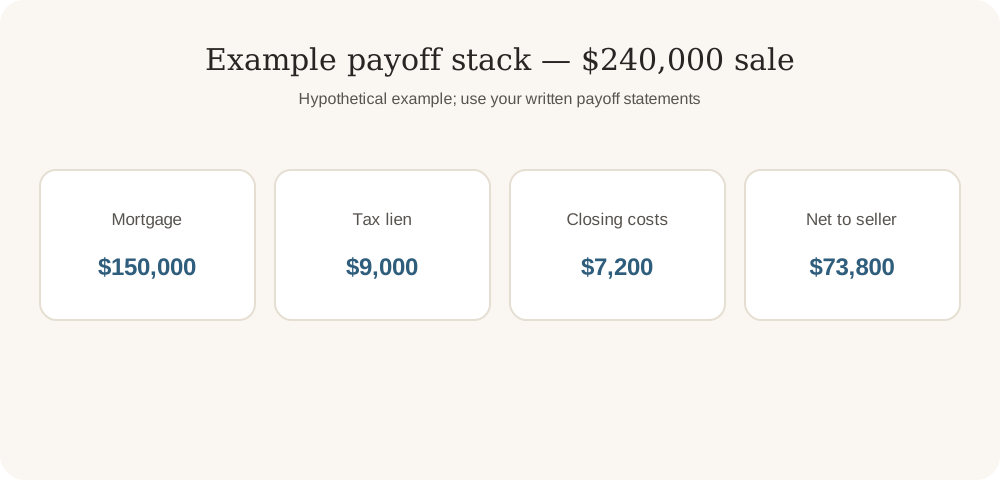
- Example sale price: $240,000
- Mortgage payoff: $150,000
- Delinquent property taxes with interest: $9,000
- Closing costs (example 3%): $7,200
- Estimated net to you: $73,800
Run the same math on your own home with our cash offer calculator, then compare it with the as-is selling options.
How do you sell a house with an IRS tax lien?
Most owners pay the IRS from the sale proceeds. If the proceeds will not cover the full debt, a certificate of discharge can release the lien from the house.
The IRS says paying the tax debt in full is the best way to get rid of a federal tax lien, and that it releases the lien within 30 days after the debt is paid. [1] A discharge removes the lien from specific property; the IRS explains how to apply in Publication 783. [2] Apply well before closing, because the buyer's title company will not close until it knows how the lien will be cleared.
Is a lien withdrawal the same as a release?
No. A release ends the lien after the debt is paid. A withdrawal removes the public notice but leaves you liable for the amount due, according to the IRS. [1]
What happens if you sell before a tax sale?
Selling before the county's tax sale usually lets you pay the delinquency and keep your remaining equity. Waiting can add penalties, fees and the risk of losing the home.
Each county sets its own notices and sale schedule. If you have a sale notice, treat the date on it as your deadline and contact the treasurer to confirm the exact payoff. Our guide to selling before foreclosure covers similar time pressure from a lender.
Where do you check delinquent property taxes?
Start with your county's official treasurer or tax collector site. Three of the largest counties publish lookups online:
- Cook County, Illinois: the Cook County Treasurer's office posts tax bills and payment status. [3]
- Los Angeles County, California: the Treasurer and Tax Collector handles secured property tax payments. [4]
- Harris County, Texas: the Harris County Tax Office collects property taxes and posts account lookups. [5]
These are examples of where to look, not local office claims. If you are selling in Illinois, California or Texas, our state pages for Illinois, California and Texas explain how the sale works there.
Mistakes that delay a tax lien sale
Most delays come from stale payoffs and a second lien found late. Ask for figures good through your closing date, and start any IRS discharge request early.
When a cash offer may not be your best option
If the home is move-in ready, the lien is small and you have months before any tax sale, listing on the open market will often net more. A cash offer makes more sense when repairs, an approaching sale date or a stack of payoffs make a long listing risky. Compare both on our selling options page.
How DispoKey handles a sale with a tax lien
Enter your address for an as-is cash offer, and your Seller Success Manager will collect the payoff figures with the title company. Liens are paid from proceeds at closing, and you can close in as little as 21 days. Start your cash offer.
Key takeaways
- A tax lien is paid from sale proceeds at closing in most sales.
- Know who holds each lien and get written payoffs through your closing date.
- The IRS releases a paid federal lien within 30 days; a discharge can clear one property.
- Sell before a county tax sale to protect your remaining equity.
Frequently asked questions
Can you sell a house with a property tax lien?
Yes. The delinquent taxes, interest and penalties are paid to the county from your sale proceeds at closing, and the title company records the payment.
Who pays the tax lien when a house is sold?
The seller does, from the proceeds. The title company pays the lienholder directly before you receive your share.
Can I sell my house with an IRS tax lien?
Yes. You can pay the IRS from the proceeds, or apply for a certificate of discharge if the proceeds will not cover the full debt.
What if I owe more than the house is worth?
You will need the lienholder to accept less, a discharge, or other funds at closing. Get every payoff in writing before you agree to a price.