
Behind on payments or received a notice? Read the options by stage section first, then request a cash offer — a sale can pay off the loan any time before the auction is completed.
Quick answer: You can sell your house at any point before the foreclosure sale is completed. Federal rules generally bar a mortgage servicer from making the first foreclosure filing until a loan is more than 120 days delinquent, and a complete loss-mitigation application can pause a scheduled sale. DispoKey sellers pay $0 in fees; our buyers pay us 5%.
- Write down every date in the servicer's letters.
- Ask the servicer for a written payoff and reinstatement quote.
- Call a HUD-approved housing counselor — the help is free.
- Compare any offer against the payoff, not an online estimate.
Falling behind on a mortgage feels like a countdown, and in a sense it is — but the clock is longer and more controllable than most owners expect. You keep the title, and the right to sell, until the foreclosure sale itself is finished. This guide explains the federal timing rules, what you can still do at each stage, and how a cash sale pays off the loan before the auction. For the broader picture, see how to sell a house as is.
How long do you have before foreclosure?
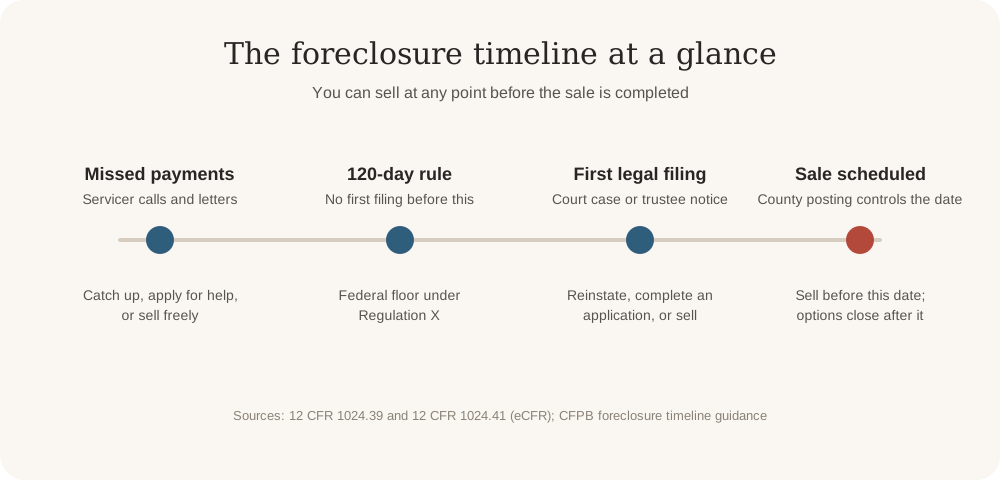
There is no single national timeline, but there is a federal floor. Under the mortgage servicing rules in Regulation X, a servicer generally cannot make the first notice or filing required to start a foreclosure until the loan is more than 120 days delinquent. [1]
What is the 120-day rule?
It is the earliest start line, not the finish line. After those first four months, the speed depends on your state: states that use a court case (judicial foreclosure) commonly take many months to over a year, while states that use a trustee's power-of-sale process can move faster once the first notice is recorded. The dates printed in your own notices control your situation.
Can a loss-mitigation application pause the sale?
Yes, in many cases. Under 12 CFR 1024.41, if a servicer receives your complete loss-mitigation application at least 37 days before a scheduled sale, it must evaluate you for all available options before the sale can proceed. "Complete" is the operative word — an application missing documents does not get the same protection, so send everything and keep proof of delivery. [2]
What can you still do at each stage?
Your options narrow as the process advances, but selling stays on the table until the sale is completed. The CFPB's foreclosure timeline guidance recommends acting quickly and responding to every servicer letter. [3]
| Stage | What it means | What you can still do |
|---|---|---|
| Missed payments (1–120 days) | Servicer calls and letters; no filing yet | Catch up, apply for loss mitigation, or sell freely |
| First legal filing or notice of default | Foreclosure formally starts; public record | Reinstate, complete a loss-mitigation application, or sell |
| Sale scheduled | Auction date set by court or trustee | Sell before the date; a complete application 37+ days ahead can pause it |
| Sale completed | Title transfers to the buyer or lender | Options are largely closed; act before this point |
Two alternatives come up often. A short sale — selling for less than the payoff with the lender's written approval — takes months of servicer review and can fall through late. A deed in lieu of foreclosure hands the title to the lender voluntarily. Both avoid a completed foreclosure on your record, but both require the lender's cooperation, which a straightforward sale does not.
Worked example: what a sale leaves you
The numbers below are an illustrative example only; your figures come from the servicer's payoff statement and the title company.
| Line (example only) | Amount |
|---|---|
| Accepted cash offer | $218,000 |
| Mortgage payoff through closing (including arrears) | −$176,400 |
| Property taxes and title charges (estimate) | −$3,900 |
| DispoKey fee paid by you | $0 (our buyer pays 5% on top) |
| Estimated proceeds to you | $37,700 |
If the payoff is larger than any realistic offer, the conversation shifts to a short sale or deed in lieu — ask the servicer about both in writing before the sale date is set.
Where is the foreclosure sale posted?
Foreclosure sales are local, county-level events. In court-based states the case runs through the county court, and in trustee states the notice of sale is recorded with the county recorder or clerk and posted publicly. Check the county clerk or recorder's official website for the county where the property sits — that posting, not a letter, is the authoritative sale date. A HUD-approved housing counselor can read the notices with you for free; find one through HUD's counseling search or the CFPB. [4]
Can you sell as-is before the auction?
Yes, and speed is the point. With DispoKey, our buyers make offers, you pick the highest one, and you can close in as little as 21 days when title and payoff paperwork are ready. Your Seller Success Manager coordinates the payoff and any reinstatement figures with the title company so the loan is satisfied at closing.
You pay no commission and no DispoKey fee. Our buyers pay us 5% of the purchase price on top of the offer, so the offer you accept is the number the payoff is measured against. Get a cash offer for your house, or see how timing works on the process page.
When DispoKey may not be your best option
If you can realistically catch up or qualify for a modification and want to keep the home, loss mitigation beats any sale. If the home is in strong condition, the equity is large and no sale date is set, listing with an agent may produce a higher price after commissions. Compare honestly before choosing.
Related situations
If missed payments are the core issue, read behind on payments. If the loan is a reverse mortgage that has come due, see selling a house with a reverse mortgage, and if a changed closing date affects your figures, check what to do when a payoff quote expires.
Key takeaways
- You can sell any time before the foreclosure sale is completed.
- Federal rules generally require more than 120 days of delinquency before the first filing.
- A complete loss-mitigation application received 37+ days before a sale must be evaluated first.
- Work from a written payoff statement and the county's posted sale date.
Frequently asked questions
Can I sell my house if it is already in foreclosure?
Yes. You keep title until the sale is completed, so you can sell during the process and pay the loan off at closing. The earlier you act, the more buyers and options you have.
How long does foreclosure take?
A servicer generally cannot make the first filing until the loan is more than 120 days delinquent. After that, court-based states commonly take many months to over a year, while trustee states can move faster. Your notices and county postings control the actual dates.
Will selling before foreclosure hurt my credit?
The missed payments already reported affect your credit, but a completed foreclosure adds a separate, more serious mark. Paying the loan off through a sale avoids the completed foreclosure itself.
What if I owe more than the house is worth?
Ask the servicer in writing about a short sale or a deed in lieu of foreclosure. Both need the lender's approval, so start that conversation well before any sale date.
References
- 12 CFR 1024.39 Early intervention requirements — eCFR.
- 12 CFR 1024.41 Loss mitigation procedures — eCFR.
- How long will it take before I'll face foreclosure? — CFPB.
- HUD-approved housing counseling — HUD.