

Quick answer: You can sell a house with a lien because most liens are paid from the sale proceeds at closing. The title company finds each lien, requests payoff figures and pays them before you receive your share. DispoKey sellers get a cash offer that shows the estimated payoffs up front, and can close in as little as 21 days once title clears.
- Order or request a title search to list every recorded lien.
- Get written payoff figures with a good-through date.
- Confirm the offer covers all payoffs, or plan how to cover a shortfall.
How liens are paid at closing
A lien is a recorded claim against the property that must be released before a buyer receives clear title. In a normal sale, the closing agent subtracts each payoff from the sale price and sends the money directly to the lienholder, so the seller does not need cash in hand first.
The order matters. Your mortgage lender, a home equity line, unpaid property taxes, a contractor's claim and a court judgment can all appear on the same title report. Each holder issues a payoff statement, and the closing disclosure or settlement statement lists every amount. The CFPB explains that a payoff amount is usually different from the balance on your monthly statement because interest and fees accrue until the payoff date. Read the lien glossary entry for the basic definition.
Common types of liens on a house
Most homes carry at least one voluntary lien, the mortgage. Involuntary liens are added without your agreement when a debt goes unpaid. Knowing which type you have tells you who to call and how long a release may take.
Voluntary liens
A first mortgage, a second mortgage and a home equity line are voluntary. The servicer provides the payoff and records a release after it is paid.
Involuntary liens
A judgment lien follows a court case. A mechanic's lien comes from unpaid work or materials. Property tax liens arise from delinquent taxes, and a federal tax lien can attach when the IRS assesses a tax debt that is not paid; the IRS describes how that lien attaches to property and how a release or discharge works. HOA and municipal liens, such as water or code-enforcement charges, also show up.
Find every lien before you accept an offer
Start with a title search, because liens you have forgotten about still block closing. A title company searches county records for recorded claims and reports them in a commitment that lists what must be paid or released.
You can also check public records yourself. County recorders keep recorded documents, and county treasurers show delinquent property taxes. In Cook County, Illinois, the Cook County Treasurer lets owners look up tax status by parcel. In Harris County, Texas, the Harris County Tax Office provides property-tax account lookups. In Los Angeles County, the Treasurer and Tax Collector lists secured-tax payment status. These sites confirm tax status only; a full title search is still the safer way to see judgments and contractor claims.
Will the sale cover the liens? A worked example
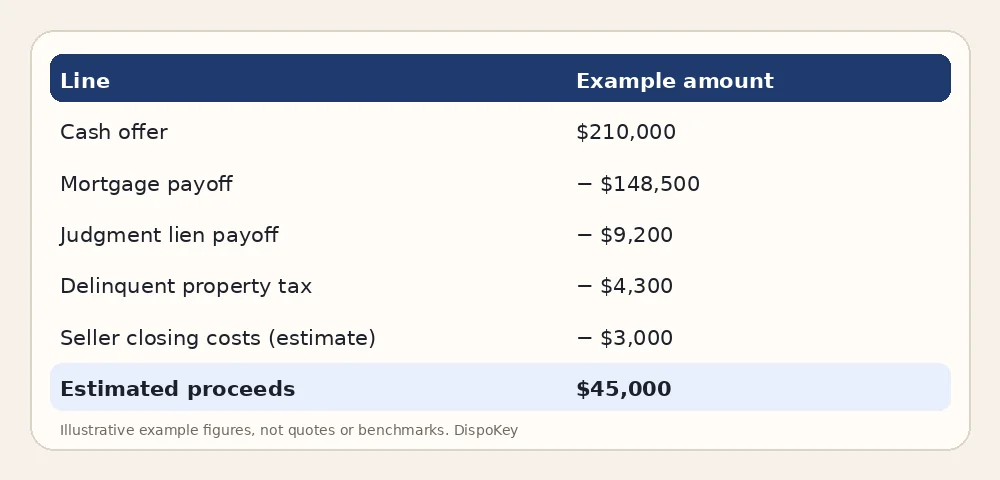
Add every payoff and closing cost, then compare the total with the offer. If the offer is larger, the liens are paid and you keep the difference. If it is smaller, you have a shortfall that must be solved before closing.
Illustrative numbers only: a seller accepts a $210,000 cash offer. The mortgage payoff is $148,500, a judgment lien payoff is $9,200, delinquent property tax is $4,300 and estimated seller closing costs are $3,000. Total deductions are $165,000, so the estimated proceeds are $45,000. The settlement statement is the document that confirms the final figures, because payoffs change daily.
| Line | Example amount |
|---|---|
| Cash offer | $210,000 |
| Mortgage payoff | − $148,500 |
| Judgment lien payoff | − $9,200 |
| Delinquent property tax | − $4,300 |
| Seller closing costs (estimate) | − $3,000 |
| Estimated proceeds | $45,000 |
What if the liens are more than the house is worth?
When payoffs exceed the price, the sale cannot close unless a lienholder accepts less, the seller brings cash, or the debt is restructured. Lenders may approve a short sale, and some judgment creditors accept a negotiated payoff in exchange for a release.
Ask each creditor for any reduced payoff in writing before closing; a verbal promise does not release a recorded lien. If foreclosure is already scheduled, read selling before foreclosure, and talk with a HUD-approved housing counselor through the HUD foreclosure resources about options. For tax-specific questions, our guide to selling a house with a tax lien covers payment plans and redemption in more depth.
Disputed, paid or very old liens
A lien that was paid but never released still appears in the records until a release is recorded. Ask the creditor for a lien release or satisfaction document and give it to the title company.
If you believe a lien is invalid, gather the paperwork, such as a receipt, a court order or a contractor's final payment record. Title companies sometimes close with funds held back in escrow while a disputed claim is resolved, which keeps the sale moving without paying a claim you contest. Owner's title insurance, which the CFPB describes as protection against covered title problems missed in the search, is one reason buyers insist the report is clean.
Selling for cash with liens on the property
A cash sale skips lender approval, so the main timing question becomes how fast each payoff and release arrives. Once title is clear, a DispoKey cash offer can close in as little as 21 days.
Your Seller Success Manager collects the address, the known liens and the payoff contacts, then shares the title commitment so you can see the estimated proceeds before signing. You can sell as-is, with no repairs. Start with the cash offer page or enter your address on the offer form. State rules on tax redemption and judgment duration differ, so check your state seller page, such as Texas, for local context.
When DispoKey may not be your best option
If your house is move-in ready, the liens are small and you have months to wait, listing with an agent may produce a higher price. A cash offer trades some price for speed and certainty, which is worth it mainly when time, repairs or a tight payoff matter. Compare both paths with the net-proceeds math above before deciding.
Key takeaways
- Most liens are paid from sale proceeds at closing.
- A title search finds liens you may have forgotten.
- Get every payoff and any reduced payoff in writing.
Frequently asked questions
Can you sell a house with a lien on it?
Yes. The closing agent pays the lien from the proceeds, and the lienholder records a release so the buyer receives clear title.
Who pays the lien when a house is sold?
The seller does, but usually through the closing. Each payoff is deducted from the sale price before the seller's share is sent.
How do I find out if my house has a lien?
Request a title search, and check your county recorder and treasurer records for recorded claims and delinquent taxes.
Can a lien stop a house sale?
It can if the payoffs exceed the price or a lienholder refuses to release. A negotiated payoff or seller funds can resolve the gap.
Official references
- CFPB: What is a payoff amount?
- IRS: Understanding a federal tax lien
- CFPB: What is owner's title insurance?
- HUD: Avoiding foreclosure