Quick answer: Selling a house with asbestos begins with condition and evidence, not automatic removal. DispoKey helps sellers compare a documented as-is offer with treatment before sale. Leave suspect material undisturbed, check applicable disclosure requirements, and compare both routes using sale price, project costs and carrying expenses rather than an assumed premium.
- Gather the records before committing money or dates.
- Separate verified facts from planning assumptions.
- Write down the next action, its owner and the review date.
Start with a safe preparation checklist
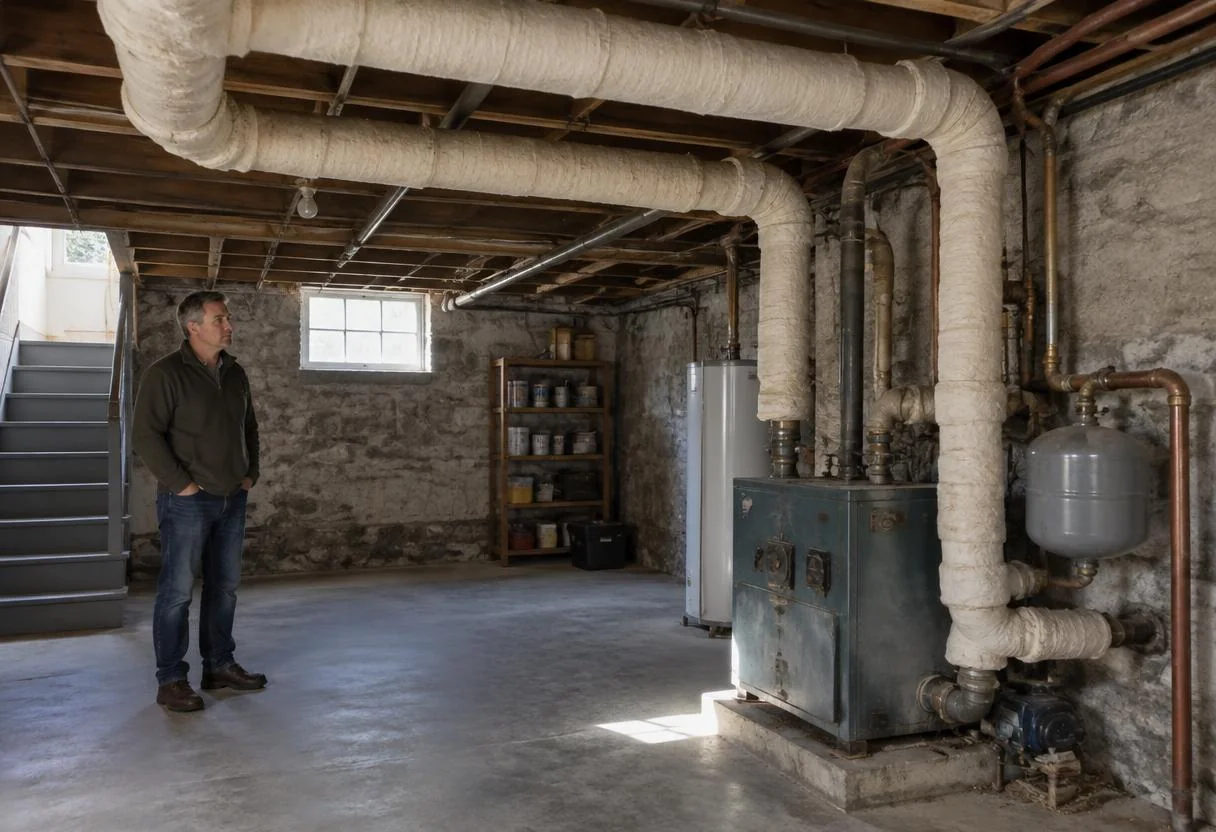
Leave suspect pipe wrap, flooring, ceiling material and insulation alone while you organize the sale. Gather laboratory reports, assessments, invoices and warranties. Record locations without scraping, lifting or sampling anything. The photograph above illustrates older insulation; appearance alone cannot confirm asbestos. A tidy listing is not worth disturbing material before its condition is understood.
Make a list of preparation jobs that could disturb the material: replacing equipment, opening walls, removing flooring or cleaning an attic. Send that list to the professional assessing the property. A sale with no renovation creates different practical questions from a sale preceded by demolition. Keep access requests separate from permission to perform work.
Establish what is confirmed and what is suspected
EPA explains that you generally cannot identify asbestos simply by looking unless the material is labeled. It recommends trained, accredited professionals for sampling because improper sampling can release fibers. A home inspection may flag concern without establishing composition. Ask whether laboratory analysis occurred, which locations were sampled and what the report actually concludes. EPA homeowner guidance supports these distinctions.
Keep statements precise. “The previous owner mentioned the pipe wrap” is not the same as “the laboratory identified asbestos in this sample.” A result from one room does not automatically describe every similar-looking material. Label each report by date and assessed area. If a buyer asks a question the file cannot answer, record it as unknown rather than filling the gap with reassurance.
Choose assessment before deciding on treatment
EPA advises considering professional inspection when remodeling could disturb suspect material or when material is damaged. Undamaged material that will not be disturbed generally does not need testing just because asbestos might be present. That is general guidance, not a safety certification for a particular property. Ask the assessor for findings, limitations and recommendations in writing.
Use the EPA state contact directory to find the relevant environmental or health agency and current training information. Ask who is qualified to assess the material and what records a completed project should provide. Do not ask a showing coordinator to make a technical judgment outside that person’s role.
Compare the three sale paths
Compare selling in current condition, professional repair or containment, and professional removal only after the condition question is understood. EPA describes sealing or covering as repair approaches and warns that improper removal can release fibers. The right path depends on the material, its condition and planned disturbance—not a universal instruction to remove everything.
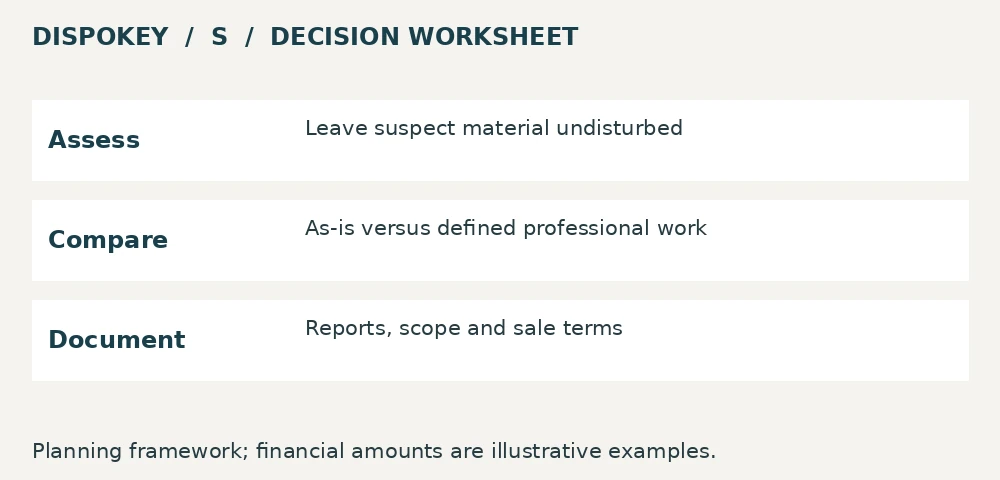
| Step | Decision |
|---|---|
| Assess | Leave suspect material undisturbed |
| Compare | As-is versus defined professional work |
| Document | Reports, scope and sale terms |
Ask a contractor to identify the work area, exclusions, scheduling, disposal arrangements and completion documents. A treatment proposal may exclude replacement flooring, wall repair or repainting. Those associated costs matter to the comparison. A broad promise that a house is “completely safe” or that “all asbestos is removed” is not supported by a report covering only selected areas.
Worked example: treatment versus as-is proceeds
Illustrative example only, not local prices or a removal-cost estimate: an as-is sale at $240,000 with $4,000 of other selling expenses leaves $236,000 before debt payoff and taxes. A treatment-then-sale scenario at $258,000, less $12,000 of treatment and related work, $3,000 of extra carrying costs and $5,000 of other expenses leaves $238,000. The difference is $2,000.
Run a second version with only a $10,000 price improvement. If the treated sale price is $250,000 with the same $20,000 combined costs, proceeds fall to $230,000. The supported price improvement matters more than the optimistic headline. Get actual offers and project scopes before spending. The as-is selling guide explains the broader net comparison.
Verify disclosure requirements for the property
EPA states that federal law does not require a home seller to disclose asbestos or vermiculite, but state or local requirements may require disclosure. That federal statement is not permission to withhold information in a specific transaction. Check the applicable forms and timing against the property’s state and local official requirements before accepting terms. EPA’s seller disclosure answer states this boundary.
Give the closing professional your existing reports and ask which documents need updating if new information arrives. “As-is” is not a substitute for checking disclosure obligations. Keep factual report language separate from a buyer’s intended renovation. For broader condition planning, compare selling with mold and the abatement definition; neither establishes this material’s identity.
Build the evidence file and access plan
Create one dated folder with assessments, laboratory results, location summaries, treatment proposals, completed-work invoices and applicable disclosures. Preserve originals and share copies through an agreed channel. A short index helps everyone see which document supports which statement. Include any limitations so buyers do not mistake a partial inspection for a whole-house assessment.
Coordinate visits with professional safety guidance. Keep restricted areas restricted, and do not authorize a visitor to disturb material simply to answer a question faster. Confirm who manages access, which tasks remain before settlement and which work the seller has actually agreed to provide. If an offer depends on additional assessment, keep that condition visible in the written terms.
When DispoKey may not be your best option
A move-in-ready home with time for broad market exposure may suit a traditional listing better. Treatment followed by listing may fit when you can fund and manage a supported project and the likely proceeds justify the risk. An as-is route may fit when avoiding pre-sale projects matters more than pursuing an uncertain price premium.
Compare selling options with DispoKey or request a cash offer. Your Seller Success Manager coordinates the process; the seller pays a $0 DispoKey fee, while other expense allocations belong in the written agreement. Close in as little as 21 days, subject to title and transaction requirements—not as a guaranteed deadline.
Key takeaways
- Make the decision from documented inputs, not a headline promise.
- Keep costs, timing and responsibilities visible.
- Recalculate when material facts change.
Frequently asked questions
Can I sell a house with asbestos?
An asbestos concern does not automatically decide the sale path. Establish what is known, obtain appropriate guidance and verify applicable disclosure requirements before agreeing terms.
Do I have to remove asbestos before selling?
Do not assume removal is always required. EPA generally recommends leaving undamaged, undisturbed material alone; property condition, applicable requirements and contract terms still matter.
Should I sample the material myself?
EPA recommends professional sampling. Incorrect sampling can release fibers; leave suspect material undisturbed while arranging appropriate guidance.